Google sucks
1 day ago
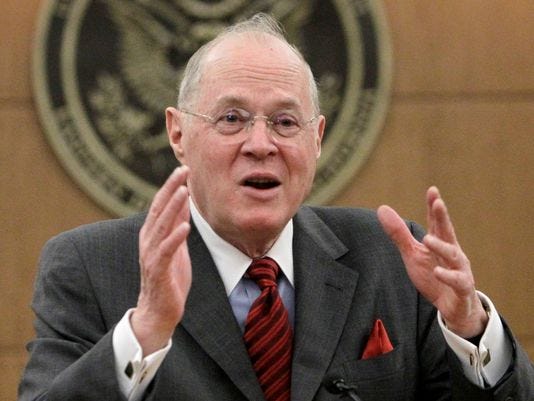 |
| Justice Anthony Kennedy |
Together, these decisions are a consummate act of judicial statesmanship. They extend federal benefits to all same-sex married couples in states that recognize gay marriage, expand the number of states recognizing gay marriage to thirteen, yet leave open the ultimate issue of state power to limit marriage to the union of a man and woman. The Court took a significant step toward recognition of the equality rights of gays and lesbians, but by not imposing same-sex marriage on the three-quarters of the states whose laws still forbid it, the Court has allowed the issue to develop further through the political process—where its trajectory is all but inevitable.
What will the Court do when the issue of whether states can limit marriage to opposite-sex couples is put before it again? It is difficult to read Justice Kennedy’s opinion in Windsor without sensing, as Justice Scalia warned in his angry dissenting opinion, that the “other shoe” will drop eventually, and the Court will ultimately recognize that denying same-sex couples the right to marry violates the Constitution in the same way that denying mixed-race couples the right to marry does. (Significantly, in his opinion for the Court, Justice Kennedy cited Loving v. Virginia, the Court’s 1967 decision on interracial marriage, for the proposition that the state’s otherwise broad authority to define marriage is subject to constitutional limits.) But Kennedy’s opinion was nonetheless written in such a way to leave the question open while political thinking about gay marriage continues to evolve. . . .
So as a matter of pure judicial craft, Justice Kennedy could have been more clear and definite. But judging is not only a matter of craft. Justice Kennedy sought to walk a fine line—invalidating a federal law limiting marriage to opposite-sex couples without simultaneously resolving the question of whether similar state laws are constitutional. Had he pronounced that classifications based on sexual orientation are suspect and subject to heightened scrutiny, or had he held that the due process clause affirmatively protects the right of two committed adults to marry, regardless of sex, he would have, in effect, decided the broader issue. By focusing instead on the federal government’s unusual intrusion into a prerogative of state law, and its dramatic imposition of a double standard in states that recognize same-sex marriage, he wisely limited his decision to the federal law at issue. By allowing the transition to full recognition of same-sex marriage to take place gradually, Kennedy’s opinion avoided the backlash that a federal mandate to recognize same-sex marriage in every state might have triggered.
Ironically, Justice Kennedy did not join the majority opinion in Perry, the California case, which sent the issue back to district court. He dissented, joined by three other justices, and would have decided that case on the merits. Had he attracted a fifth vote for that view, it would have rendered all the care he took in the Windsor decision moot, because the Court would have had to address the question of state authority directly. The statesmanship of the two decisions, then, comes not from any one justice, but from the collective action of the court as a whole. There’s a reason we have nine justices. . . .
The justifications for denying a “dignity and status of immense import” to gay and lesbian couples are unpersuasive, whether at the federal or the state level. Same-sex couples, like opposite-sex couples, can and do make long-term commitments to live together as a family unit. They can and do raise children, pay taxes, care for dependent family members, and the like. The real reason so many states have denied marital status to same-sex couples is a sense, founded on tradition and moral disapproval, that these couples do not deserve it, simply because they are of the same sex. But the Court has already held, in Lawrence v. Texas, its 2003 decision invalidating state sodomy laws, that tradition and mere moral disapproval are insufficient grounds for differential treatment of gay and straight couples.
We will have to wait for the other shoe to drop, but drop it will.
Civil laws that permit only heterosexual marriage reflect and honor a collective moral judgment about human sexuality. This judgment entails both moral disapproval of homosexuality, and a moral conviction that heterosexuality better comports with traditional (especially Judeo-Christian) morality.You can read the entire report here.

In response to some questions about Windsor: Only Section 3 of the Defense of Marriage Act -- which defines the words "marriage" and "spouse," for federal purposes, as referring only to marriages between opposite-sex couples -- has been struck down. Consequently, any federal statute that refers to a "marriage" or a "spouse" should be interpreted as applying with equal force to same-sex married couples.
The federal Defense of Marriage Act defines "marriage," for purposes of over a thousand federal laws and programs, as a union between a man and a woman only. Today the Court ruled, by a vote of five to four, in an opinion by Justice Kennedy, that the law is unconstitutional. The Court explained that the states have long had the responsibility of regulating and defining marriage, and some states have opted to allow same-sex couples to marry to give them the protection and dignity associated with marriage. By denying recognition to same-sex couples who are legally married, federal law discriminates against them to express disapproval of state-sanctioned same-sex marriage. This decision means that same-sex couples who are legally married must now be treated the same under federal law as married opposite-sex couples.
Here's a Plain English take on Hollingsworth v. Perry, the challenge to the constitutionality of California's Proposition 8, which bans same-sex marriage: After the two same-sex couples filed their challenge to Proposition 8 in federal court in California, the California government officials who would normally have defended the law in court, declined to do so. So the proponents of Proposition 8 stepped in to defend the law, and the California Supreme Court (in response to a request by the lower court) ruled that they could do so under state law. But today the Supreme Court held that the proponents do not have the legal right to defend the law in court. As a result, it held, the decision by the U.S. Court of Appeals for the Ninth Circuit, the intermediate appellate court, has no legal force, and it sent the case back to that court with instructions for it to dismiss the case.
A few final, legal steps must be completed before same-sex couples can once again marry in California, which should take only about a month. First, the Supreme Court’s ruling must become final, which will happen 25 days after the ruling. Under the Supreme Court’s rules, the party who loses a case has a right to ask the Court to re-hear the case within 25 days of the decision’s release. Petitions for re-hearing are very rarely granted, so it is unlikely that anything will change during this 25 days. Once the ruling is final, the Ninth Circuit will issue a “mandate” that will send the case back to the District Court. When the mandate is issued, the injunction against the enforcement of Prop 8 will take effect, and same-sex couples in California will once again have the freedom to marry. We expect that the State of California will issue guidance to all County Clerk offices in the state about when the decision becomes final and when those offices must resume issuing licenses on an equal basis to same-sex couples. Please note that couples should wait until the Supreme Court ruling is final and the Ninth Circuit issues a mandate to the District Court before attempting to obtain a marriage license or to marry, to ensure that your marriage is valid. . . .
Yes. The legal order (or injunction) that stops the State of California from enforcing Prop 8 applies to state officials throughout the state. This means that Prop 8 cannot be enforced anywhere in the state. There may be efforts to try to limit the effect of the injunction to apply to only some parts of the State but we strongly believe that those efforts are futile and will not succeed. . . .
If you live in another state and get married in California you will be legally married. However, depending on where you live, your home state may not respect your marriage. The Supreme Court’s ruling in United States v. Windsor striking down Section 3 of DOMA concerns only the federal government’s treatment of marriages. The ruling does not require states to recognize a valid marriage of a same-sex couple performed in another state. Thus, if you marry in California but live elsewhere, it is still possible that your home state will not recognize your marriage.Update, 12:30 p.m.: In California, Governor Jerry Brown has issued the following statement:
After years of struggle, the U.S. Supreme Court today has made same-sex marriage a reality in California. In light of the decision, I have directed the California Department of Public Health to advise the state’s counties that they must begin issuing marriage licenses to same-sex couples in California as soon as the Ninth Circuit confirms the stay is lifted.Update, 12:45 p.m.: At the Pentagon, Secretary of Defense Chuck Hagel has issued this statement:
The Department of Defense intends to make the same benefits available to all military spouses -- regardless of sexual orientation -- as soon as possible. That is now the law, and it is the right thing to do. The department will immediately begin the process of implementing the Supreme Court's decision in consultation with the Department of Justice and other executive branch agencies.Update, 1:00 p.m.: From aboard Air Force One en route to Africa, President Obama has issued the following statement:
I applaud the Supreme Court’s decision to strike down the Defense of Marriage Act. This was discrimination enshrined in law. It treated loving, committed gay and lesbian couples as a separate and lesser class of people. The Supreme Court has righted that wrong, and our country is better off for it. We are a people who declared that we are all created equal - and the love we commit to one another must be equal as well.
This ruling is a victory for couples who have long fought for equal treatment under the law; for children whose parents’ marriages will now be recognized, rightly, as legitimate; for families that, at long last, will get the respect and protection they deserve; and for friends and supporters who have wanted nothing more than to see their loved ones treated fairly and have worked hard to persuade their nation to change for the better.
So we welcome today’s decision, and I’ve directed the Attorney General to work with other members of my Cabinet to review all relevant federal statutes to ensure this decision, including its implications for Federal benefits and obligations, is implemented swiftly and smoothly.
On an issue as sensitive as this, knowing that Americans hold a wide range of views based on deeply held beliefs, maintaining our nation’s commitment to religious freedom is also vital. How religious institutions define and consecrate marriage has always been up to those institutions. Nothing about this decision - which applies only to civil marriages - changes that.
The laws of our land are catching up to the fundamental truth that millions of Americans hold in our hearts: when all Americans are treated as equal, no matter who they are or whom they love, we are all more free.And in New York City, Edie Windsor, plaintiff in the DOMA case, had this to say, according to the Washington Post:
After learning of the Supreme Court ruling, Windsor broke into tears. “If I had to survive Thea, what a glorious way to do it, and she would be so pleased,” she said at a news conference. She thanked her lawyers and her allies, gay and straight: “We won all the way, so thank you from the bottom of my heart.”
Asked what Spyer would say to her if she were alive, Windsor replied, “‘You did it, honey.’”
 |
| Click to enlarge. |

“It's painful to think about — leaving behind my family, leaving behind eight years of building a stellar reputation within my community,” he said in an interview from his new home, San Miguel de Allende, Mexico, where he and his partner have settled. “I'm hopeful the country has come to a point that we can have this discussion. . . . There's no other place than San Angelo I'd rather be,” he said. “But I have no plans to return again, unless (my partner) can come with me.”
 |
| Cheering crowds hail Boston police at the end of the manhunt on Friday night. |
Following what could only be described by witnesses as the goddamned week to end all soul-crushing weeks, sources all across the nation reported that, sorry, is all this shit really happening at once? Because if all this shit is really happening at once, multiple reports verified, then this might actually be, honest to God, one of the worst weeks of all time.
No joke, added anyone with a set of working eyes and ears. Of all time.

 |
| Edie Windsor arrives at the Supreme Court this morning, accompanied by her attorney, Roberta Kaplan. |
 |
| How far we have come in half a century: a small group of neatly dressed, very brave homosexuals - in an era when homosex could get you not only fired, but also jailed and even lobotomized - picket the White House in the first gay-rights demonstration, April 17, 1965. |
It appears that even this stalwart homo-hater, who slithers around gay porn palaces and scurries about licentious leather bars looking for smut to post on his prurient website, knows the end is near. It is clear that there is a shrinking market for professional gay bashers and one can only hope he polishes off his cracker-thin resume and finds a new gig before it is too late. Since he has so much experience visiting the tubs in Chicago, and is likely a familiar face, maybe they will be kind and offer him an exciting, new opportunity cleaning the cubicles.Read the rest of the article in which Besen demolishes LaBarbera's twisted claims here.
 |
| Larry Duncan and Randy Shepherd of Washington state, whose marriage-license pic I posted last Friday, arrived for their wedding on Sunday, nattily attired this time. The couple were married at Seattle First Baptist Church, along with 24 other same-sex couples. All good wishes to them. |
Here is a movie plot you have never seen and never will see: a disadvantaged athlete struggles against the odds, makes it to the Olympics by sheer force of grit and talent, and is ahead in the race for gold—when, with the finish line in sight, the referee calls off the competition, hands the hero a medal, and everybody goes home.
Gay Americans are in sight of winning marriage not merely as a gift of five referees but in public competition against the all the arguments and money our opponents can throw at us. A Supreme Court intervention now would deprive us of that victory. Our right to marry would never enjoy the deep legitimacy that only a popular mandate can bring.
I tell my gay friends: imagine if the Supreme Court had ordered gay marriage this past June, at the end of its 2011-2012 term. November’s game-changing electoral victories would never have happened. Gay marriage advocates would be forever stereotyped as political losers who won by running to mommy. Our opponents would mock and denigrate our marriages as court-created, legalistic fictions. The country would never have shown how much it has changed.
If we have come that far in five years, imagine where we might be in five more. Imagine, then, the opportunities to extend and consolidate support that we will lose if the Supreme Court steps in now. Strange but true: a favorable Supreme Court intervention next year would make us weaker, not stronger.

 |
| Karen Golinski and wife Amy Cunninghis |
DOMA, as applied to Ms. Golinski, violates her right to equal protection of the law under the Fifth Amendment to the United States Constitution by, without substantial justification or rational basis, refusing to recognize her lawful marriage to prevent provision of health insurance coverage to her spouse.More on the story here and here. Text of Judge White's ruling below, which applies very nearly the same judicial reasoning found in the ruling by Judge Joseph L. Tauro in the Gill and Massachusetts cases in 2010: it just ain't right to discriminate without good reason, and the other side has no damn good reason. Period.
Accordingly, the Court issues a permanent injunction enjoining defendants, and those acting at their direction or on their behalf, from interfering with the enrollment of Ms. Golinski's wife in her family health benefits plan.
Although we are both the legal parents of four American children, and both the state and federal government recognizes our status as parents, it will not recognize our marriage because of the Defense of Marriage Act. According to the U.S. government, I am the father of our four children, and Fred is the father of the same four children, but we are legal strangers to each other. Our marriage, our nearly 22 years together, all of that amounts to nothing. Fred has no right to stay in the United States beyond the expiration date of his visa. And that day was rapidly approaching. At the same time, while France would recognize our relationship under its less-than-optimal Civil Solidarity Pact (“PACS”), and it may even permit me to reside in France legally as an immigrant on the basis of our relationship (but not our marriage), the French government refuses to recognize the adoption of our children, because under French law same-sex couples are prohibited from adopting children. We are trapped by U.S. law that refuses to see our marriage, and French law that refuses to see our children.Mark and Frédéric are seeing U.S. immigration officials this week in yet another bid to get permission to keep their family united in this country.