|
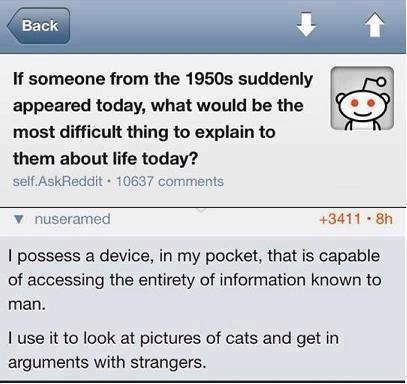
| New Yorker cartoon by Liam Walsh |
The unceasing and daily intensifying coverage by the news media of the Trump trainwreck is certainly fascinating and appalling in equal parts - but perhaps a bit too much so. It might, in fact, be salutary for us all to stick our heads out of the tweetstorm now and then, and remind ourselves that there is an entire world existing right below our feet that also is worthy of attention - really it is.
Here's an article from the Atlantic that may give pause for thought: "The Binge Breaker." Excerpt:
While some blame our collective tech addiction on personal failings, like weak willpower, Harris points a finger at the software itself. That itch to glance at our phone is a natural reaction to apps and websites engineered to get us scrolling as frequently as possible. The attention economy, which showers profits on companies that seize our focus, has kicked off what Harris calls a “race to the bottom of the brain stem.” “You could say that it’s my responsibility” to exert self-control when it comes to digital usage, he explains, “but that’s not acknowledging that there’s a thousand people on the other side of the screen whose job is to break down whatever responsibility I can maintain.” In short, we’ve lost control of our relationship with technology because technology has become better at controlling us. . . .
McDonald’s hooks us by appealing to our bodies’ craving for certain flavors; Facebook, Instagram, and Twitter hook us by delivering what psychologists call “variable rewards.” Messages, photos, and “likes” appear on no set schedule, so we check for them compulsively, never sure when we’ll receive that dopamine-activating prize. (Delivering rewards at random has been proved to quickly and strongly reinforce behavior.) Checking that Facebook friend request will take only a few seconds, we reason, though research shows that when interrupted, people take an average of 25 minutes to return to their original task.
Sites foster a sort of distracted lingering partly by lumping multiple services together. To answer the friend request, we’ll pass by the News Feed, where pictures and auto-play videos seduce us into scrolling through an infinite stream of posts—what Harris calls a “bottomless bowl,” referring to a study that found people eat 73 percent more soup out of self-refilling bowls than out of regular ones, without realizing they’ve consumed extra. The “friend request” tab will nudge us to add even more contacts by suggesting “people you may know,” and in a split second, our unconscious impulses cause the cycle to continue: Once we send the friend request, an alert appears on the recipient’s phone in bright red—a “trigger” color, Harris says, more likely than some other hues to make people click—and because seeing our name taps into a hardwired sense of social obligation, she will drop everything to answer. In the end, he says, companies “stand back watching as a billion people run around like chickens with their heads cut off, responding to each other and feeling indebted to each other.” . . .
“Our generation relies on our phones for our moment-to-moment choices about who we’re hanging out with, what we should be thinking about, who we owe a response to, and what’s important in our lives,” he said. “And if that’s the thing that you’ll outsource your thoughts to, forget the brain implant. That is the brain implant. You refer to it all the time.”
And here's a video interview with the subject of the article.
For clarity: Your Head Trucker has no smart phone or even dumb phone, and has no intention of having any.
(Ain't that a damn shame, boys?)