|
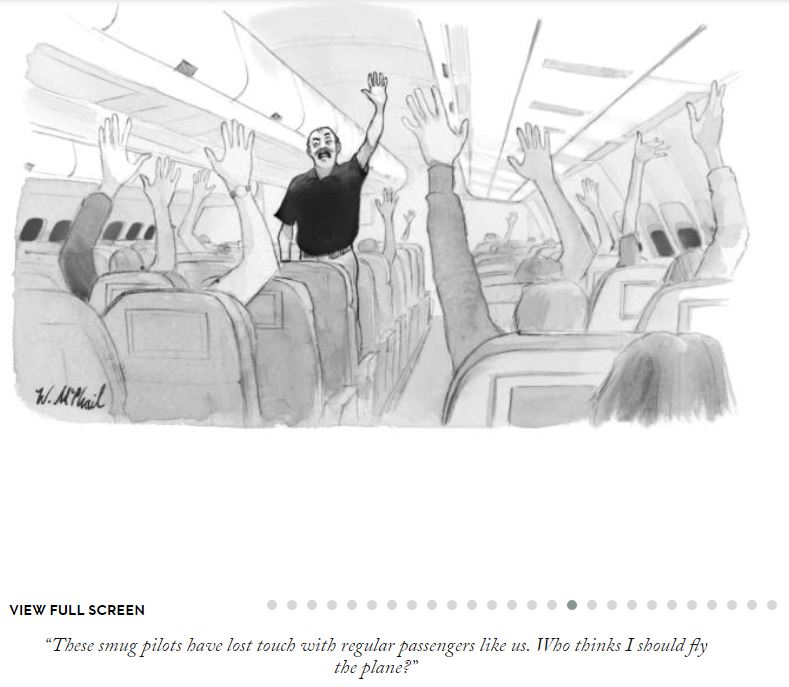
| "We'll have to stop research now that the Neanderthals are back in charge." |
-----
|
| "We'll have to stop research now that the Neanderthals are back in charge." |
 |
| The naked truth is plain to see. |

And because they know all about you, they could tailor your Social Security check as they please - or withhold it for "undersirable" behavior. Does your retired Aunt Sadie, so upset about the price of eggs, know about this? What about disabled, gun-loving Cousin Clem in his red cap? Whenever the news finally trickles down to them and their pocketbooks, I hope they choke on it.
Senator Adam Schiff tells it plainly: "this is a corrupt scheme to turn this country into one-man rule, and enrich Donald Trump and his wealthy friends like Elon Musk."
And now, not content with scooping up Canada, Greenland, and Panama - a costly invasion is not necessary; economic terror is enough to bring them all into submission - the Very Stable Genius wants to take over Gaza and rebuild it as "the Riviera of the Middle East" - after expelling the 2 million people who live there:
And here's a headline from Canada, which just got played like a hockey puck over tariffs, where all those nice, polite, friendly folks are trying to figure out the game plan:
Now you can watch the video if you like; suave Andy Chang has some very good charts and facts to show the big picture, but he misses the really big picture. So your Head Trucker is going to cut to the chase here.
iT'S NOT ABOUT DRUGS. IT'S NOT ABOUT TRADE BALANCES. IT'S ALL ABOUT TOTAL DOMINATION BY GLORIOUS LEADER: EVERYTHING, EVERYWHERE, ALWAYS.
Why am I the only one who sees this?
Canada, stop trying to find a logical reason for the tariffs; there is none. If it's not one issue, the Orange One will make up another. Any hammer will do to beat you into submission while he takes all your valuables.
People, it's all right out of Hitler's playbook: Border problems. Fake outrage about neighboring countries. Scare tactics. A police state. Removal of civil servants and political opponents. Demonizing one section or another of the citizenry. A constant barrage of lies from state mouthpieces. Scrubbing away facts from books and schools. Keeping other states in perpetual fear of what might happen next. Lebensraum - i. e., fake justification for seizing foreign territory. Redrawing the map, renaming things. Deportations. Concentration camps. And there is more yet to come! It's only just begun . . .
And fellas, cut the crap about "Oh my, we still have 1400+ days to go before his term ends." HIS TERM WILL NEVER FUCKING END. If good ol' Joe Biden had to be prised out of the Oval Office with a crowbar, do you really think Tyrant Trump will just quietly walk away from the power and glory?
Seriously, people?? HE'LL NEVER LEAVE. HE WANTS TO BE KING OF THE WHOLE WORLD.
There now, I've said it. You have been warned. What to do about it, I don't know. You'll have to figure that out for yourself.
-----

Atop Trump’s agenda, Bannon said, was the “deconstruction of the administrative state” — meaning a system of taxes, regulations and trade pacts that the president and his advisers believe stymie economic growth and infringe upon one’s sovereignty.
“If you look at these Cabinet nominees, they were selected for a reason, and that is deconstruction,” Bannon said. He posited that Trump’s announcement withdrawing from the Trans-Pacific Partnership was “one of the most pivotal moments in modern American history.”
The crippling or wholesale elimination of Federal agencies that ensure we receive such things as clean air, clean water, fair labor laws, fair housing standards, anti-discrimination laws, financial protections, food and drug safety, national education standards and the like, has been a goal of far-right “thinkers" for decades. Their rationale, propagated by corporate and industry-funded think tanks such as the Heritage Foundation, has always been that that the existence of these “unelected" agencies represents a mortal threat to American “sovereignty and self-government." This is exactly the line Bannon was peddling at CPAC today. It is delusional, right-wing garbage.
The leader of the band of Mad Hatters occupying the White House has already insulted allied world leaders, issued illegal and badly written orders, impugned a “so-called” judge appointed by his own party, and appointed the least-qualified cabinet ever. The first secretary of state was Thomas Jefferson. Trump appointed a big-oil executive with close ties to Russia. The first treasury secretary was Alexander Hamilton. Trump appointed a former Goldman Sachs exec who got rich foreclosing on homeowners. The national security advisor lasted 24 days.
And all that’s just at the time I write this. Who knows what happens next. Each new day is a new nightmare. We are still trying to digest one breathtaking assault on America when another is signed, issued, or Tweeted. All this amid constant lies. Constant. Lies.
I am a lifelong Republican. I voted for every Republican presidential candidate from 1968 to 2004. But I have watched what once was a sane, center-right party go off the rails, first to the extreme right, then to wherever Trump is, which is in another universe.
It’s tough, but we must end this dangerous presidency. Trump must be impeached and removed with all haste. But only Congress can initiate the process. . . .
Basic American values – free speech, the rule of law, separation of powers, even common decency – are unknown in this White House. We now have a president who has no concept of separation of powers, or why we have three branches of government. If he knew anything about the Constitution, he would know the framers envisioned just the situation we have now – a would-be dictator. They provided checks and balances – such as an independent judiciary to protect us from presidential tyranny. . . .
All the above bothers me and should appall all Americans. We must admit we have elected a president who has immediately proved himself to be a grifter, a pathological liar, a mean-spirited bully and dangerous to American values. This not-ready-for-prime-time show is too dangerous to continue. America is at stake.
The time for normalizing, dissembling, and explaining away Donald Trump has long since passed. The barring of respected journalistic outlets from the White House briefing is so far beyond the norms and traditions that have governed this republic for generations, that they must be seen as a real and present threat to our democracy. These are the dangers presidents are supposed to protect against, not create.
For all who excused Mr. Trump's rhetoric in the campaign as just talk, the reckoning has come. I hope it isn't true, but I fear Mr. Trump is nearing or perhaps already beyond any hope of redemption. And now the question is will enough pressure be turned to all those who enable his antics with their tacit encouragement. There has been a wall of unbending support from virtually every Republican in Congress, and even some Democrats. Among many people, this will be seen as anything approaching acceptable. And mind you, talk is cheap. No one needs to hear how you don't agree with the President. What are you going to do about it? Do you maintain that an Administration that seeks to subvert the protections of our Constitution is fit to rule unchecked? Or fit to rule at all?
This is an emergency that can no longer be placed solely at the feet of President Trump, or even the Trump Administration. This is a moment of judgement for everyone who willingly remains silent. It is gut check time, for those in a position of power, and for the nation.


 |
| New Yorker cartoon by Liam Walsh |
While some blame our collective tech addiction on personal failings, like weak willpower, Harris points a finger at the software itself. That itch to glance at our phone is a natural reaction to apps and websites engineered to get us scrolling as frequently as possible. The attention economy, which showers profits on companies that seize our focus, has kicked off what Harris calls a “race to the bottom of the brain stem.” “You could say that it’s my responsibility” to exert self-control when it comes to digital usage, he explains, “but that’s not acknowledging that there’s a thousand people on the other side of the screen whose job is to break down whatever responsibility I can maintain.” In short, we’ve lost control of our relationship with technology because technology has become better at controlling us. . . .
McDonald’s hooks us by appealing to our bodies’ craving for certain flavors; Facebook, Instagram, and Twitter hook us by delivering what psychologists call “variable rewards.” Messages, photos, and “likes” appear on no set schedule, so we check for them compulsively, never sure when we’ll receive that dopamine-activating prize. (Delivering rewards at random has been proved to quickly and strongly reinforce behavior.) Checking that Facebook friend request will take only a few seconds, we reason, though research shows that when interrupted, people take an average of 25 minutes to return to their original task.
Sites foster a sort of distracted lingering partly by lumping multiple services together. To answer the friend request, we’ll pass by the News Feed, where pictures and auto-play videos seduce us into scrolling through an infinite stream of posts—what Harris calls a “bottomless bowl,” referring to a study that found people eat 73 percent more soup out of self-refilling bowls than out of regular ones, without realizing they’ve consumed extra. The “friend request” tab will nudge us to add even more contacts by suggesting “people you may know,” and in a split second, our unconscious impulses cause the cycle to continue: Once we send the friend request, an alert appears on the recipient’s phone in bright red—a “trigger” color, Harris says, more likely than some other hues to make people click—and because seeing our name taps into a hardwired sense of social obligation, she will drop everything to answer. In the end, he says, companies “stand back watching as a billion people run around like chickens with their heads cut off, responding to each other and feeling indebted to each other.” . . .
“Our generation relies on our phones for our moment-to-moment choices about who we’re hanging out with, what we should be thinking about, who we owe a response to, and what’s important in our lives,” he said. “And if that’s the thing that you’ll outsource your thoughts to, forget the brain implant. That is the brain implant. You refer to it all the time.”
 |
| Politifact is tracking Trump's claims. |
In his memoir, Zweig did not excuse himself or his intellectual peers for failing early on to reckon with Hitler’s significance. “The few among writers who had taken the trouble to read Hitler’s book, ridiculed the bombast of his stilted prose instead of occupying themselves with his program,” he wrote. They took him neither seriously nor literally. Even into the nineteen-thirties, “the big democratic newspapers, instead of warning their readers, reassured them day by day, that the movement . . . would inevitably collapse in no time.” Prideful of their own higher learning and cultivation, the intellectual classes could not absorb the idea that, thanks to “invisible wire-pullers”—the self-interested groups and individuals who believed they could manipulate the charismatic maverick for their own gain—this uneducated “beer-hall agitator” had already amassed vast support. After all, Germany was a state where the law rested on a firm foundation, where a majority in parliament was opposed to Hitler, and where every citizen believed that “his liberty and equal rights were secured by the solemnly affirmed constitution.”
Zweig recognized that propaganda had played a crucial role in eroding the conscience of the world. He described how, as the tide of propaganda rose during the First World War, saturating newspapers, magazines, and radio, the sensibilities of readers became deadened. Eventually, even well-meaning journalists and intellectuals became guilty of what he called “the ‘doping’ of excitement”—an artificial incitement of emotion that culminated, inevitably, in mass hatred and fear. Describing the healthy uproar that ensued after one artist’s eloquent outcry against the war in the autumn of 1914, Zweig observed that, at that point, “the word still had power. It had not yet been done to death by the organization of lies, by ‘propaganda.’ “ But Hitler “elevated lying to a matter of course,” Zweig wrote, just as he turned “anti-humanitarianism to law.” By 1939, he observed, “Not a single pronouncement by any writer had the slightest effect . . . no book, pamphlet, essay, or poem” could inspire the masses to resist Hitler’s push to war.
Propaganda both whipped up Hitler’s base and provided cover for his regime’s most brutal aggressions. It also allowed truth seeking to blur into wishful thinking, as Europeans’ yearning for a benign resolution to the global crisis trumped all rational skepticism. “Hitler merely had to utter the word ‘peace’ in a speech to arouse the newspapers to enthusiasm, to make them forget all his past deeds, and desist from asking why, after all, Germany was arming so madly,” Zweig wrote. Even as one heard rumors about the construction of special internment camps, and of secret chambers where innocent people were eliminated without trial, Zweig recounted, people refused to believe that the new reality could persist. “This could only be an eruption of an initial, senseless rage, one told oneself. That sort of thing could not last in the twentieth century.” In one of the most affecting scenes in his autobiography, Zweig describes seeing the first refugees from Germany climbing over the Salzburg mountains and fording the streams into Austria shortly after Hitler’s appointment to the Chancellorship. “Starved, shabby, agitated . . . they were the leaders in the panicked flight from inhumanity which was to spread over the whole earth. But even then I did not suspect when I looked at those fugitives that I ought to perceive in those pale faces, as in a mirror, my own life, and that we all, we all, we all would become victims of the lust for power of this one man.” . . .
I wonder how far along the scale of moral degeneration Zweig would judge America to be in its current state. We have a magnetic leader, one who lies continually and remorselessly—not pathologically but strategically, to placate his opponents, to inflame the furies of his core constituency, and to foment chaos. The American people are confused and benumbed by a flood of fake news and misinformation. Reading in Zweig’s memoir how, during the years of Hitler’s rise to power, many well-meaning people “could not or did not wish to perceive that a new technique of conscious cynical amorality was at work,” it’s difficult not to think of our own present predicament. Last week, as Trump signed a drastic immigration ban that led to an outcry across the country and the world, then sought to mitigate those protests by small palliative measures and denials, I thought of one other crucial technique that Zweig identified in Hitler and his ministers: they introduced their most extreme measures gradually—strategically—in order to gauge how each new outrage was received. “Only a single pill at a time and then a moment of waiting to observe the effect of its strength, to see whether the world conscience would still digest the dose,” Zweig wrote. “The doses became progressively stronger until all Europe finally perished from them.”
And still Zweig have might noted that, as of today, President Trump and his sinister “wire-pullers” have not yet locked the protocols for their exercise of power into place. One tragic lesson offered by “The World of Yesterday” is that, even in a culture where misinformation has become omnipresent, where an angry base, supported by disparate, well-heeled interests, feels empowered by the relentless lying of a charismatic leader, the center might still hold. In Zweig’s view, the final toxin needed to precipitate German catastrophe came in February of 1933, with the burning of the national parliament building in Berlin–an arson attack Hitler blamed on the Communists but which some historians still believe was carried out by the Nazis themselves. “At one blow all of justice in Germany was smashed,” Zweig recalled. The destruction of a symbolic edifice—a blaze that caused no loss of life—became the pretext for the government to begin terrorizing its own civilian population. That fateful conflagration took place less than thirty days after Hitler became Chancellor. The excruciating power of Zweig’s memoir lies in the pain of looking back and seeing that there was a small window in which it was possible to act, and then discovering how suddenly and irrevocably that window can be slammed shut.
How did he speak with his two daughters about the election results, about the post-election reports of racial incidents? “What I say to them is that people are complicated,” Obama told me. “Societies and cultures are really complicated. . . . This is not mathematics; this is biology and chemistry. These are living organisms, and it’s messy. And your job as a citizen and as a decent human being is to constantly affirm and lift up and fight for treating people with kindness and respect and understanding. And you should anticipate that at any given moment there’s going to be flare-ups of bigotry that you may have to confront, or may be inside you and you have to vanquish. And it doesn’t stop. . . . You don’t get into a fetal position about it. You don’t start worrying about apocalypse. You say, O.K., where are the places where I can push to keep it moving forward.”
In the hours since voters chose Trump to serve as our country’s forty-fifth President, I’ve thought about those students often — perhaps because this torturous election season was, among other things, a sharp, sudden reminder of just how briefly a political “era” lasts in America. We have often, over the past eight years, congratulated ourselves for the fact that an entire generation of American children will take for granted that a figure like President Obama — black, brilliant, wholesome, dignified, cool — can ascend to the loftiest peaks of our national life. Trump’s admission into a club that includes Washington and Lincoln, both Roosevelts, and, yes, Obama promises to teach the same generation a different lesson altogether. Certainly, we seem to have ratified the darkest of their suspicions: that our politics are a joke; that American democracy is a game fit for reality-TV contestants; that their elders, however well-intentioned, are feckless, or fools.
Obama had the younger generation in mind yesterday afternoon, when he stood in the Rose Garden and delivered a short speech on the election results. “To the young people who got into politics for the first time and may be disappointed by the results, I just want you to know, you have to stay encouraged,” he said, toward the end of his remarks. “Don’t get cynical, don’t ever think you can’t make a difference.” This was of a piece with much of Obama’s rhetoric this year; his general-election exertions on Hillary Clinton’s behalf often doubled as civics lessons in miniature. There were tactical reasons for this, of course: the Democrats’ strategy depended, in large part, on describing the distance that lay between Trump’s trashy ethos and the norms of the democracy that he hoped to lead. . . .
Frustrations notwithstanding, Obama was characteristically graceful and mature in the Rose Garden. He had called the President-elect, he said. He’d meet with him to insure a smooth transition. He even made a joke or two. After a year spent pointing out Trump’s unbelievable unfitness for the Presidency, he tried to make the election result seem continuous with the patterns of American progress. “You know, the path that this country has taken has never been a straight line,” he said. “We zig and zag and sometimes we move in ways that some people think is forward and others think is moving back, and that’s O.K.”
This was all appropriate. It was time, after all, for the President to model the ideals for which he’d so strenuously — and, in the end, it must be said, ineffectually — argued. It’s up to the rest of us, however, never to allow Trump’s rise to seem O.K. A morning that arrives with the huckster strolling into the Oval Office should always strike us — and the kids who already expect so little of us — as an instance of the absurd. This was the most powerful impression of Obama’s speech: one tried, stupefied, to imagine Trump behind that lectern, following the class act that was Obama.
 |
| "Madiba," by Kadir Nelson. |


Saddam first used gas bombs [in 1987] to thwart Iran’s zealous swarms of “human wave” infantry. Chemical terror broke the will of young Iranian volunteers, a lesson that informed Majid’s subsequent Kurdish campaign. The Reagan Administration’s decision to tolerate Saddam’s depravities proved to be a colossal moral failure and strategic mistake; it encouraged Saddam’s aggression and internal repression, and it allowed Iraq to demonstrate to future dictators the tactical value of chemical warfare.
The consequences of similar passivity in Syria now are unknowable. After more than two years and a hundred thousand deaths, the war has descended into a miasma of kidnappings, executions, and indiscriminate attacks. It would not be surprising if Assad or his henchmen seized upon selective gassings as a way to break the opposition’s will, or to flush rebels from strategic neighborhoods. Obama has said that his aim in Syria is to prevent more gassings, not to overthrow Assad. Since the costs of even a limited Western military intervention in Syria might be very high, in diplomatic standing and in lives, it is reasonable to ask whether the cause of punishing and deterring the use of chemical weapons is worth the risks. . . .