Showing posts with label cartoon. Show all posts
Showing posts with label cartoon. Show all posts
Sunday, October 13, 2019
Sunday Drive: Liszt, The Cat Concerto
Otherwise known as Hungarian Rhapsody No. 2, as performed by 16-year-old Yannie Tan in 2017:
Wednesday, May 9, 2018
Today's Toons: Donelan
Back in the Dark Ages, long before there was the intertoobs - or any other way for small-town gays to meet other gays, or even know there were any others on the planet - I used to subscribe to The Advocate. I remember fondly the charmingly satirical cartoons of Donelan that were a regular feature, some of which I just ran across.
Ah, the more things change, the more they stay the same, isn't that so, fellas?


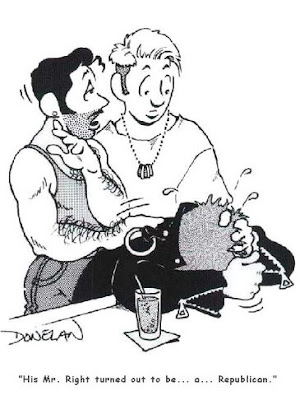
Ah, the more things change, the more they stay the same, isn't that so, fellas?


Thursday, February 9, 2017
The Blind Tweeting the Blind
 |
| New Yorker cartoon by Liam Walsh |
The unceasing and daily intensifying coverage by the news media of the Trump trainwreck is certainly fascinating and appalling in equal parts - but perhaps a bit too much so. It might, in fact, be salutary for us all to stick our heads out of the tweetstorm now and then, and remind ourselves that there is an entire world existing right below our feet that also is worthy of attention - really it is.
Here's an article from the Atlantic that may give pause for thought: "The Binge Breaker." Excerpt:
While some blame our collective tech addiction on personal failings, like weak willpower, Harris points a finger at the software itself. That itch to glance at our phone is a natural reaction to apps and websites engineered to get us scrolling as frequently as possible. The attention economy, which showers profits on companies that seize our focus, has kicked off what Harris calls a “race to the bottom of the brain stem.” “You could say that it’s my responsibility” to exert self-control when it comes to digital usage, he explains, “but that’s not acknowledging that there’s a thousand people on the other side of the screen whose job is to break down whatever responsibility I can maintain.” In short, we’ve lost control of our relationship with technology because technology has become better at controlling us. . . .
McDonald’s hooks us by appealing to our bodies’ craving for certain flavors; Facebook, Instagram, and Twitter hook us by delivering what psychologists call “variable rewards.” Messages, photos, and “likes” appear on no set schedule, so we check for them compulsively, never sure when we’ll receive that dopamine-activating prize. (Delivering rewards at random has been proved to quickly and strongly reinforce behavior.) Checking that Facebook friend request will take only a few seconds, we reason, though research shows that when interrupted, people take an average of 25 minutes to return to their original task.
Sites foster a sort of distracted lingering partly by lumping multiple services together. To answer the friend request, we’ll pass by the News Feed, where pictures and auto-play videos seduce us into scrolling through an infinite stream of posts—what Harris calls a “bottomless bowl,” referring to a study that found people eat 73 percent more soup out of self-refilling bowls than out of regular ones, without realizing they’ve consumed extra. The “friend request” tab will nudge us to add even more contacts by suggesting “people you may know,” and in a split second, our unconscious impulses cause the cycle to continue: Once we send the friend request, an alert appears on the recipient’s phone in bright red—a “trigger” color, Harris says, more likely than some other hues to make people click—and because seeing our name taps into a hardwired sense of social obligation, she will drop everything to answer. In the end, he says, companies “stand back watching as a billion people run around like chickens with their heads cut off, responding to each other and feeling indebted to each other.” . . .
“Our generation relies on our phones for our moment-to-moment choices about who we’re hanging out with, what we should be thinking about, who we owe a response to, and what’s important in our lives,” he said. “And if that’s the thing that you’ll outsource your thoughts to, forget the brain implant. That is the brain implant. You refer to it all the time.”
And here's a video interview with the subject of the article.
For clarity: Your Head Trucker has no smart phone or even dumb phone, and has no intention of having any.
(Ain't that a damn shame, boys?)
Friday, December 26, 2014
Wednesday, December 17, 2014
Animating Popeye
A fascinating 1939 report from Popular Science - in color, too! - of the filmmaking process at the studio of pioneer animator Max Fleischer. Nowadays I suppose there must be software that would allow a child of 8 to make a cartoon - but even though I myself grew up in pre-computer times, it's still mind-boggling to contemplate the vast amount of skilled, painstaking work that was necessary - and which produced such beautiful results.
First, some background from Wikipedia on Fleischer's stereoptical process:
And here's the complete film they were working on in the short subject: the two-reel Aladdin and His Wonderful Lamp:
First, some background from Wikipedia on Fleischer's stereoptical process:
This technique replaced the usual flat-plane, drawn and painted cartoon backgrounds with a circular 3-D scale-model background — a diorama — in front of which the action cels were positioned and photographed. As the character, say, hustled down a city street, the camera operator would rotate the diorama a click with each frame. The result was a constantly changing perspective of converging parallel lines that gave an amazing sense of depth. The process worked most dramatically with pans or tracking shots; for static shots, traditional drawn backgrounds sufficed. It was used to great effect in the longer format Popeye cartoons Popeye the Sailor Meets Sindbad the Sailor (1936) and Popeye the Sailor Meets Ali Baba's Forty Thieves (1937). These series of double-length (two-reel) cartoons were a gradual progression expressing Fleischer's desire to produce feature-length animated features.
And here's the complete film they were working on in the short subject: the two-reel Aladdin and His Wonderful Lamp:
Saturday, December 13, 2014
Thursday, October 30, 2014
To Boo or Not to Boo
I always loved Casper, bought all the comic books - but the syndicated show wasn't aired by any of the three stations we could get, so I couldn't watch the cartoons, which was a great disappointment.
Once in a great while, I suppose when the atmosphere was just right, we could get them in a very snowy picture from a station in another city a hundred miles away - but that was rare. It goes without saying that all the cartoons on television were in black and white - you had to go to the movies to see a color cartoon.
Young'uns today have no concept of a TV show they just can't see by any means, I guess. But y'all can see this one right here and now - in color, even! Enjoy.
Thursday, October 16, 2014
Saturday, September 20, 2014
Donald's Garden
Is Saturday still cartoon day for kids? Or has the Internet replaced that too? Come to think of it, do they even watch cartoons or make cartoons anymore?
Wednesday, August 27, 2014
Donald Duck: Modern Inventions (1937)
In the mood to have a duck fit today? Just sit back and let Donald do the work:
Tuesday, September 3, 2013

Friday, August 9, 2013

Wednesday, July 31, 2013
What I'm Watching: The Anatomy of a New Yorker Cartoon
New Yorker cartoon editor Bob Mankoff explains what works, what doesn't work, and why:
Mankoff's eleven favorite cartoons are here.
If you're in the mood for more, here's a slideshow of readers' favorites to enjoy.
Mankoff's eleven favorite cartoons are here.
If you're in the mood for more, here's a slideshow of readers' favorites to enjoy.
Tuesday, April 2, 2013
Hate the Sin, Love the Sinner
 |
| Click to enlarge. |
Three videos with a common thread: what do you think it is?
And just for fun: Stop Gray Marriage Now!
Tuesday, August 21, 2012

Wednesday, July 4, 2012
Happy Fourth!

Hope you guys have a good one.
P.S. - a belated happy Canada Day to my truckbuddies north of the border.
 |
What the delegate from Texas would have said. |
From the White House, a performance of "America the Beautiful." Yeah, it's partly a campaign ad - but aren't you glad it's not McCain or Bush or Romney?
Friday, December 30, 2011

Sunday, August 28, 2011
Pre-emptive Paranoia

An excerpt of what Adam Gopnik writes today at the New Yorker News Desk:
Obviously, this was a big storm with a lot of water and wind in it; if things broke the wrong way, it could do a great deal of harm to a lot of people—and, just as obviously, the politicians had made an intelligent decision not to get caught with their raincoats down this time. (See Katrina.) But the relentless note of incipient hysteria, the invitation to panic, the ungrounded scenarios—the overwhelming and underlying desire for something truly terrible to happen so that you could have something really hot to talk about—was still startling. We call disasters unimaginable, but all we do is imagine such things. “It hasn’t even started, and the city is already Atlantis,” one of the back seat riders announced.
That, you could conclude mordantly, is the real soundtrack of our time: the amplification of the self-evident toward the creation of paralyzing, preëmptive paranoia. The real purpose not to get you to do anything, but to get you so scared that all you can do is keep the television, or radio, on. This is obvious, and yet there is something truly helpful, really instructive, about experiencing it again after a month of absence and silence. Two things that ought to be apparent all the time become briefly clear to you again. First, that the media, television particularly, are amplifying devices in which tiny kernels of information become vast, terrifying structures of speculation. The news business is one in which a minimum of news is really given the business.
And second, that the reasons for this are essentially non-ideological; frightened people need news for reassurance, and want to get a more heightened experience by being frightened still more, and the business the people supplying the fright are in (which we’re in too, of course) is not really that of dispensing information but of assembling enough listeners or readers, preferably still caught in that same spirit of credulous attentiveness, to offer to advertisers or keep subscribing. Sirius radio makes this clear in a backward way because it “blacks out” the commercials on the TV stuff they broadcast, not having been paid for them. Right in the middle of being terrified, everything stops and you’re bored stiff for a few minutes—and it occurs to you, as if for the first time, that those few minutes, when a commercial is being shown on CNN or MSNBC, are actually the whole point of the exercise. . . .

Tuesday, June 21, 2011

Sunday, May 8, 2011

Subscribe to:
Posts (Atom)