C I V I L    M A R R I A G E    I S    A    C I V I L    R I G H T.

A N D N O W I T ' S T H E L A W O F T H E L A N D.


Showing posts with label outer space. Show all posts

Thursday, June 5, 2014

Far Out

Click to enlarge.


From NASA:
Astronomers using NASA's Hubble Space Telescope have assembled a comprehensive picture of the evolving universe – among the most colorful deep space images ever captured by the 24-year-old telescope. Researchers say the image, in new study called the Ultraviolet Coverage of the Hubble Ultra Deep Field, provides the missing link in star formation. The Hubble Ultra Deep Field 2014 image is a composite of separate exposures taken in 2003 to 2012 with Hubble's Advanced Camera for Surveys and Wide Field Camera 3.

Astronomers previously studied the Hubble Ultra Deep Field (HUDF) in visible and near-infrared light in a series of images captured from 2003 to 2009. The HUDF shows a small section of space in the southern-hemisphere constellation Fornax. Now, using ultraviolet light, astronomers have combined the full range of colors available to Hubble, stretching all the way from ultraviolet to near-infrared light. The resulting image -- made from 841 orbits of telescope viewing time -- contains approximately 10,000 galaxies, extending back in time to within a few hundred million years of the big bang.

Prior to the Ultraviolet Coverage of the Hubble Ultra Deep Field study of the universe, astronomers were in a curious position. Missions such as NASA's Galaxy Evolution Explorer (GALEX) observatory, which operated from 2003 to 2013, provided significant knowledge of star formation in nearby galaxies. Using Hubble's near-infrared capability, researchers also studied star birth in the most distant galaxies, which appear to us in their most primitive stages due to the significant amount of time required for the light of distant stars to travel into a visible range. But for the period in between, when most of the stars in the universe were born -- a distance extending from about 5 to 10 billion light-years -- they did not have enough data.

All that is so big, and we are so small.  Kinda makes you stop and think, don't it?
Monday, August 6, 2012

Shatner on Mars

I reckon most of you guys are already up to speed on this, but your Head Trucker is a little behind the times out here on the vast and trackless prairie - so it comes as news to him. William Shatner once again takes us where no man has gone before with this animated demonstration of how the Curiosity lander - wonderful name - touched down on the Red Planet last night.

A sky crane? OMG. If you saw it in a movie, you wouldn't believe it.


Sunday, June 17, 2012

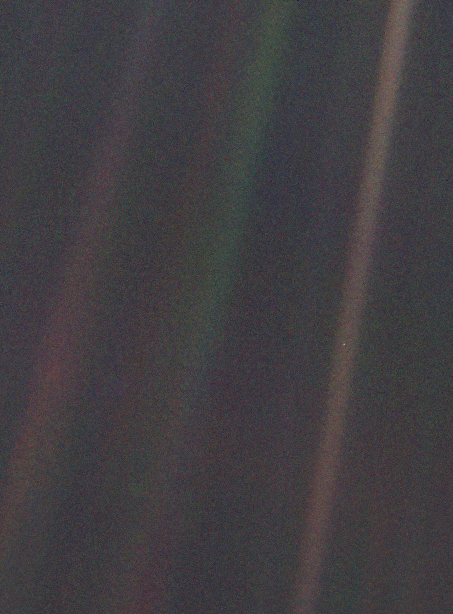
Pale Blue Dot

Home, from afar:
Earth is the pale blue dot in the middle
of the streak on the righthand side of the photo:
just an eighth of a pixel contains the whole world.
Click to enlarge.

Well, you learn something every day. Although this photo was taken in 1990, when Voyager 1 was already beyond the orbit of Pluto, 3.7 billion miles from home, I never heard of it until today. It's deeply moving, though.

What flashed on me when I looked at it is similar to what the late Carl Sagan writes:
Look again at that dot. That's here. That's home. That's us. On it everyone you love, everyone you know, everyone you ever heard of, every human being who ever was, lived out their lives. The aggregate of our joy and suffering, thousands of confident religions, ideologies, and economic doctrines, every hunter and forager, every hero and coward, every creator and destroyer of civilization, every king and peasant, every young couple in love, every mother and father, hopeful child, inventor and explorer, every teacher of morals, every corrupt politician, every "superstar," every "supreme leader," every saint and sinner in the history of our species lived there – on a mote of dust suspended in a sunbeam.

The earth is a very small stage in a vast cosmic arena. Think of the rivers of blood spilled by all those generals and emperors so that in glory and in triumph they could become the momentary masters of a fraction of a dot. Think of the endless cruelties visited by the inhabitants of one corner of the dot on scarcely distinguishable inhabitants of some other corner of the dot. How frequent their misunderstandings, how eager they are to kill one another, how fervent their hatreds. Our posturings, our imagined self-importance, the delusion that we have some privileged position in the universe, are challenged by this point of pale light. Our planet is a lonely speck in the great enveloping cosmic dark. In our obscurity – in all this vastness – there is no hint that help will come from elsewhere to save us from ourselves. It is up to us. It's been said that astronomy is a humbling, and I might add, a character-building experience. To my mind, there is perhaps no better demonstration of the folly of human conceits than this distant image of our tiny world. To me, it underscores our responsibility to deal more kindly and compassionately with one another and to preserve and cherish that pale blue dot, the only home we've ever known.

Thursday, August 11, 2011

Mars Cars

A couple of years ago, I was touched by the plight of the valiant little Spirit rover, which after several years of brilliant success exploring the Red Planet and reporting back to Earth with fantastic pics and data, became stuck in a sand trap, and finally expired there, its solar panels covered with light-blocking dust. Of course, this is anthropomorphizing in the worst way, and it's silly of me. But I was touched just the same.

Here are some very cool vids about Spirit and its brother hot-rod, Opportunity, who is still going about his lonely chores up there.

Artist's concept of Spirit on the Martian surface


First-ever picture of Earth taken from another planet.
Now what was that big problem you were talking about?

P. S. - If I'm silly enough to care about the death of a robot, I'm also silly enough to believe there are canals on Mars - which, as late as my grammar school days, there were still science books in the library that acknowledged the possibility they exist.  And what are possibilities, after all, but the stuff that dreams are made on?  Like us.


I'm not much for science fiction now, but growing up I drank deeply at the trough - wonderful adventures in dream-laden books like Red Planet by Heinlein and The Martian Chronicles by Bradbury.  So don't try to confuse me with science; they just haven't looked in the right places yet, maybe.  I much prefer to imagine the ancient canals still filling with glistening, life-giving water every Martian spring, flowing amid the ruined towers of the cities, where the inscrutable eyes of the old ones watch in the dreamtime.

Do you grok me, brother?


Related Posts with Thumbnails