Showing posts with label Perry v. Schwarzenegger. Show all posts
Showing posts with label Perry v. Schwarzenegger. Show all posts
Thursday, June 27, 2013
Reactions to the Marriage Rulings: Rachel
The full import of yesterday's rulings by the Supreme Court in the DOMA and Prop 8 cases is still settling in with your Head Trucker. Here's Rachel's inimitable, insightful take on things, and this clip should lead you through several segments of her show last night, dealing with various facets of the marriage news.
Wednesday, June 26, 2013
DOMA OVERTURNED, MARRIAGE RETURNING TO CALIFORNIA

Bless God, I have lived to see this day.
The Supreme Court this morning overturned Section 3 of DOMA in a 5-4 vote as being an unconstitutional violation of due process and equal protection - meaning the federal government has to recognize same-sex marriage in those states where it is legal; text of the ruling is here. Commentary from SCOTUSblog editors:
In response to some questions about Windsor: Only Section 3 of the Defense of Marriage Act -- which defines the words "marriage" and "spouse," for federal purposes, as referring only to marriages between opposite-sex couples -- has been struck down. Consequently, any federal statute that refers to a "marriage" or a "spouse" should be interpreted as applying with equal force to same-sex married couples.
The federal Defense of Marriage Act defines "marriage," for purposes of over a thousand federal laws and programs, as a union between a man and a woman only. Today the Court ruled, by a vote of five to four, in an opinion by Justice Kennedy, that the law is unconstitutional. The Court explained that the states have long had the responsibility of regulating and defining marriage, and some states have opted to allow same-sex couples to marry to give them the protection and dignity associated with marriage. By denying recognition to same-sex couples who are legally married, federal law discriminates against them to express disapproval of state-sanctioned same-sex marriage. This decision means that same-sex couples who are legally married must now be treated the same under federal law as married opposite-sex couples.
The Court also in a roundabout way sent Prop 8 to the garbage can, also by a 5-4 vote; text of the ruling is here. Comment from Amy Howe at Scotusblog:
Here's a Plain English take on Hollingsworth v. Perry, the challenge to the constitutionality of California's Proposition 8, which bans same-sex marriage: After the two same-sex couples filed their challenge to Proposition 8 in federal court in California, the California government officials who would normally have defended the law in court, declined to do so. So the proponents of Proposition 8 stepped in to defend the law, and the California Supreme Court (in response to a request by the lower court) ruled that they could do so under state law. But today the Supreme Court held that the proponents do not have the legal right to defend the law in court. As a result, it held, the decision by the U.S. Court of Appeals for the Ninth Circuit, the intermediate appellate court, has no legal force, and it sent the case back to that court with instructions for it to dismiss the case.
Photos of plaintiff Edie Windsor, at the home of her attorney in New York City, as she heard that she won her case this morning, in the New Yorker.
Report on the rulings from NBC News, with some jubilant crowd reactions in the background:
Update, 12 noon: The ACLU has issued a FAQ on "Marriage for Same-Sex Couples in California," discussing the implications of the Court's ruling on Prop 8; a couple of notable excerpts:
A few final, legal steps must be completed before same-sex couples can once again marry in California, which should take only about a month. First, the Supreme Court’s ruling must become final, which will happen 25 days after the ruling. Under the Supreme Court’s rules, the party who loses a case has a right to ask the Court to re-hear the case within 25 days of the decision’s release. Petitions for re-hearing are very rarely granted, so it is unlikely that anything will change during this 25 days. Once the ruling is final, the Ninth Circuit will issue a “mandate” that will send the case back to the District Court. When the mandate is issued, the injunction against the enforcement of Prop 8 will take effect, and same-sex couples in California will once again have the freedom to marry. We expect that the State of California will issue guidance to all County Clerk offices in the state about when the decision becomes final and when those offices must resume issuing licenses on an equal basis to same-sex couples. Please note that couples should wait until the Supreme Court ruling is final and the Ninth Circuit issues a mandate to the District Court before attempting to obtain a marriage license or to marry, to ensure that your marriage is valid. . . .
Yes. The legal order (or injunction) that stops the State of California from enforcing Prop 8 applies to state officials throughout the state. This means that Prop 8 cannot be enforced anywhere in the state. There may be efforts to try to limit the effect of the injunction to apply to only some parts of the State but we strongly believe that those efforts are futile and will not succeed. . . .
If you live in another state and get married in California you will be legally married. However, depending on where you live, your home state may not respect your marriage. The Supreme Court’s ruling in United States v. Windsor striking down Section 3 of DOMA concerns only the federal government’s treatment of marriages. The ruling does not require states to recognize a valid marriage of a same-sex couple performed in another state. Thus, if you marry in California but live elsewhere, it is still possible that your home state will not recognize your marriage.Update, 12:30 p.m.: In California, Governor Jerry Brown has issued the following statement:
After years of struggle, the U.S. Supreme Court today has made same-sex marriage a reality in California. In light of the decision, I have directed the California Department of Public Health to advise the state’s counties that they must begin issuing marriage licenses to same-sex couples in California as soon as the Ninth Circuit confirms the stay is lifted.Update, 12:45 p.m.: At the Pentagon, Secretary of Defense Chuck Hagel has issued this statement:
The Department of Defense intends to make the same benefits available to all military spouses -- regardless of sexual orientation -- as soon as possible. That is now the law, and it is the right thing to do. The department will immediately begin the process of implementing the Supreme Court's decision in consultation with the Department of Justice and other executive branch agencies.Update, 1:00 p.m.: From aboard Air Force One en route to Africa, President Obama has issued the following statement:
I applaud the Supreme Court’s decision to strike down the Defense of Marriage Act. This was discrimination enshrined in law. It treated loving, committed gay and lesbian couples as a separate and lesser class of people. The Supreme Court has righted that wrong, and our country is better off for it. We are a people who declared that we are all created equal - and the love we commit to one another must be equal as well.
This ruling is a victory for couples who have long fought for equal treatment under the law; for children whose parents’ marriages will now be recognized, rightly, as legitimate; for families that, at long last, will get the respect and protection they deserve; and for friends and supporters who have wanted nothing more than to see their loved ones treated fairly and have worked hard to persuade their nation to change for the better.
So we welcome today’s decision, and I’ve directed the Attorney General to work with other members of my Cabinet to review all relevant federal statutes to ensure this decision, including its implications for Federal benefits and obligations, is implemented swiftly and smoothly.
On an issue as sensitive as this, knowing that Americans hold a wide range of views based on deeply held beliefs, maintaining our nation’s commitment to religious freedom is also vital. How religious institutions define and consecrate marriage has always been up to those institutions. Nothing about this decision - which applies only to civil marriages - changes that.
The laws of our land are catching up to the fundamental truth that millions of Americans hold in our hearts: when all Americans are treated as equal, no matter who they are or whom they love, we are all more free.And in New York City, Edie Windsor, plaintiff in the DOMA case, had this to say, according to the Washington Post:
After learning of the Supreme Court ruling, Windsor broke into tears. “If I had to survive Thea, what a glorious way to do it, and she would be so pleased,” she said at a news conference. She thanked her lawyers and her allies, gay and straight: “We won all the way, so thank you from the bottom of my heart.”
Asked what Spyer would say to her if she were alive, Windsor replied, “‘You did it, honey.’”
And that's about as far as your Head Trucker can go today, I have to get some sleep now. But I'll have more reactions and analyses in my next post, sometime tonight.
Odd sensation, looking out my window at the green grass and the rose bushes and the sycamore tree and corners of the blue summer sky above: all is just as it was yesterday and all the days before, yet now there's something different about this plot of ground I live on, this green earth, this land of ours. A quick, sly thought whistles up from my heart to my eyes: we belong here, we are kindred, we are of the tribe - we are truly, fully Americans, and strangers no more.
We belong. And that makes all the difference.
Just one more:
Thursday, March 28, 2013
Popcorn and a Movie: Part I

Hey guys, come on in! Welcome to the Blue Truck Theater. Admission is free, but here's the deal: first you have to get through all the popcorn - i.e., my exposition of the way I see the legal issues now before the Supreme Court - then you can watch the movie, which I guarantee will be a crowd-pleaser. Deal? Now turn off those damn cell phones, and take that gum out of your mouth.
Everybody else and his brother is expatiating on these cases, even when they don't know what the hell they are talking about, so I figure I might as well too, and if you pay attention, you just might learn something you didn't know before - though in all honesty, I must begin by telling you that I am not an attorney or an expert in the law.
But a few things I do know, and I think I have the overall gist of things right, so I'll share those little nuggets with you, and add my observations, which you can take or leave as you please. Some of this is a repetition of an exchange I got into over on Box Turtle Bulletin, but I'd already planned to write this post on the Blue Truck, as much to jog my own memory as anything else.
First of all, the most obvious point to make: nobody has a crystal ball, and no one can be certain how the Court will rule on Prop 8 and DOMA until they issue the actual rulings. When we do get the rulings, to avoid being unduly elated or disappointed, it's important that you understand what the Court is deciding, and why, and what the constitutional background is, the rules of the game, as it were.
Continued after the jump . . .
Tuesday, March 26, 2013
Hollingsworth v. Perry: Arguments and Analysis

 |
| Above and below: signs carried by demonstrators in front of the U. S. Supreme Court building this morning as the justices listened to oral arguments on Hollingsworth v. Perry. |

From SCOTUSblog, an audio recording of this morning's Supreme Court hearing on the Prop 8 case (1 hr., 19 min.).
Or if you prefer, a written transcript here (PDF, 278 kb). Hint: you'll get the most out of both by reading and listening to them together.
Analysis:
1. By Tom Goldstein, editor of SCOTUSblog.
2. By Lyle Denniston, SCOTUSblog reporter.
3. By Greg Stohr at bloomberg.com:
The U.S. Supreme Court raised the prospect that it will decline to say whether the Constitution gives gays the right to marry in an argument that revealed a chasm among the justices on one of the country’s most divisive issues. A decision to back out of the case would let gay marriage resume in California, without directly affecting the rest of the country. Justice Anthony Kennedy, potentially the court’s swing vote, twice asked whether the most prudent course for the court would be not to rule. He said the case was taking the court into “uncharted waters.”4. By Jacob Combs of Equality on Trial:
As always, Justice Kennedy is almost certainly going to be the swing vote: none of the other conservative Justices appeared anywhere close to a ruling that would declare Prop 8 unconstitutional. Kennedy’s questions on the merits were pointed and probed both sides. At one point, Kennedy pointed out that the sociological evidence about families headed by same-sex couples and whether there are any effects on children is new and not conclusive. But in the very same sentence, he mentioned that there is a specific legal injury present in the case suffered by the almost 40,000 children living in California with same-sex parents.
Continued after the jump . . .
Monday, March 25, 2013
Ringside at History
 |
| The Supreme Court of the United States: Top row (left to right): Associate Justice Sonia Sotomayor, Associate Justice Stephen G. Breyer, Associate Justice Samuel A. Alito, and Associate Justice Elena Kagan. Bottom row (left to right): Associate Justice Clarence Thomas, Associate Justice Antonin Scalia, Chief Justice John G. Roberts, Associate Justice Anthony Kennedy, and Associate Justice Ruth Bader Ginsburg. |
Tomorrow, the Supreme Court hears oral arguments on the Prop 8 case (originally known as Perry v. Schwarzenegger, then as Perry v. Brown, now called Hollingsworth v. Perry), which has been coordinated for the good guys by the American Foundation for Equal Rights. Matt Baume provides the voice-over for this summary of AFER's efforts:
SCOTUSblog has a summary "In Plain English" of the legal issues involved with the case here, if you want to read it.
On Wednesday, the high court will hear arguments in the DOMA case, United States v. Windsor.
It's worth noting two things: first, that the Supremes don't have to hear any case that's appealed to them; they pick and choose the ones they want. And second, broadly speaking, the Prop 8 case deals with state issues surrounding same-sex marriage, while the DOMA case deals with federal issues. So in choosing to hear these two particular cases out of the dozen or more other same-sex marriage cases that have also been appealed to the court in the past year, the justices would seem ready to make a clean, sweeping ruling, or combined rulings, to cover the whole spectrum of legal issues concerning same-sex marriage in this country. Or that's how it seems to me, but what do I know.
However, the justices have also specifically asked in both cases that the issue of legal standing be addressed, which is a technical thing that might, or might not, give the court some wiggle room not to make any sweeping rulings at all. So we just have to wait and see, because the bottom line is - the court could go either way, and I'm not expecting gay marriage will be legal all over the country anytime soon.
However, given the breathtaking speed of changing attitudes in this country towards same-sex marriage, it seems highly unlikely to your Head Trucker that the court will avoid ruling in our favor, at least to some extent. As I said when the cases were accepted by the court, my intuition tells me that the court will certainly legalize gay marriage in California, at the very least, and will also declare that the federal government has to recognize same-sex marriage in those states where it is allowed.
Beyond that, who knows? Rulings are not expected to be delivered until sometime in June, so we'll have to wait and see. But what an exciting moment in history - especially for those of us who remember what the world was like before Stonewall.
Friday, December 7, 2012
Marriage Equality Updates, 12/7/12
Sometimes it seems like Change is as slow as Christmas; but then other times, it seems like it's bustin' out all over. A few news notes to show you what I mean.
Same-sex couples began getting marriage licenses yesterday in the Evergreen State. A headline in Towleroad says, "These Men Are Officially, Wonderfully, the Face of Marriage Equality in Washington State":
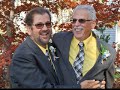
Hooray! Finally, some real middle-aged gay guys, not stereotyped twinklets in sequins. Your Head Trucker can totally relate. Especially since my beard is now nearly as white and as long as the older dude's is. Yeah, really.
Of course, lots of other queer couples are flocking to the altar, or at least to the courthouse, in Washington - including Dan Savage and his longtime "husband in Canada, boyfriend in America" Terry Miller. The state requires a three-day waiting period, so weddings won't happen until Sunday.
In Mexico, on Wednesday of this week the Mexican Supreme Court struck down a law against same-sex marriage in the state of Oaxaca, which may lead to marriage equality nationwide soon. Since 2010, Mexican couples have already been able to get married in Mexico City. A more detailed analysis of the meaning of the ruling is here.
At the same link as above, lawmakers in Colombia, Chile, and Uruguay are all set to debate marriage equality next week.
Maryland began issuing marriage licenses to same-sex couples yesterday, although weddings won't begin until January 1.
And in Virginia, NPR reports that the CIA for the first time is actively looking to recruit gay and lesbian employees.
And in Washington D.C., the Supreme Court may - or may not - announce today which of the same-sex marriage cases it will consider. As I noted last week, if the Court declines to review the Prop 8 case, which has been upheld in our favor by a federal district court and a federal appeals court already, marriages could resume very quickly in California. So stay tuned.
Update, 12/8, 5 a.m.: Okay, so I'm not on the same sleep schedule as the rest of the world. But I've just learned that the Supreme Court has decided to review both the Prop 8 case and the Windsor case. The Washington Blade reports:
More analysis and commentary, if you want to read it:
"Today at the Supreme Court - Explained" from Lambda Legal
"Supreme Court to Hear Two Challenges to Gay Marriage" from the New York Times
"Prop 8 Attorneys Confident SCOTUS Will Strike Down Marriage Ban" from the Washington Blade
"Same-sex Marriage in the Courts" from the Pew Forum on Religion and Public Life
"Supreme Court Will Hear DOMA and Prop 8 Challenges: An Analysis" at Towleroad
What I say: Your Head Trucker has no crystal ball, but it seems most likely that when the Supremes finally rule on these cases, sometime between now and when the court term ends next June, that
1) it will concur in striking down Prop 8, letting marriages resume in California, but not applying that to any other state;
2) it will say that if a state says you're married under its laws, the feds have to recognize that marriage for all federal rights and benefits, just as with any other married couple across the land; but
3) the Court will not say that other states have to recognize your marriage if they don't want to. The polls may show a slight majority of Americans are now in favor of the idea, but the Supremes rarely jump very far ahead of public opinion. It's just too early, I think, for a nationwide ruling to the right to marry in every state: I don't expect that it another 15 years, at least.
Of course, I hope I'm wrong about that last bit. We'll find out by the time it's beach weather next year. My God, and I remember when "homosexual" was practically an unmentionable word in public. Now the Supreme Court is going to deliberate on our right to marry. How times have changed.
Same-sex couples began getting marriage licenses yesterday in the Evergreen State. A headline in Towleroad says, "These Men Are Officially, Wonderfully, the Face of Marriage Equality in Washington State":
 |
| Larry Duncan, 56, and Randy Shepherd, 48, partners for eleven years, apply for their marriage license in Seattle on Thursday. |
Hooray! Finally, some real middle-aged gay guys, not stereotyped twinklets in sequins. Your Head Trucker can totally relate. Especially since my beard is now nearly as white and as long as the older dude's is. Yeah, really.
Of course, lots of other queer couples are flocking to the altar, or at least to the courthouse, in Washington - including Dan Savage and his longtime "husband in Canada, boyfriend in America" Terry Miller. The state requires a three-day waiting period, so weddings won't happen until Sunday.
In Mexico, on Wednesday of this week the Mexican Supreme Court struck down a law against same-sex marriage in the state of Oaxaca, which may lead to marriage equality nationwide soon. Since 2010, Mexican couples have already been able to get married in Mexico City. A more detailed analysis of the meaning of the ruling is here.
At the same link as above, lawmakers in Colombia, Chile, and Uruguay are all set to debate marriage equality next week.
Maryland began issuing marriage licenses to same-sex couples yesterday, although weddings won't begin until January 1.
And in Virginia, NPR reports that the CIA for the first time is actively looking to recruit gay and lesbian employees.
And in Washington D.C., the Supreme Court may - or may not - announce today which of the same-sex marriage cases it will consider. As I noted last week, if the Court declines to review the Prop 8 case, which has been upheld in our favor by a federal district court and a federal appeals court already, marriages could resume very quickly in California. So stay tuned.
Update, 12/8, 5 a.m.: Okay, so I'm not on the same sleep schedule as the rest of the world. But I've just learned that the Supreme Court has decided to review both the Prop 8 case and the Windsor case. The Washington Blade reports:
Ending months of anticipation, the U.S. Supreme Court signaled on Friday it would take up litigation challenging California’s Proposition 8 and one case challenging the Defense of Marriage Act.
Justices decided to take up the case of Hollingsworth v. Perry, which seeks to overturn the state constitutional amendment California voters passed in 2008 that took away marriage rights for same-sex couples.
They also decided to take up Windsor v. United States, litigation challenging the constitutionality of the Defense of Marriage Act. That lawsuit was filed by Edith Windsor, a New York widow who was forced to pay $363,000 in estate taxes in 2009 upon the death of her spouse, Thea Spyer.
The court made the news in an orders list published Friday following a conference the justices held on the same day. Four justices must vote affirmatively to grant a writ of certiorari in any particular case, but that vote isn’t public information.
Windsor, 83, expressed excitement in a statement that her lawsuit would be the one to challenge DOMA at the Supreme Court. Her lawsuit was filed by the American Civil Liberties Union along with Paul, Weiss, Rifkind, Wharton & Garrison LLP and other groups.
“When Thea and I met nearly 50 years ago, we never could have dreamed that the story of our life together would be before the Supreme Court as an example of why gay married couples should be treated equally, and not like second-class citizens,” Windsor said. “While Thea is no longer alive, I know how proud she would have been to see this day. The truth is, I never expected any less from my country.”
More analysis and commentary, if you want to read it:
"Today at the Supreme Court - Explained" from Lambda Legal
"Supreme Court to Hear Two Challenges to Gay Marriage" from the New York Times
"Prop 8 Attorneys Confident SCOTUS Will Strike Down Marriage Ban" from the Washington Blade
"Same-sex Marriage in the Courts" from the Pew Forum on Religion and Public Life
"Supreme Court Will Hear DOMA and Prop 8 Challenges: An Analysis" at Towleroad
What I say: Your Head Trucker has no crystal ball, but it seems most likely that when the Supremes finally rule on these cases, sometime between now and when the court term ends next June, that
1) it will concur in striking down Prop 8, letting marriages resume in California, but not applying that to any other state;
2) it will say that if a state says you're married under its laws, the feds have to recognize that marriage for all federal rights and benefits, just as with any other married couple across the land; but
3) the Court will not say that other states have to recognize your marriage if they don't want to. The polls may show a slight majority of Americans are now in favor of the idea, but the Supremes rarely jump very far ahead of public opinion. It's just too early, I think, for a nationwide ruling to the right to marry in every state: I don't expect that it another 15 years, at least.
Of course, I hope I'm wrong about that last bit. We'll find out by the time it's beach weather next year. My God, and I remember when "homosexual" was practically an unmentionable word in public. Now the Supreme Court is going to deliberate on our right to marry. How times have changed.
Wednesday, October 10, 2012
Rachel Interviews Boies and Olson
Via Towleroad: Last Friday, in an interview at NYU Law School, Rachel Maddow spoke at length with David Boies and Ted Olson, attorneys for our side in the Prop 8 case (Perry v. Brown) now pending review by the Supreme Court. It's 55 minutes, but a fascinating discussion of the fundamental principles of equality at stake in this and other marriage cases about to be considered by the high court.
Visit NBCNews.com for breaking news, world news, and news about the economy
Monday, June 18, 2012
A Fighting Chance

An excerpt from a moving piece in the New York Times written by the father of Anthony Zarillo, one of the plaintiffs in Perry v. Brown, the Prop 8 case:
ONE of the worst days in my son’s life was in November 2008, when a majority of Californians voted in favor of Proposition 8, a ballot measure to change California law in a way that bans marriage for same-sex couples. None of us could believe something like that would pass in California. When it did, I wondered if Jeff and Paul would move from the place they loved and had called home for so long.
They didn’t, though. Nor did they accept the new law and try to blend in as I told Jeff to do all those years ago. Instead, they did something that’s made me as proud as I’ve ever been: they fought back.
Jeff and Paul and two women challenged the law in court, and in a landmark decision two years later, they won: Proposition 8 was declared unconstitutional by a judge in San Francisco. The proponents of Proposition 8 appealed, and Jeff and Paul won that, too.
The United States Court of Appeals recently declined to take up the case before a larger panel, which opened the door for it to head to the Supreme Court. Meanwhile, Jeff and Paul still can’t legally marry.
As this Father’s Day approached, all I could think about was how much I want my son to experience the joys of being a father, how much I want him to marry the person he loves and to raise a family.
For now, he is still waiting, and fighting. I see how much the struggle costs him, how discouraging it is that despite his strength and patience and faith in the system, the ultimate decision rests in the hands of those who have yet to act.
One day soon, though, the powers that be are going to do the right thing. I’m his father, and it’s Father’s Day, so let me believe it. One day soon they’re going to let my brave, beautiful boy walk the same path we all get to take home.
Saturday, June 9, 2012
This Week in Marriage News

This week, three steps forward and two steps back for marriage equality:
Another Federal appeals court found section 3 of DOMA unconstitutional, in the Edie Windsor case I've blogged about before. Here's Edie thanking her supporters:
Also, in the Perry v. Brown case, the federal Ninth Circuit appeals court turned down a request by anti-gay proponents to have the case reheard by the full 11-member court; a three-member panel in February of this year upheld the finding of a lower federal court that California's Prop 8, which in 2008 took away from gays and lesbians the right to marry in that state, was unconstitutional. The anti-gay side has 90 days in which to appeal the case to the U. S. Supreme Court.
And in far-away Denmark, the first country in the world to authorize same-sex registered partnerships back in 1989, their parliament has voted 85-24 to enact same-sex marriage, which will begin on June 15.
Elsewhere, though, the struggle goes on: in both Maryland and Washington state, anti-gay forces have submitted enough signatures to subject those states' recently-enacted equal-marriage laws to referendums in November. In no state so far have voters ever approved same-sex marriage.
But hey, there's got to be a first time somewhere, right? So we'll keep our fingers crossed.
But consider this New Yorker piece that discusses the ramifications of the marriage struggle on the presidential election, and vice-versa.
Wednesday, February 8, 2012
"Marriage Is a Conservative Value"
Last night, Rachel interviewed Ted Olson who, along with David Boies, is lead counsel for plaintiffs in the Prop 8 case.
Over on the PBS Newshour, David Boies took the stuffings out of one of NOM's lawyers:
Finally, some of you guys may find Salon's in-depth investigation of Maggie Gallagher's sexual and marital history very, very interesting. An excerpt:
Over on the PBS Newshour, David Boies took the stuffings out of one of NOM's lawyers:
Finally, some of you guys may find Salon's in-depth investigation of Maggie Gallagher's sexual and marital history very, very interesting. An excerpt:
With Gallagher, it is not that the personal is political but that the personal gave birth to the political. They were umbilically linked, and they are related, but they are separate. Two anima live within her; when you are talking with her, sometimes the personal answers back, sometimes the political. The personal is uncauterized emotion; the political is pure thought, almost autistically so. The personal facts do not always impinge on the political conclusion. Gallagher’s family life is a cobbled-together, junk-strewn, happy, loving mess: absent baby-daddy, later husband (of a different religion), separation then reunion, two sons by two fathers, and an annoyed biological grandmother on Facebook. But Gallagher’s political philosophy brooks no uncertainty.
“I have no doubts who will win in the end,” Gallagher says. “One hundred years from now the globe will not be full of societies that endorse same-sex unions as marriages. What happens between now and then is going to be less certain and full of struggle. In the long struggle, I’ll bet on human nature to overwhelm ideology. The thing about same-sex marriage is it’s based on a fundamental untruth: same-sex unions are not the same as opposite sex unions. They are not marriages.” . . .
Same-sex marriage is just a big lie, she believes, like Communism. It is weak at its foundations, like the Iron Curtain. It may get built, she seems to concede — in 10 years, or 20, there may be more states that recognize same-sex marriage, more shiny, happy couples raising rosy-cheeked, well-adjusted children, children who play with dogs and go to school and fall from jungle gyms and break their arms, children often adopted after being abandoned by the heterosexuals who did not want them or could not care for them — but in time (big time, geological time, God time) the curtain will be pulled back, or it will fall. Because it has to. It cannot be otherwise. Because a son, as Maggie Gallagher will tell you, needs a dad.
Tuesday, February 7, 2012
Court Strikes Down Prop 8
Although the Constitution permits communities to enact most laws they believe to be desirable, it requires that there be at least a legitimate reason for the passage of a law that treats different people differently. There was no such reason that Proposition 8 could have been enacted.A three-judge panel of the federal Court of Appeals for the Ninth Circuit today struck down California's gay-marriage ban as violating the Due Process and Equal Protection clauses of the Fourteenth Amendment to the U. S. Consitution. The court's opinion was written by Judge Stephen Reinhardt, joined by Judge Michael Daly Hawkins.
Proposition 8 serves no purpose, and has no effect, other than to lessen the status and human dignity of gays and lesbians in California, and to officially reclassify their relationships and families as inferior to those of opposite-sex couples. The Constitution simply does not allow for laws of this sort.
The San Jose Mercury News reports:
Judge N. Randy Smith dissented, saying there were "legitimate governmental interests" in restricting the definition of marriage to a union between a man and woman.The Los Angeles Times makes this observation:
Proposition 8 backers can now ask the 9th Circuit to rehear the case with an 11-judge panel, or proceed directly to the Supreme Court. Smith's dissent could be a strong indicator there will be some support within the court to take a second look at the case.
The appeals court also rejected the argument that Walker's ruling should be scrapped because he did not disclose he was in a long-term same-sex relationship while he was handling the case. Smith joined in that part of the ruling.
As a result of the continued legal wrangling, same-sex marriages are not expected to resume in California any time soon, with further appeals likely to stretch at least into next year.
In the ruling, Reinhardt, considered one of the nation's most liberal judges, relied heavily on the U.S. Supreme Court's 1996 decision striking down a Colorado law that stripped gays and lesbians of protections against discrimination there.
The ruling, however, was focused on California's circumstances, notably the fact Proposition 8 took away the right of same-sex couples to marry that had been established in a 2008 California Supreme Court decision.
The 9th Circuit did not declare a fundamental right for same-sex couples to marry, a broader definition that could have undercut bans on gay marriage in four other western states.
The 2-1 decision by the U.S. 9th Circuit Court of Appeals will have limited effect outside California because it is based on voter repeal of a right a minority already enjoyed.
"The people may not employ the initiative power to single out a disfavored group for unequal treatment and strip them, without a legitimate justification, of a right as important as the right to marry," the court said.
Santa Clara University constitutional law Professor Margaret M. Russell said the ruling overturned Proposition 8 on “the narrowest grounds possible,” which makes it less likely that the U.S. Supreme Court would review it.
“It is very much anchored in the role of Proposition 8 in California’s history,” the professor said, adding that it would have little effect outside of California.
The court will not allow same-sex marriages to begin again in California until the deadline has passed for proponents of Prop 8 to appeal today's ruling or an appeal has been denied, a process that could take months, according to the folks at Prop 8 Trial Tracker.
Full text of the ruling below.
10-16696 #398_Decision
Tuesday, November 2, 2010
Voices for Equal Marriage
I. From Towleroad, Ted Olson, speaking in New York last week:
II. From Box Turtle Bulletin, reporting on some of the many amicus curiae briefs that have been filed in the Prop 8 case, Perry v. Schwarzengger, now under appeal to the Ninth Circuit federal court of appeals:
II. From Box Turtle Bulletin, reporting on some of the many amicus curiae briefs that have been filed in the Prop 8 case, Perry v. Schwarzengger, now under appeal to the Ninth Circuit federal court of appeals:
172 - Howard University School of Law Civil Rights Clinic – Howard is among the oldest and most revered of the traditionally black universities. They spoke from a history of civil rights and made comparisons that the gay community on its own dare not claim. Read this brief. The conclusion is truly touching:
In the final analysis, there is nothing new in the arguments against same-sex couples having the freedom to marry. However much opponents of marriage for same-sex couples may insist “this time it is different,” there remains an appalling familiarity to the refrain that allowing same-sex couples the same human dignity as everyone else will threaten social order, degrade individuals, and harm children. We suffered through the same awful dirge when slave owners sought to preserve the ban against slave marriage and segregationists opposed interracial marriage. Then, as now, some claimed with all sincerity and unwavering conviction that, if African-Americans were accorded full human dignity, our society, our morality, and our faith would come to grief and lay in ruins.
But the certainty and monotony with which some will always sound the death knell for society, morality, and faith, just because two adults choose to marry cannot obscure the reality that we heard virtually the same arguments for almost three hundred years to justify preventing two black people from marrying and then a black man from marrying a white woman. Nor, when all is said and done, can these jeremiads about how marriage equality for same-sex couples will lead to our final slouching toward Gomorrah obscure the reality recognized long ago by the great African-American gay writer, James Baldwin, that it is “an inexorable law that one cannot deny the humanity of another without diminishing one’s own.”
Continued after the jump . . .
Monday, August 16, 2010
Federal Court Will Hear Appeal of Prop 8 Case
Told you. But it's all good, as these observations by legal experts at Prop 8 Trial Tracker show:
When I was a kid, at the drive-in my family patronized most often, the carhops would always leave a little card under your windshield wiper after they took your order, which went something like this: We know you're hungry, and we aim to please, but remember - Good Things Take Time.

First, and drastically most importantly, the Court granted the stay. Consequently the thousands of couples who were waiting for the day of equality will have to wait at least a few more months until December.And:
Second, the Court wants this case to be resolved quickly. Appellants’ opening brief is due in just a month and the hearing will happen on December 6th. This is lightning quick for a Federal Court of Appeals, and it’s a very good sign. The Court understands that this case is important, and it doesn’t want it to linger.
Third, the Court specifically orders the Prop 8 proponents to show why this case should not be dismissed for lack of standing. Here’s a discussion of the standing issue. This is very good news for us. It shows that the Court has serious doubts about whether the Appellants have standing. . . . a very good sign . . . .
A victory in this appeal on the jurisdiction/standing issue would be phenomenal. Although the principles established in Judge Walker’s ruling would only result in the striking down of Proposition 8, rather than the establishment of marriage equality nationwide, dismissal of the appeal would eliminate the risk associated with bringing these claims before the Supreme Court of the United States — the most conservative Court that we have had in the last fifty years, in many respects — and Judge Walker’s devastating analysis of the factual record and the utter lack of evidence supporting any reason for excluding same-sex couples from marriage would remain on the books and be available for us to cite in all our future efforts at litigation and legislative reform.So, unless somebody in the judiciary throws a curve ball, it seems that patience will be rewarded with success in the end, and not so very long from now, perhaps.
It is frustrating that California couples will need to wait yet longer to have their rights vindicated, but this order holds much promise for the successful elimination of Proposition 8 once and for all.
When I was a kid, at the drive-in my family patronized most often, the carhops would always leave a little card under your windshield wiper after they took your order, which went something like this: We know you're hungry, and we aim to please, but remember - Good Things Take Time.
Where the Road Goes from Here
From Friday's NYT editorial, "In Defense of Marriage":
On Wednesday, unless there is an order from the United States Court of Appeals for the Ninth Circuit, gay and lesbian couples in California once again will be able to marry. Like other couples around the world, they will be able to pledge to support each other, buy some dishes, raise families, argue about the bills, maybe sit on a park bench years from now and chuckle at the hysterical old claims that their lives together would destroy the institution of marriage. . . .Well, there you go. The New York Times says gays should be able to marry anywhere in the country. Another breathtaking development for this old coot, who remembers that for many years, this very paper refused to use the word "gay" in its pages, clinging to "homosexual" instead, well into the 1990's, I think.
Because of Judge Walker’s firmly reasoned and occasionally soaring decision earlier this month, there was no reason to continue the prohibition. After a full-blown trial that gave opponents every opportunity to prove the harm caused by same-sex marriage, the court found that it caused no harm whatsoever to the state or society. But substantial harm was caused to gay and lesbian couples by depriving them of their constitutional rights.
There already are 18,000 same-sex couples in the state who were married before Proposition 8 was passed, and their presence does not seem to have damaged relationships between men and women. The State of California filed a brief with the court urging that marriages be allowed to resume immediately, making it clear that it would impose no burden and would, in fact, serve the public interest. . . .
But even if Judge Walker’s ruling stands in California, it would be a shame if the case stopped there. Only through appeals, first at the Ninth Circuit and, ultimately, the Supreme Court, is there a chance that the principles set down by Judge Walker will apply to the entire country. Yes, there is the possibility that the judgment could be struck down, but it is sometimes necessary to take big risks to get important results, as the lawyers behind this lawsuit have demonstrated. If same-sex couples in California have the constitutional right to be part of the mainstream of society, then so should every couple in America.
It does seem more and more that educated straight people on both coasts - where the national mindset is ultimately rooted - are swinging solidly in support of equal marriage. A big, big change. Which is as yet completely invisible here in small-town Texas, except that I do hear, or hear of, the younger generation - under 25 - being on the whole much more accepting of gays and lesbians in their midst than I ever thought possible.
However, I realize that not everyone up there in the blue-state wonderland supports equal marriage. Contrast the NYT's stand with this excerpt from a recent Chicago Tribune editorial:
Judge Vaughn Walker did a thorough job of making the case that same-sex marriage would advance the same purposes the state has in sanctioning heterosexual marriage, such as "creating stable households," "legitimizing children" and "assigning individuals to care for one another." He cited plenty of evidence to indicate that fears of unwanted effects, such as undermining heterosexual marriage, are unfounded.So the Trib says A) judges should not strike down any laws that discriminate against a class of people, because they are judges, not legislators - and B) every state has the right to discriminate against any group in its territory if the majority feels like it - and C) give the homos "civil unions" to shut them up, but don't you dare use the M-word. (But if it's merely a symbolic difference, why the hell not, exactly? Answer: because homos are different from straights, meaning not as good as.)
What he didn't do was refute the argument of a California Supreme Court justice, who in 2008 said no court has "the right to erase, then recast, the age-old definition of marriage, as virtually all societies have understood it, in order to satisfy its own contemporary notions of equality and justice."
This federal judge insists that "the withholding of the designation 'marriage' significantly disadvantages" same-sex couples. In fact, the disadvantage is symbolic — and the nation has not had enough experience with civil unions to establish whether they will someday acquire the same cultural status as marriage.
This ruling, of course, will stand only if it is upheld by the U.S. Supreme Court, which would be a drastic and highly controversial step. But the justices might seize on the same middle option used by several states — civil unions. The court could rule that equal protection requires giving gay couples the same prerogatives granted heterosexual couples, but not by the same name.
That course offers a compromise that, while satisfying neither side entirely, accommodates each in its central concern. It would show a respect for democracy and a humility about the role of the judiciary.
It would accord with prevailing opinion: In a recent Washington Post-ABC News poll, two out of every three Americans favored providing civil unions for same-sex couples. It also would preserve the right of states to enact same-sex marriage if they choose.
Well, boys, you can see as well as I can there are several problems with this line of argument. It's the whole separate-but-equal talk I remember so well from my childhood in the legally segregated South, with its separate schools, restrooms, water fountains, etc. (And fellas, trust me because I was there: all those things reserved for blacks were definitely not equal to the accomodations provided for whites.) But let me remark on just one point here: will civil unions someday acquire the "same cultural status as marriage"?
Continued after the jump . . .
Sunday, August 15, 2010
Angels in America
 |
| Judith and Samuel Peabody |
The Rich article also has some very pertinent remarks on the Perry case and Judge Walker that you ought to check out. Excerpt:
There has already been an attempt to discredit Walker, who has never publicly discussed his sexual orientation but has been widely reported to be gay. The notion that a judge’s sexuality, gay or not, might disqualify him from ruling on marriage is as absurd as saying Clarence Thomas can’t rule on cases involving African-Americans. By this standard, the only qualified judge to rule on marital rights would be a eunuch. No less ridiculous has been the attempt to dismiss Walker as a liberal “activist judge.” Walker was another Reagan nominee to the federal bench, recommended by his attorney general, Edwin Meese (an opponent of same-sex marriage and, now, of Walker), in a December 1987 memo residing at the Reagan library. It took nearly two years and a renomination by the first President George Bush for Walker to gain Senate approval over opposition from Teddy Kennedy, the N.A.A.C.P., La Raza, the National Organization for Women and the many gay groups who deemed his record in private practice too conservative.What I Say: The other day a famous gay blogger slimed a less-famous but well-respected conservative gay journalist as a "quisling" - for the mere reason that Maggie Gallagher's National Organization for Marriage used a quote from the latter as part of a statement against same-sex marriage; in the excerpt they quoted he was favoring civil unions as a more winnable achievement.
The attacks on Walker have fizzled fast. With rare exceptions from the hysterical fringe — Michele Bachmann, Newt Gingrich — most political leaders have either remained silent about the Prop 8 decision (the Republican National Committee) or punted (the Obama White House). Over at Fox News, Ted Olson silenced the states’-rights argument in favor of Prop 8 last weekend by asking Chris Wallace: “Would you like Fox’s right to a free press put up to a vote and say, well, if five states have approved it, let’s wait till the other 45 states do?” (No answer was forthcoming.)
Most of those who do argue for denying marriage equality to gay couples are now careful to say that they really, really like gay people. This, like the states’-rights argument, is a replay of the battle over black civil rights. Eric Foner, the pre-eminent historian of Reconstruction, recalled last week via e-mail how Strom Thurmond would argue in the early 1960s “that segregation benefited blacks and whites and had nothing to do with racism” — as if inequality were O.K. as long as segregationists pushing separate-but-equal “compromises” claimed their motives were pure.
Which ignores the fact that this writer has written numerous articles, and an entire book for that matter, arguing the case for gay marriage. And in fact did marry his partner earlier this year in D. C. So, far from being a traitor to our cause, he is indeed working on the same team - with us, not against us. Having read his blog articles many times in the past, I believe this conservative blogger is making the case for achieving a solid, permanent goal of equal marriage rather than a Pyrrhic victory that will remain questioned and unsettled in the public mind for years to come, like Roe v. Wade.
Which is a legitimate concern, and a worthy subject for discussion and debate; and while your Head Trucker wants to see equal marriage the law of the land in this country as quick as we can get it, I also admire greatly anyone who can make a clear, cogent case for something in impeccable English, based on logical reasoning and a command of all the relevant facts. It's important to consider carefully who is and who is not the enemy. As Frank Rich makes clear in his column, Walker's nomination was fiercely opposed by gay groups at the time - but supposing they had succeeded in blocking his appointment to the bench? Where would we be today with the Perry case, under some other judge, eh?
Of course, even reasonable people with a fine command of facts, logic, and language can still disagree on ways and means to a worthwhile goal - and what seems best at one moment in history may be found later to have been an honestly mistaken view; that's the whole idea subsumed in the concept of freedom of speech, which is the very bedrock of our frame of government and democratic society: the lifeblood of our body politic. Disagree if you like with someone's conclusions, but disagree with respect for the other guy's character, if not his point of view.
If you are going to claim American values, it's important to live them yourself. Otherwise, you are morally on the same level with the enemies of individual liberty. You want freedom for yourself, you must want it for others as well - or you are simply being a self-centered hypocrite. Acting the part of a nasty brat.
Which is what your mama and daddy were trying to get across to you when they made you share your cookies with the other kids, and not wolf down the whole box all by yourself, ya know?

Friday, August 13, 2010
Please Remain Seated until the Aircraft Comes to a Complete Stop

There's a lot of premature
But guys, I'll bet you a hundred dollars there will be no gay marriages in California next week. Or the week after. Or for several years more.
If the Ninth Circuit doesn't issue a stay, then the Supreme Court surely will. This is just too big a fucking deal to be decided for good and all by one district judge, and that's just the reality of things - and that is, I have no doubt, exactly the way the Supremes will see it. It's a big, hairy Constitutional matter with major longterm ramifications on lots of things you may not have thought of yet - things that have nothing to do with marriage at all - not some small-town ordinance against jaywalking or whatever, ya know? They may rule for us or against us, but they will have their say before the dust settles, sure as shootin'.
So - hold your hosses, boys, not your breath. This ain't over yet, not by a long shot.
When it is, I'll bring the champagne and we'll all have a helluva great party. But not before.
Wednesday, August 11, 2010
Sound Familiar?

OMG! If we let those people marry, it will destroy the whole institution of marriage - not to mention the whole country - and bring the world to a screeching halt! It just ain't Christian, I tell ya. We have to stop this terrible thing before it destroys us all - and think of the poor little babies too . . . and yada yada yada.
Since Judge Walker posted his ruling last week, there's been a lot of good stuff on marriage equality coming out, and here's another bit I just found, from a commenter on the Guardian's article about the ruling:
“[If interracial couples have a right to marry], all our marriage acts forbidding intermarriage between persons within certain degrees of consanguinity are void.”Note - Perez v. Lippold, aka Perez v. Sharp, is the landmark 1948 decision by the California Supreme Court allowing interracial marriages in that state.
(Source: Perez v. Lippold, 198 P.2d at 40 (Shenk, J., dissenting, quoting from a prior court case)
“The underlying factors that constitute justification for laws against miscegenation closely parallel those which sustain the validity of prohibitions against incest and incestuous marriages.”
(Source: Perez v. Lippold, 198 P.2d at 46 (Shenk, J., dissenting, quoting from a prior court case)
“[T]he State's prohibition of interracial marriage . . . stands on the same footing as the prohibition of polygamous marriage, or incestuous marriage, or the prescription of minimum ages at which people may marry, and the prevention of the marriage of people who are mentally incompetent.”
(Source: Excerpted United States Supreme Court oral argument transcripts from Loving v. Virginia, from Peter Irons and Stephanie Guitton, eds., May it Please the Court (1993) at 282-283, quoting Virginia Assistant Attorney General R. D. McIlwaine, arguing for Virginia's ban on interracial marriage)
“Each [party seeking to marry a member of a different race] has the right and the privilege of marrying within his or her own group.”
(Source: Perez v. Lippold, 198 P.2d at 46 (Shenk, J., dissenting, quoting from a prior court case)
“When people of [different races] marry, they cannot possibly have any progeny, . . . and such a fact sufficiently justifies those laws which forbid their marriages.”
(Source: A judge in a Missouri case, quoted in Eric Zorn, Chicago Tribune, May 19,1996)
Allowing interracial marriages “necessarily involves the degradation” of conventional marriage, an institution that “deserves admiration rather than execration.”
(Source: A U.S. representative from Georgia quoted in Eric Zorn, Chicago Tribune, May 19, 1996)
“[S]uch laws [banning interracial marriage] have been in effect in this country since before our national independence and in this state since our first legislative session. They have never been declared unconstitutional by any court in the land although frequently they have been under attack. It is difficult to see why such laws, valid when enacted and constitutionally enforceable in this state for nearly one hundred years and elsewhere for a much longer period of time, are now unconstitutional under the same constitution.”
(Source: Perez v. Lippold, 198 P.2d at 35 (Shenk, J. dissenting))
Loving v. Virginia is the 1967 ruling by the U. S. Supreme Court striking down Virginia's miscegenation law, and ending all such bans on interracial marriage throughout the nation.
It's important to understand that both of these cases determined that the laws in question violated the Due Process and Equal Protection clauses of the 14th Amendment - which is exactly what Judge Walker found to be wrong with Prop 8 in the Perry case.
All these points of comparison and more are found in an excellent handout produced by Vermont Freedom to Marry: download the entire 2-page pdf document here.
Send a copy to your nearest and dearest while you're at it. Probly won't change anybody's mind - but at least now you can quote them chapter and verse, if that's what they like to do to you.
P.S. - From the New York Times, November 12, 2000:
Alabama voters quietly removed one piece of arcana from their Jim Crow-era constitution: a 1901 state law banning marriage between a Negro and Caucasian. The Supreme Court struck down such laws in 1967, but until last week, when voters passed a ballot initiative to purge that law from the books, it held on as the last such state law in the nation. The margin by which the measure passed was itself a statement. A clear majority, 60 percent, voted to remove the miscegenation statute from the state constitution, but 40 percent of Alabamans -- nearly 526,000 people -- voted to keep it.Also, FYI: That Texas sodomy statute that the Supremes struck down in 2003? It's still on the books here in God's Country. Old times here are not forgotten, oh hell no.
Check out this parody of a Prop 8 ad, from the 2008 election in California:
Thursday, August 5, 2010
The Reach of the Majority

From Judge Walker's ruling, page 24 (pdf):
For the reasons stated in the sections that follow, the evidence presented at trial fatally undermines the premises underlying proponents’ proffered rationales for Proposition 8. An initiative measure adopted by the voters deserves great respect. The considered views and opinions of even the most highly qualified scholars and experts seldom outweigh the determinations of the voters. When challenged, however, the voters’ determinations must find at least some support in evidence. This is especially so when those determinations enact into law classifications of persons. Conjecture, speculation and fears are not enough. Still less will the moral disapprobation of a group or class of citizens suffice, no matter how large the majority that shares that view. The evidence demonstrated beyond serious reckoning that Proposition 8 finds support only in such disapproval. As such, Proposition 8 is beyond the constitutional reach of the voters or their representatives.

Videos on the Prop 8 Ruling
There's a lot of 'em to be found if you google around; here's a few I found most worthy of sharing.
I have to include Rob Tisinai's parody from a few weeks ago, very apropos:
Also, Andrew Sullivan once again quotes Hannah Arendt:
I have to include Rob Tisinai's parody from a few weeks ago, very apropos:
Also, Andrew Sullivan once again quotes Hannah Arendt:
The right to marry whoever one wishes is an elementary human right compared to which "the right to attend an integrated school, the right to sit where one pleases on a bus, the right to go into any hotel or recreation area or place of amusement, regardless of one’s skin or color or race" are minor indeed.
Even political rights, like the right to vote, and nearly all other rights enumerated in the Constitution, are secondary to the inalienable human rights to "life, liberty, and the pursuit of happiness" proclaimed in the Declaration of Independence; and to this category the right to home and marriage unquestionably belongs.
Wednesday, August 4, 2010
Prop 8 Declared Unconstitutional

Which your Head Trucker said thirty years ago, but nobody would listen. It's quite plain and simple if you just read the Constitution. Once we had a local attorney - good-looking rascal, athletic build and great stache, never did know if he was gay or just open-minded - come sit in on the gay rap group at my college campus to discuss legal issues, and I put that exact question to him - this was back in 1980 - and he agreed that antigay laws do violate the Equal Protection Clause, but of course it would require a Supreme Court ruling to establish that.
Well maybe one of these days.
I wouldn't go out and dance in the streets just yet, fellas. It's a great, well-reasoned ruling, as was the Marriage Cases ruling by the California Supreme Court a couple of years ago. But these are just more paving stones in the long road to equality: today's ruling doesn't change anything. It's going to be appealed to the 9th U.S. Circuit Court of Appeals and then undoubtedly to the Supreme Court - if the Supremes deign to hear the case. Which they don't have to, on this or any other case; that's just how it works.
So - a little smile today, and we'll cross our fingers for the days and years to come.
Which makes me think of this haiku I ran across somewhere many years ago and which has stuck in my head ever since:
Snail, my little manYou can read the complete ruling here.
slowly, oh so slowly -
climb up Mount Fuji!

PS - Even if it gets to the Supremes one day, and even if they rule in our favor - do you really think any of that will ever change the minds of the half of the population who think this way?
Rich Nelson, a pastor from Oakland, was among a small group of protesters in favor of Proposition 8. Together with a pastor from San Francisco, he unfurled a large banner that said, "Re-criminalize Sodomy."
"It was likely that a homosexual judge would rule in his own interest so this was no big surprise to me," Nelson said minutes after Chief U.S. District Judge Vaughn Walker, who is gay, made his verdict public.
"But I'm sure that the fight will not stop here and the case will go in front of the U.S. Supreme Court. The only real solution to the debacle of gay marriage is to back to the 1960s when sodomy was penalized in all 50 states," Nelson said.
Subscribe to:
Posts (Atom)