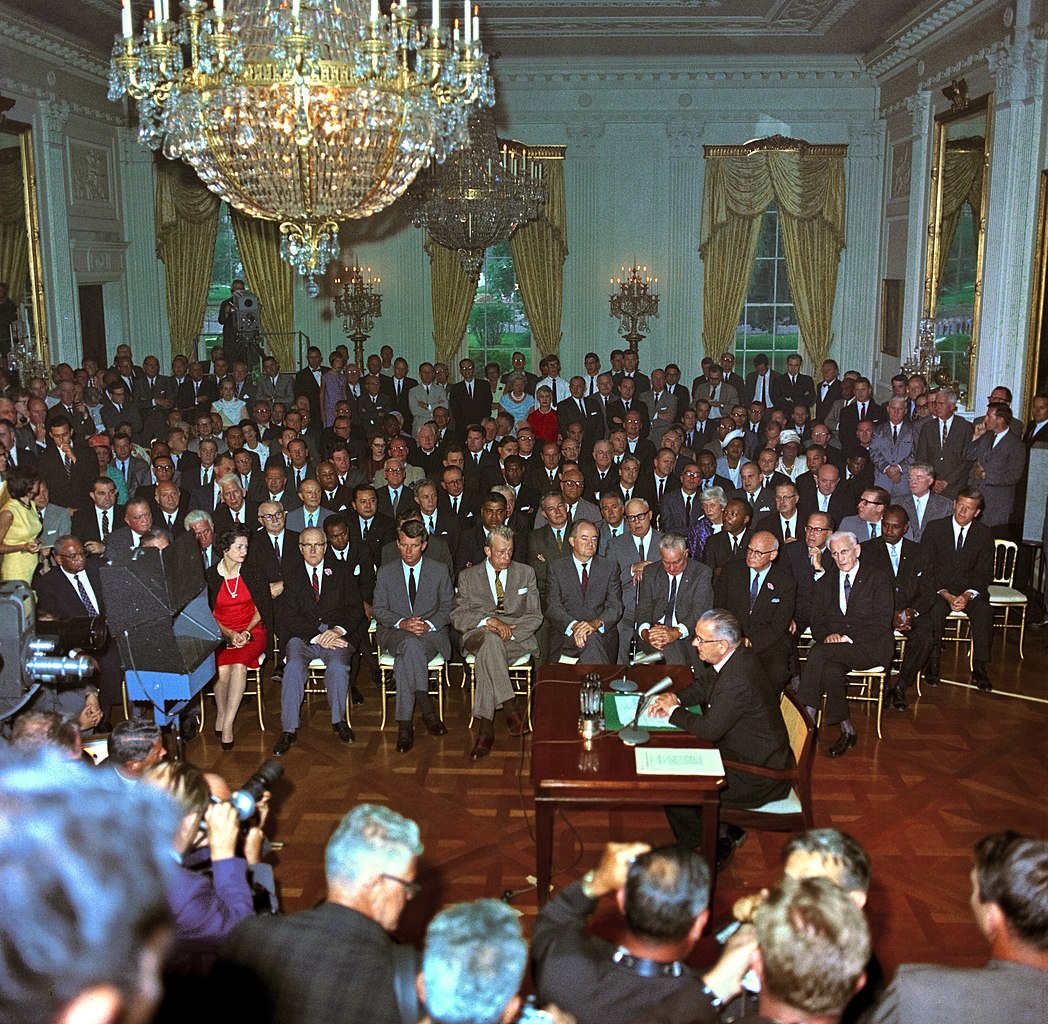
President Johnson addresses a nationwide television audience during his signing of the Civil Rights Act in the East Room of the White House, July 2, 1964. Among the dignitaries in the front row are Lady Bird Johnson, Attorney General Robert Kennedy, Vice President Hubert Humphrey, and Senator Barry Goldwater.
President Obama spoke on Thursday at the LBJ Library in Austin, commemorating the fiftieth anniversary of the passage of the Civil Rights Act of 1964, a great turning point in American history that was largely the result of President Lyndon Johnson's strenuous efforts to ensure that Congress passed the bill, which he signed on July 2, 1964. Notice what Obama says about gay Americans, and about the movement of history.
Just to refresh your memory, here's a mini-documentary about LBJ's work on the Civil Rights Act, which was an uphill battle all the way - this Wikipedia article gives details on the votes in the House and the Senate.
And a short study of Barry Goldwater's attitude towards civil rights - notice at the 1:28 mark, the sign held by white protesters in New Orleans, 1960: "God Demands Segregation." Sound familiar?
While we await this morning's Supreme Court hearing on the DOMA case, United States v. Windsor, here's some incidentally related things to refresh your mind with.
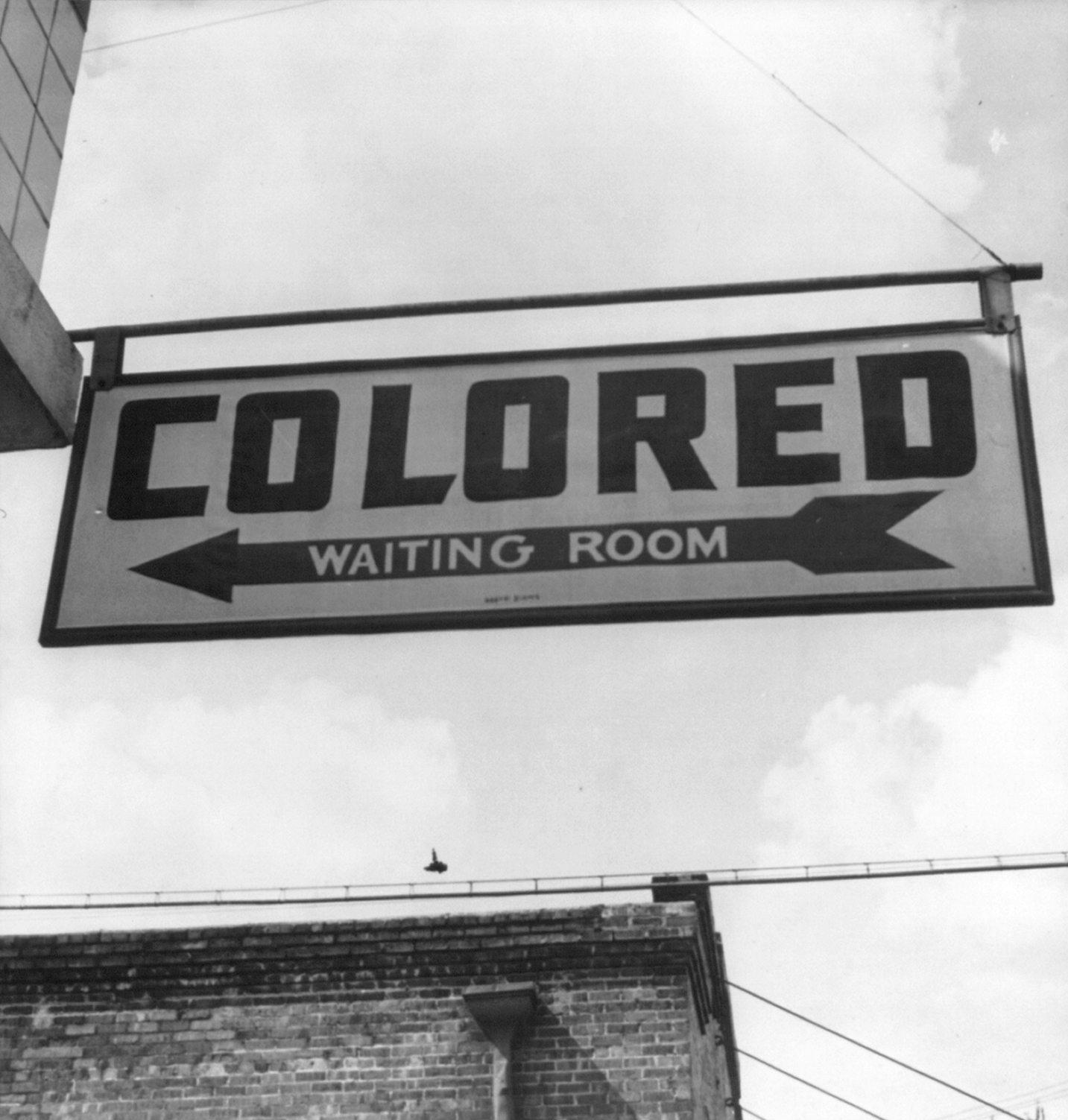
Your Head Trucker remembers seeing many signs like this one in the legally segregated South of his childhood. Little did he suspect that as a gay man, he would spend most of his adult life shoved aside in just such a waiting room.
Everyone has heard of the landmark Supreme Court ruling in Brown v. Board, 1954. But have you ever studied it? Do you know what pro and con arguments were used at that time about racial segregation, or what reasoning the Court used in ruling it unconstitutional? Just as we saw in yesterday's hearing on the Prop 8 case, the justices were not of one mind, and had to work their way through a swamp of legal and constitutional entanglements, and considerations of original intent of the Fourteenth Amendment about equal protection and due process, in order to reach a decision - so in that sense, Brown is highly relevant reading for us today. If you like, here's the Wikipedia article, with lots of links to primary sources, as well as the actual ruling of the court. And also revealing of the mixed mood of the times, read Governor Leroy Collins's courageous refusal to sign and remarks at the end of the Florida Legislature's Resolution of Interposition, 1957, which declared (unsuccessfully) the Supreme Court's desegration order "null, void and of no force or effect in Florida."
The more I think about Justice Alito's lame-brained demand for "scientific evidence" that gay marriage is not harmful to society, and Justice Scalia's assoholic demand to be told "when the Constitution changed" - the more my blood boils. But do read this sweet, cooling essay by a proud daughter: "What Makes a Family." Excerpt:
Two gay, Catholic Jesuit psychologists raising a multiracial daughter in San Francisco: it sounds like Hollywood’s next sitcom, but in many ways my life is just like yours. When the Supreme Court hears oral arguments next week on marriage equality, I want the country to know the love that exists in families like mine, and how my upbringing is in many ways an American success story. . . .
Check out the amusing video of a 1971 takeover of the New York City Marriage Bureau by the Gay Activist Alliance in "The Prehistory of Gay Marriage." Even the cops seem rather jolly when they arrive on the scene - by contrast, imagine the SWAT team that would respond today.
Much ink and many pixels have been employed recently over the oppostion of Chick-Fil-A's Chief Operating Officer, Dan Cathy, to marriage equality. The mayors of Boston, Chicago, and Washington, D. C., have called for the company to be banned from opening stores in their locales. But pardners, that just ain't the American way. Giddown off your high horse for a minute and give a listen to Kevin Naff in the Washington Blade:
It’s true that the bigots at Chick-fil-A are on the wrong side of history, but unfortunately so are HRC and the groups that support government retaliation against a citizen on the basis of his political views. Does the LGBT movement really want to find itself on the losing side of a debate over freedom of speech? Sure, criticize Cathy and his views. Organize boycotts and protests of the restaurants. And use this ugly episode to make the case for the federal Employment Non-Discrimination Act, because surely Cathy’s LGBT employees lack job security. But endorsing government attacks on a business over its president’s views — however offensive and wrong — is reckless and ignores our community’s long, painful history of being victimized by government officials. . . .
Members of the LGBT community ought to be the most aggressive in defending the freedom of speech. We continue to use it in powerful ways to advance our equality. To now applaud politicians who would deny business licenses to companies based on the political views of their owners might feel good, but are we so desperate for validation that we want to stoop to the ugly (and unconstitutional) practices of our opponents?
New York Mayor Michael Bloomberg got it right when he said, “trampling on the freedom to marry whoever you want is exactly the same as trampling on your freedom to open a store.” Dan Cathy deserves the right of free speech. He’s entitled to his views and welcome to spend his money funding our enemies. It’s ultimately a losing fight so his money is wasted. We should counter his message of hate and intolerance by pressing for justice. This controversy should be Exhibit A in the case for ENDA.
Let's think this through here, fellas. What is the purpose of a business? To sell a product or service to the public, and thereby make a profit for its owners. As long as the business pays its taxes, complies with the laws that prohibit selling shoddy or dangerous merchandise, as well as the laws regulating pay and treatment of its workers, you're good to go here in the U. S. of A., right?
There is no political or religious test for running a business. And do you really want to see that here, friends? The proprietor can be an atheist or a Holy Roller - a flaming liberal or a die-hard conservative - a member of PETA or the NRA. None of that matters a bit, nor how the proprietor votes or what he thinks about any issue of the day. Our government simply takes no notice of all these irrelevant things. Nor should it.
They don't ask to check your gay card when you walk up to the counter and order a scrumptious chicken sandwich and waffle fries, do they? Which is a treat your Head Trucker dearly loves - but I won't be eating any, anytime soon. That's also my privilege in this land of the free and home of the brave.
But frankly, this whole uproar is getting much more attention than it deserves - to reduce marriage equality, which means so much to so many, to a goddamn chicken sandwich is just so fucking 5th-grade that I don't know whether to laugh or cry.
So can the government - local, state, federal - take any action against a company run by a bigoted owner? Um, no. No more than the government can tell you what neighborhood you can or can't live in because of your political views, bucko, or where you can or can't buy your groceries. It's called freedom, ya know?
So Russ, you're asking me, does that mean the government can never touch a business that's behaving badly? Well, it can - when the business breaks a duly enacted law. It's called the rule of law, ya know?
Take a little walk with me back to the Civil Rights era of the 1960's, to a controversy involving another Atlanta-based outfit. The government did indeed step up to the plate then to prosecute businesses that broke the law - but it was because they violated the law, not because the owner shot off his mouth in one direction or another. That is always an American's privilege - yours and mine and even the buffoonish bigot, Lester Maddox, whose Pickrick Restaurant in Atlanta was smack-dab in the middle of a major civil rights confrontation back in 1964. From the New Georgia Encyclopedia:
Maddox refused to serve African American patrons. He kept ax handles--called "Pickrick drumsticks" near the restaurant's front door to discourage African Americans seeking to eat at the restaurant.
Following the passage of the 1964 Civil Rights Act, Maddox chased two African Americans away from the Pickrick at gunpoint. Maddox publicly announced he would go to jail before serving African Americans, even after being charged in court for pointing a gun at the men. On July 22 in a case against the Pickrick and the white-only Heart of Atlanta Motel, a federal court upheld the Civil Rights Act and issued an injunction beginning August 11 against both businesses prohibiting them from denying service to customers based on color or race. Lawyers appealed the case to the United States Supreme Court which heard the case in October; while waiting for the court to hear the case, the Heart of Atlanta began accepting African American customers, and Maddox closed the Pickrick on August 13.
On September 26 Maddox opened the Lester Maddox Cafeteria in the Pickrick's old location and announced he would serve "acceptable" Georgians. During a trial for contempt of court on September 29, Maddox argued that he was not in contempt because he was no longer offering service to out-of-state travelers or integrationists. In December 1964 the United States Supreme Court ruled in favor of the Civil Rights Act. On February 5, 1965 a federal court ruled Maddox was in contempt of court for failing to obey the injunction and ordered him fined two hundred dollars a day for failing to serve African Americans. Maddox closed the restaurant February 7, 1965 blaming president Johnson and communism for putting him out of business.
Maddox had to close his restaurant not, be it noted, for his opinions on race, but because he violated the law - though the notoriety got him elected Governor of the state of Georgia at the very next election. And so for four years, he was Bozo-in-Chief of the Peach State, until succeeded by Jimmy Carter in 1971.
Still, it's the rule of law that is the lesson here. White, black, gay, straight - everybody can speak their mind in these United States, even if it's the mind of a dipshit jackass. And if you don't agree with that, you don't deserve the freedom to speak yours.
Picket, protest, abstain, do whatever peaceful thing you want to do - but just remember: what goes around comes around, fellas. We may be gay, but we're Americans first.
Here's some clips of Lester at his asshole best, I thought you boys might get a chuckle out of them. The first is from 1964, when a few black activists tried to enter the Pickrick, and Maddox arrogantly turned them away:
Another clip is from 1968, when then-Governor Maddox was interviewed by Joe Pyne - forgotten now, he was a hard-hitting forerunner of Phil Donahue:
Bonus: The Rev. Baxter Wynn, of First Baptist Church of Greenville, South Carolina, and a nephew of Lester Maddox, compares his uncle with another Atlanta boy, Martin Luther King Jr., in this fascinating excerpt of a talk (I wish someone had posted the whole thing on YT):
A couple of new films your Head Trucker recommends.
The first one, I'm a little behind time on: it premiered Tuesday night on HBO. Using newly discovered archival footage, it brings to life the principals in the landmark case of Loving v. Virginia, which by a unanimous Supreme Court decision invalidated all remaining laws against interracial marriage in 1967.
The second one is a complete short film by Eliot London, and you will need a hanky for sure.
Support London's new feature-length film about a bullied gay teen here.
I've not commented recently on the whole DADT thing because it's all such a muddle, and now it's tossed salad between the courts and a lame-duck Congress and a dithering President. Who knows how or when it will ever get repealed.
I will say, and some of you may disagree, that it seems to me very improper for one District Court judge in California - who is very low on the totem pole, as federal judges go - to resolve the whole big debate by a singlehanded "worldwide" ruling. The reason being, guys, that the military is a special case for several very good reasons. And the Constitution makes the President the Commander-in-Chief, while Congress holds the purse strings. The Supreme Court, it seems to me, is the only body that can possibly have a say in the matter, so for constitutional reasons, I'm glad the appeals are headed that way.
Similarly, my love for my country requires me to sharply disagree with the notion proposed today by Adam Serwer today in the Washington Post blog The Plum Line, in an article entitled "On DADT, it's imperial presidency time," where he argues:
If Republicans continue to block DADT repeal from even coming to a vote, the president should take a page from Truman and end the policy through an executive order advising the military not to enforce the policy and cease defending it from challenges in court. The military's own empirical studies show allowing gays and lesbians to serve does not hurt military effectiveness, and the military's own policy of occasionally delaying DADT investigations of deployed troops confirms that finding. The military in Truman's time was deeply opposed to integration, and if he had waited for a favorable political climate to act desegregation might not have occurred for decades.
During the Bush years, liberals complained about his "imperial presidency," and so the idea that Obama should simply end the policy by fiat would seem hypocritical. But the use of an executive order to end a policy a majority of Americans, including conservatives, want to end, is no more undemocratic than Republicans' use of procedural maneuvers to thwart an up or down vote. Republicans holding the legislative process, and the fundamental rights of gay and lesbian servicemembers, hostage to their own homophobic prejudices, would still be the greater act of tyranny.
This is an extremely short-sighted view, and a very, very dangerous one. Guys - think about it. No matter how hurt, disappointed, or outraged we may feel at this moment over the delay in repealing DADT, you really don't want to live in a banana republic where the Congress passes laws that the President of the day simply ignores at will.
Nor do you want government-by-opinion-poll. Just think about that. Serwer's proposal would throw the entire Consitutional system of checks and balances into the toilet, and set an incredibly dangerous precedent for future presidents. Some of whom will be Republican. Or worse. We do not want a system where the President just does whatever the hell he pleases, when he pleases. Do you understand?
The glory of our nation is that we live under the rule of law, not of men. That rule was already stretched nearly to the breaking point by the last President. Let's not go backwards, fellas. You want to make rules for others to live by? Well then, knucklehead, you have to live by the rules and play by the rules yourself. Didn't you learn that on the playground in first grade?
Also, you need to understand, as I've blogged about before, that Truman did notwave a magic wand and zap! integrate the military overnight, with everybody loving up on everybody else and saying ain't it wonderful. It took more than ten years, from the first surveys of troop attitudes during World War II to the removal of all segregated facilities on military bases. If you want to be truly informed - and therefore, worth listening to on this subject - go read the timeline of military desegregation at the Truman Presidential Library website.
Also, you should understand that when Truman issued his executive order, Congress had never passed a law requiring the armed forces to be segregated; it was merely longstanding policy. The difference today is that Congress did pass a law, DADT, which makes it a different ballgame. Yes, the Supreme Court ought to rule that DADT is totally unconstitutional - but we just aren't there yet.
Dr. Gregory Herek, psychology professor at UC-Davis, has an excellent web site with many valuable links pertaining to DADT. Also, after noting the somewhat reluctant use of black troops from the Revolutionary War to World War I, Herek explains (emphasis mine):
At the beginning of World War II, as in the past, personnel needs dictated that Black recruits be accepted for military service. Once again, Black enlisted personnel were segregated from Whites – usually led by Black officers – and placed in support roles. As the war effort progressed, however, the Navy experimented with integration of enlisted personnel, which was less expensive than maintaining combat-ready segregated units. By the War’s end, more than one million African-Americans served efficiently in various service branches. Inter-racial conflict did not appear to be a problem in combat zones, although some tensions were reported in rear areas. As Stouffer and his colleagues concluded in their social scientific study of the American soldier, events in World War II demonstrated that Blacks were effective fighters and that racial integration in the military would not compromise unit effectiveness.
Nevertheless, racial segregation remained official government policy until President Harry Truman's historic Executive Order 9981, issued a few months before the 1948 election, which "declared to be the policy of the President that there shall be equality of treatment and opportunity for all persons in the armed services without regard to race, color, religion, or national origin." Following this order, the armed forces began to institute a policy of racial desegregation. Desegregation proceeded slowly, however, and met with resistance.
Most civilians and military personnel opposed racial integration. One month before President Truman's Executive Order, a Gallup poll showed that 63% of American adults endorsed the separation of Blacks and Whites in the military; only 26% supported integration. A 1949 survey of white Army personnel revealed that 32% completely opposed racial integration in any form, and 61% opposed integration if it meant that Whites and Blacks would share sleeping quarters and mess halls. However, 68% of white soldiers were willing to have Blacks and Whites work together, provided they didn't share barracks or mess facilities.
As the 1993 RAND report noted,
"Many white Americans (especially Southerners) responded with visceral revulsion to the idea of close physical contact with blacks. Many also perceived racial integration as a profound affront to their sense of social order. Blacks, for their part, often harbored deep mistrust of whites and great sensitivity to any language or actions that might be construed as racial discrimination" (National Defense Research Institute, 1993, p. 160).
As in past wars, the Korean conflict created a shortage of personnel and Black Americans helped to fill this need. Because of troop shortages and the high costs of maintaining racially segregated facilities, integration rapidly became a reality. In 1951, integration of the Army was boosted by the findings from a study of the impact of desegregation on unit effectiveness of troops deployed in Korea. The researchers concluded that racial integration had not impaired task performance or unit effectiveness, that cooperation in integrated units was equal or superior to that of all-White units, and that serving with Blacks appeared to make White soldiers more accepting of integration. By the end of the Korean conflict [1953], the Department of Defense (DOD) had eliminated all racially segregated units and living quarters.
Igor Volsky at the Wonk Room has transcribed some surveys done by the American military from 1942 to 1945, which reveal how widespread and unpopular the idea of racial integration was among enlisted men and officers:
These surveys show that the same attitude pervaded the military: 3/4 Air Force men favored separate training schools, combat, and ground crews and 85% of white soldiers thought it was a good idea to have separate service clubs in army camps . . .
While smaller, these racial polls share some common questions with the DADT survey. In fact, in some instances one can even replace “negro” for “gay” and end up with today’s questionnaire. Both polls ask servicemembers if they objected to working alongside minorities, how they felt serving with minorities, how effective minorities are in combat and if their feelings have changed about the minority after serving with them. (Interestingly, 77% of respondents said they had more favorable opinion).
Truman integrated the forces despite the objections of the troops and it remains to be seen if Gates, Chairman of the Joint Chiefs of Staff Mike Mullen and President Obama (who have to sign off on the DOD study) are willing to do the same for Don’t Ask, Don’t Tell.
The surveys make interesting reading; good stuff to know if you get into a conversation about DADT. Here's the transcript of what Volsky found:
Bottom line: Fight hard, fight fair, but it's important to play by the rules, and to expect a period of adjustment even after DADT is repealed - which it will be one day, please God. But nobody and nothing is going to make it all happen peachy-keen overnight.
And you absolutely do not want a fucking dictatorship where that could happen. Think it over, guys. The rule of law, checks and balances, constitutional government: gay or straight, white or black, male or female, our first allegiance must be to all those those things that make our country what it is, and will in time make it what it should be.
Without them, America would not be worth living in. Without them, we would be the Evil Empire of the world. I don't want to go there, do you?
Update:Kevin Drum at Mother Jones via Andrew Sullivan:
Let's face it: if you pick your jurisdiction right you can probably find a district court judge to rule just about anything unconstitutional. It would be easy, for example, to find a district court judge somewhere to say that the healthcare reform law was unconstitutional. If this happened in 2013 and President Palin decided not to appeal the ruling, thus overturning the law, what would we think of this? Not much, and rightfully so. A district court judgment is just flatly not sufficient reason to overturn an act of Congress.
On Wednesday, unless there is an order from the United States Court of Appeals for the Ninth Circuit, gay and lesbian couples in California once again will be able to marry. Like other couples around the world, they will be able to pledge to support each other, buy some dishes, raise families, argue about the bills, maybe sit on a park bench years from now and chuckle at the hysterical old claims that their lives together would destroy the institution of marriage. . . .
Because of Judge Walker’s firmly reasoned and occasionally soaring decision earlier this month, there was no reason to continue the prohibition. After a full-blown trial that gave opponents every opportunity to prove the harm caused by same-sex marriage, the court found that it caused no harm whatsoever to the state or society. But substantial harm was caused to gay and lesbian couples by depriving them of their constitutional rights.
There already are 18,000 same-sex couples in the state who were married before Proposition 8 was passed, and their presence does not seem to have damaged relationships between men and women. The State of California filed a brief with the court urging that marriages be allowed to resume immediately, making it clear that it would impose no burden and would, in fact, serve the public interest. . . .
But even if Judge Walker’s ruling stands in California, it would be a shame if the case stopped there. Only through appeals, first at the Ninth Circuit and, ultimately, the Supreme Court, is there a chance that the principles set down by Judge Walker will apply to the entire country. Yes, there is the possibility that the judgment could be struck down, but it is sometimes necessary to take big risks to get important results, as the lawyers behind this lawsuit have demonstrated. If same-sex couples in California have the constitutional right to be part of the mainstream of society, then so should every couple in America.
Well, there you go. The New York Times says gays should be able to marry anywhere in the country. Another breathtaking development for this old coot, who remembers that for many years, this very paper refused to use the word "gay" in its pages, clinging to "homosexual" instead, well into the 1990's, I think.
It does seem more and more that educated straight people on both coasts - where the national mindset is ultimately rooted - are swinging solidly in support of equal marriage. A big, big change. Which is as yet completely invisible here in small-town Texas, except that I do hear, or hear of, the younger generation - under 25 - being on the whole much more accepting of gays and lesbians in their midst than I ever thought possible.
However, I realize that not everyone up there in the blue-state wonderland supports equal marriage. Contrast the NYT's stand with this excerpt from a recent Chicago Tribune editorial:
Judge Vaughn Walker did a thorough job of making the case that same-sex marriage would advance the same purposes the state has in sanctioning heterosexual marriage, such as "creating stable households," "legitimizing children" and "assigning individuals to care for one another." He cited plenty of evidence to indicate that fears of unwanted effects, such as undermining heterosexual marriage, are unfounded.
What he didn't do was refute the argument of a California Supreme Court justice, who in 2008 said no court has "the right to erase, then recast, the age-old definition of marriage, as virtually all societies have understood it, in order to satisfy its own contemporary notions of equality and justice."
This federal judge insists that "the withholding of the designation 'marriage' significantly disadvantages" same-sex couples. In fact, the disadvantage is symbolic — and the nation has not had enough experience with civil unions to establish whether they will someday acquire the same cultural status as marriage.
This ruling, of course, will stand only if it is upheld by the U.S. Supreme Court, which would be a drastic and highly controversial step. But the justices might seize on the same middle option used by several states — civil unions. The court could rule that equal protection requires giving gay couples the same prerogatives granted heterosexual couples, but not by the same name.
That course offers a compromise that, while satisfying neither side entirely, accommodates each in its central concern. It would show a respect for democracy and a humility about the role of the judiciary.
It would accord with prevailing opinion: In a recent Washington Post-ABC News poll, two out of every three Americans favored providing civil unions for same-sex couples. It also would preserve the right of states to enact same-sex marriage if they choose.
So the Trib says A) judges should not strike down any laws that discriminate against a class of people, because they are judges, not legislators - and B) every state has the right to discriminate against any group in its territory if the majority feels like it - and C) give the homos "civil unions" to shut them up, but don't you dare use the M-word. (But if it's merely a symbolic difference, why the hell not, exactly? Answer: because homos are different from straights, meaning not as good as.)
Well, boys, you can see as well as I can there are several problems with this line of argument. It's the whole separate-but-equal talk I remember so well from my childhood in the legally segregated South, with its separate schools, restrooms, water fountains, etc. (And fellas, trust me because I was there: all those things reserved for blacks were definitely not equal to the accomodations provided for whites.) But let me remark on just one point here: will civil unions someday acquire the "same cultural status as marriage"?
Hecklers pour sugar, condiments, and water over sit-in protesters at a lunch counter in Jackson, Mississippi, 1963. Notice that the protesters are practicing nonviolent resistance, as Dr. King advocated.
Jeezus. People who didn't pass high school American History really should not be allowed to run for public office. Notice how this fuckweasel consistently avoids answering Rachel's direct questions about his real view on segregation:
What I Say: Boys, I was there in the segregated South, and when I close my eyes I can see it all again just plain as day. Hotels, movie theaters, restaurants, cafes, railroad stations, bus stations, gas stations, barrooms - all those private businesses were strictly segregated, often with separate restrooms for "Colored" and "White" and separate entrances - or, as in the case of hotels and motels, including the major chains like Holiday Inn and Howard Johnson's, simply did not take any black customers at all.
I well recall that every place that served food - even down to the corner hot-dog stand or ice-cream parlor - had a sign prominently displayed behind the counter:
We Reserve the Right to Refuse Service to Anyone.
As a kid, waiting to be served or to pay for my hamburger, I often studied that sign and pondered what it meant. Now I know: "We Don't Serve Blacks" is the translation.
True, it was all required by law; but that law was the express will of the vast, overwhelming majority of white citizens of the South, too. Even if the segregation laws had all been rescinded, I promise you that all those businesses would have kept the signs and policies in place - as a "business necessity," because white people, like my own family, I am sad to say, simply would not have patronized them otherwise - unless there was a positive law forbidding private businesses from discriminating, which is part of what the Civil Rights Act achieved.
And that is the America that dumbshit racist assholes like Rand Paul want to take us back to. No thank you. Here's a couple of clips to give you a little hint of what life was like under the segregation regime - imposed not arbitrarily by "big government," but directly at the hands of the white majority:
A story I stumbled upon this morning over at Culture Choc: in 1946 Viola Desmond, a black Nova Scotia businesswoman, was forcibly dragged out of a movie theater by police for sitting in the downstairs "whites only" section (rather than the "colored" balcony), spent the night in jail, and was ultimately convicted of tax evasion for - get this - not paying the extra one cent sales tax for the downstairs seat, and fined $20 plus costs. Even though she'd offered to pay the extra charge, but the theater manager refused, telling her he couldn't sell a ticket to "you people."
I never knew before now that Canada had any kind of racial segregation in that period, but it just goes to show that racism is definitely not unique to the South, or to the United States.
Last Thursday, however, the Premier of Nova Scotia apologized on behalf of the province at a ceremony honoring Desmond - who died in 1965 - and representing the Queen of Canada, the Lieutenant Governor, herself a black woman, signed a free pardon for the wrongful conviction. Good deal. Story and video here and here. Viola's 83-year-old sister, Wanda, was present to receive the honors accorded her late sister.
Sometimes you may think your one tiny act of courage or decency is too small, too obscure, to be remembered or make any difference in the universe. But you never can tell what the ultimate effect of doing the right thing will be, even if it comes many years after you've gone to dust.
Your Head Trucker once had the privilege to get a glimpse of a great civil rights champion whose name ought to be more famous than it is: Virginia Foster Durr.
Back in the mid-1980's when I was dating a smart, sexy redheaded guy in Montgomery, we went to the Alabama Shakespeare Festival a few times to catch some plays. On one of those occasions, as we were walking through the parking lot towards the theater building, he nudged me and said, "Look, that's Virginia Durr." I turned and saw a very small, white-haired lady conversing animatedly with a friend as they strolled up to the entrance.
No, I didn't go say hello or ask for an autograph or anything; I'm not that pushy. Still, it was a memorable moment actually to see someone who, with her attorney husband, had figured so prominently in the civil rights struggle in Alabama. Among other things, they are the ones who went and bailed Rosa Parks out of jail after her famous refusal to move to the back of the bus in 1955, and he represented her in court.
Well, while sitting here tonight waiting for my supper to cook, I was surfing around here and there, and came across the wonderful oral history interview she gave in 1975, now available through the awesome Documenting the American South online history collection from the University of North Carolina. Tons of great reading there, if you like history. Lots of stuff that ought to be required reading in school.
In particular, the extensive Durr interview is fascinating, and I hope some of my truckbuddies will dip into it. Here I want to present just a little excerpt that illustrates what I was saying in my post the other day about how white Southerners felt about the blacks in their midst. This excerpt and its continuation are about an incident in 1910, when Durr was a girl of 7, living on her wealthy grandmother's plantation in rural Alabama; but the racial attitudes illustrated by the story were still very much in operation fifty years later, when I was coming up. Notice the part about venereal disease, which is something I was told, too, in all seriousness.
This time, I was seven years old and I was going to school the next fall. I always had my birthday in the back yard with the black children and we would have barbeque and they would let us barbeque over a little pit that they would dig for us. So, this time, my mother and grandmother and aunts and all said that I had to have it in the front yard and with just the white children, no black children could come to the party. Well, I got very angry about that and the main thing was that I wanted the barbeque. (laughter) You see, they would dig a pit in the back yard, which was sandy, and then the cook would give us chickens and we would build a grill over the hole and build a fire and then we were allowed to baste the chickens and turn them over and of course, by the time that we got through, they were full of sand, but to me, (this had been my usual birthday party) and to me, this was a great event. Here I was presiding over the chickens, you know. Well, anyway, I had a tantrum at breakfast and made strong protest about the party in the afternoon and no barbeque. So, they agreed that I could have the barbeque in the morning and the party in the afternoon. This was the compromise that they reached. . . .
Well, Elizabeth, Aunt May's daughter was there and Aunt May would bring a French maid with her when she came, if you can imagine. You can imagine how happy the French maid was. (laughter) Aunt May, as you could say, really put on airs. Anyway, Elizabeth was always dressed up in these beautiful dresses with sashes and everything matching and her hair curled . . . .
She was a little older than I was, about my sister's age. So, we had the barbeque and everything was going on fine and we were dividing up the chicken and one of the little black girls was tearing up the chicken and she offered a piece to Elizabeth and Elizabeth, who must have felt like an outcast in this group anyway, she all of a sudden said, "Don't you give me any chicken out of that black hand of yours. I'm not going to eat any chicken that your black hand has touched, you little nigger." . . .
African-American and white soldiers at a base in Italy during World War II.
Today there's supposed to be some further news from the Defense Department on Don't Ask, Don't Tell. Some blogs and news sources are already reporting what they think will or won't be said.
Whatever the case may be, don't expect anything to change overnight. It always takes time. To illustrate the point, look at this timeline from the Truman Library, which shows how long it took from Truman's 1948 executive order until the military was fully integrated.
And note also the many committees, reports, studies, and recommendations the military put itself through along the way . . . as well as the foot-dragging and bellyaching and protestations that the military was "not an instrument for social evolution" (Secretary of the Army Kenneth Royall, 1949). Notice also the fulminating reaction in Congress:
[T]his proposed program would adversely affect the rights, privileges, and freedom of the people of all sections and of all walks of life in this country. It stabs at the very heart of the rights and freedom of all races, colors, and sections of our great country. For, if the Federal Government can repeal the poll tax in Mississippi and several other Southern States, regulate employment under the FEPC, punish innocent taxpayers under the Anti-Lynch Bill, and abolish segregation in the several States by usurpation of the sovereign rights of the several States of the Union, then we have indeed witnessed an end of constitutional government as conceived by the founding fathers. . . .
Is it any wonder then, Mr. Speaker, that a revolt has arisen all over our country, from Mississippi on the shores of the Gulf-kissed coast in the South to the stony crags of Maine in the North, and from the Atlantic to the Pacific Oceans, by southern Democrats and those freedom-loving Americans everywhere, at this attempt to destroy the true civil rights of the citizens of our great and common country? . . .
But now, for the first time in the history of the country, and the loyalty of my section to the Democratic Party, a President of the United States has asked the Congress to enact such a devastating, obnoxious, and repugnant program to the people of that section and their Jeffersonian conception of democracy as this so-called civil-rights program. No President, either Democrat or Republican, has ever seen fit heretofore to make such recommendations. . . .
"Freedom-loving Americans." Right. Doesn't the tone of those remarks sound awfully familiar? Can you say teabagger?
So you see, the decades roll on, but some attitudes just stay the same - only the names are changed.
One more thing I want to mention: some people who want to keep gays out of the military talk about their disgust at the idea of straight boys having to take showers with gay ones, and all such as that; as if that's the most repellent idea ever, something no decent (heterosexual) male should ever have to be subjected to.
What some of my Yankee truckbuddies may or may not understand - something that is practically forgotten nowadays - is that white Southerners felt an equally strong aversion to fraternizing with blacks. Speaking from my own personal knowledge and experience growing up in that legally segregated world, a great many white Southerners had an inward feeling - completely irrational, of course, but a strong one - that "Negroes" were somehow simply dirty, if not diseased, and therefore close contact was to be avoided - for example, eating together, or riding public transportation together. Whites in that time and place felt contaminated by that kind of contact - physically so.
Which is utterly ridiculous - no, asinine - when you realize that they had not a shadow of hesitation about eating anything dished up by black cooks in the kitchen - either at home, or in a restaurant - and served to them by black waiters. No, that never troubled anyone's mind for a second, not a bit.
You see how people are?
But to have a black person sitting at your elbow, eating off a plate next to your own - that was a horrifying thing, as much so as socializing with a typhoid carrier. Plenty of people - including my own dear, kind, intelligent, college-graduate parents, I'm sorry to say - believed that "all black people have syphillis" or some such nonsense. But even if you didn't think about veneral disease, still, as an ordinary Southerner, you usually felt the need to keep your distance from black people in certain public activities.
I bring this up just to make the point: no matter how the straight boys and girls foam on now about how awful it would be to shower with teh gayz, et cetera - and how amusing that attitude is, because it's a fact they've been showering with us all these years anyway, without knowing, right? - no matter how they carry on right now, it is a reaction that they can and will get over.
No one in the South now thinks anything about eating in a restaurant with blacks, or riding the bus with them, or sleeping in a motel bed a black person might have slept in the night before - or all the hundred-and-one other things that would have completely horrified white people down here, fifty years ago and more. It's simply not an issue now, even if some other racist attitudes still linger.
And the homophobes of today will get over it too. Once the laws are changed and enforced, attitudes will follow. Just realize that, as with desegregation of the services, the process of dismantling DADT will probably take a few years, no matter what the President and the military chiefs say or do this week. And just like with the Dixiecrats of 1948, there will be thunder and lightning in Congress too, no doubt - but it will all work itself out eventually, I'm sure. Just not overnight.
Sullivan quotes from a letter written by a fellow Texan to President Johnson just two days after President Kennedy's assassination - of which today is the 46th anniversary (emphasis mine):
There is a virus of disrespect and hate spreading here very rapidly. And unless one lives right here with it, day in and day out, it is unbelievable how quickly and subtly it infects reasonably intelligent persons. This is not too hard to understand only if one recognizes the unremitting, deep, bitter religious and racial prejudice existing today in this section of our land — I don’t know if any of them are similarly infected in other sections, but I know personally of what I speak as regards East Texas.
In fact, although nearly every one indignantly denies having any racial or religious prejudice to the point where he deceives even himself in this matter, after listening seriously to protestations of horror and shock one can almost hear a collective sigh in essence, "Too bad he had to die but after all a Catholic is no longer in the White House and this ought to set the 'niggers' back on their heels for awhile!" It is painful to some of us I know to give credence to such a condition so we blind ourselves and blame a mentally confused person — forgetting in our desire to remove the blame from ourselves that where religious and racial prejudice prevails, not just the killer but all are mentally confused.
The first sentence of the second paragraph confirms what I've been telling you boys in my posts about the segregated South I grew up in: millions of otherwise decent, respectable people - my own family, for example - were in serious denial about their prejudice and its roots in hatred. And completely unwilling to examine their thinking or their behavior. In fact, that, you might say, is the history of the South: ever since the first slaves were brought to Jamestown about 1614, the long, long windings of the dark river, the tragic story of master and slave, us versus them.
If it had been left up to a popular vote in the Southern states in the 1960's, not a single one of them would have passed civil rights laws, and especially interracial marriage. I guarantee you. I'm not sure those things would ever have been passed at the ballot box down to this very day.
Yet this same Southern land is the most religious in the country, speckled with churches, piled up with Bibles. So proud to be Christians and Americans.
The human ability to deceive oneself, to ignore one's true motives, is powerful: and that is where the human capacity for evil begins.
At the 1:45 mark, note the coffee and catsup thrown
on the sit-in protesters by the nice white people.
And the unresisting, nonviolent response.
Some of you younger folks do not remember a world where the races were legally segregated. I do. Here's one video that shows some scenes from that day and time, to bring to mind exactly what Dr. King and all the civil rights activists were fighting for: an end to the blind, unreasoning, hateful, hate-filled attitudes that were deeply held, cherished, by millions and millions of people here in the South - and sponsored, promoted, fanned into flame by not a few churches.
All this was in my lifetime. And I'm not anywhere near ready for the rocking chair yet, boys. I remember those days vividly. There were no civil rights protests in the town where I lived, not that I ever remember hearing about - but I have only to close my eyes, and I see again very clearly all the separate water fountains, entrances, restrooms, schools, libraries, hospitals, the signs everywhere: White. Colored.
And all this seemed perfectly normal and natural when you grew up in it. Just part of the ordinary course of the universe, The Way Things Are. All the grown-ups thought it was just fine. Indeed, they all bristled at the suggestions that rippled into this whites-only world from time to time, that things should be any different. Impossible; the world would come to an end if that happened.
Because of course they had been taught by their parents - and their teachers and their preachers - that this was the only right way things could be. The Bible said so.
The Bible also clearly proved that Negroes, or to be polite, colored people were inferior beings. Doomed by the long-ago curse of God to be forever servants to their white "brethren." You could look it up. Preachers were fond of looking it up for you, and declaiming loudly that this was God's firm, immutable law. Who could argue with God?
And so you simply grow up accepting it all as a truth, as sure as the sun rising in the east, and the moon and stars coming out at night, Captain Kangaroo and cornflakes for breakfast. Just the Way Things Are. And so you naturally see blacks as not merely different - but inferior. Ugly. Bad. Nasty. You didn't call it hate, oh no. You would deny all day long that you hated them. That wouldn't be Christian.
But you would never, ever allow that they were equal to you. Oh no. Impossible.
Not when even your own dear parents - college graduates, professionals, intelligent, kind, caring, wonderful - told you as a certain truth that all black people have syphillis. Which is why they simply couldn't be allowed to use the same restrooms, you see. Or when they repeated the horrible tales about how the blacks ate one another on the Selma March - all black people were of course just one step away from being the cannibals they really were at heart. Which is why they simply couldn't be allowed to vote, you see.
And of course, even though there was always a colored maid, sometimes two, in your house who kept the place sparkling, Negroes were just simply dirty people. Look at the run-down shacks they lived in, the unpaved dirt streets! So of course they simply couldn't be allowed to live in nice, clean white neighborhoods. They would only trash whatever they got, and then all the property values would go down.
Besides, you wouldn't want to live next door to people who smelled. That musk, you know. And oh good heavens, the very idea of little black boys and girls in school next to my child; quite unacceptable, regardless of what any silly judge might say about it. They have their own schools, plenty good enough for them, let them stay over there.
But your parents didn't hate the Negroes either. They never spat on anybody, never called anyone names in public. They were always polite to the maids and the handyman, they helped them out when they were in trouble, stopped to give little old colored ladies a ride to downtown. In fact, they cautioned you most severely as a little boy never, ever to refer to any of them as "black" in their hearing - that would be very rude. You were taught to be polite to everyone, and say "colored."
Nigger, of course, was a word never used in public. Except sometimes, in a casual way, by your grandparents, but they were very old and had different rules. You and your parents only used that word at home. Or with your playmates after school. Eenie, meenie, minie, moe, catch a . . . . Which was quite a funny thing to say, if you thought about it.
Oh no, it was not hatred.
But a thorn by any other name hurts just as much. It tears and rips at the soul. It keeps you at the back of the bus, and the bottom of the list.
The black experience and the gay experience are not the same thing, no.
But the experience of being hated and despised for simply existing and being who you are is very much the same.
- A minority community is upset with the Mormon church. - The Mormon Church "severely opposes" one certain kind of marriage. - The Mormon church fails to see why people are upset with them. - Despite their clearly unfair actions, the Mormon church denies any bias
That is the simplified story of 2008's gay-Mormon debate. As you will see from this AP report, these exact same bullet points were also in play way back in 1969 (click to enlarge):
I'm in favor of religious tolerance and a decent respect for others' beliefs. But frankly, the Mormon history of blatant, "divinely authorized" racism makes me want to throw up. Here's a link to the very well-documented Wikipedia article on "Blacks and the Church of Jesus Christ of Latter-Day Saints" for those of you who want to get the scoop on this. It ought to be required reading at this time of Prop 8 protests.
I also realize the parallels that could be made with other Christian churches on the issue of civil rights, slavery, and other racial beliefs like the Curse of Cain and the Curse of Ham, which I remember hearing freely and zealously preached as the God-given justification for the separation of the races - and the subjugation of the black race, in particular - during my childhood in the segregated South. It's God's will!
Which is why I am so sick of hearing, "The Bible says . . . ". So much of that Bible talk is just the wish-fulfillment of straight white men holding on to power and domination - and, letthe truth be said, of straight white women who like it that way. Men talking, not God. See Richard Rodriguez' comments on the "male God of the desert religions" in an earlier post here.
The Mormon leadership got zapped by a revelation direct from God himself on June 1, 1978, saying blacks were just OK with Him. How nice of God to phone in like that. I wonder when the LDS Church will get another convenient "revelation," this time about the gays, hmm?
Lord, make me an instrument of your peace. Where there is hatred, let me sow love; where there is injury, pardon; where there is discord, harmony; where there is doubt, faith; where there is despair, hope; where there is darkness, light; where there is sadness, joy. Grant that I may seek not so much to be consoled as to console; to be understood as to understand; to be loved as to love. For it is in giving that we receive; it is in pardoning that we are pardoned; and it is in dying that we are born to eternal life. Amen.
.
We cannot all do great things, but we can do small things with great love.
and welcome to the Blue Truck, a blog for mature gay men with news and views on gay rights, history, art, humor, and whatever comes to mind. Plus a few hot men. The truck's all washed and gassed up, so hop in buddy, let's go.
CAUTION: For mature gay men only beyond this point. Some posts and links may not be suitable for children or the unco guid. You have been warned.
Insert valid picture ID with date of birth now, or click here.
My Story
click photograph to read
Churches say that the expression of love in a heterosexual monogamous relationship includes the physical, the touching, embracing, kissing, the genital act - the totality of our love makes each of us grow to become increasingly godlike and compassionate. If this is so for the heterosexual, what earthly reason have we to say that it is not the case with the homosexual?
It is a perversion if you say to me that a person chooses to be homosexual. You must be crazy to choose a way of life that exposes you to a kind of hatred. It's like saying you choose to be black in a race-infected society.
If God, as they say, is homophobic, I wouldn't worship that God.