C I V I L    M A R R I A G E    I S    A    C I V I L    R I G H T.

A N D N O W I T ' S T H E L A W O F T H E L A N D.


Showing posts with label gay history. Show all posts

Wednesday, July 29, 2026

Exploring Gay HIstory at the Smithsonian

Fascinating artifacts from the the Smithsonian Institution trace the stories of gay Americans, famous and obscure, from the 1800s till today in this 2024 documentary.  It's fairly good, though as is so often the case with such broad summaries, it sometimes glamorizes and dramatizes a bit more than is necessary - but worth watching anyway.  

We've come a long way, baby; I just hope I don't live to see the pendulum swing back the other way.  But it can and does sometimes, as history has shown many times in many places.  

It bugs me when people talk about being on "the right side of history" - that's a misnomer.  What they really mean is the right side of the future; but the future is unknown and unknowable.  It hasn't happened yet.  And there are no guarantees in this universe.

All we can ever know for sure is this little stepping-stone of time we live in - the present.  So make the best of it.

-----

Wednesday, July 8, 2026

Fifty Years Ago: Bay Gays, 1976

A compilation of news reports on the burgeoning "homosexual community" in San Francisco, in the freewheeling carnival days before Harvey Milk, before the riots, before AIDS and all that.  I was still in the closet, and though I knew I was gay I didn't feel any kinship with the screaming queens out there.  The two quiet, polite, monogamous guys interviewed in the first clip here were more my speed, and still are.  But San Francisco was in the vanguard of the gay rights movement, which has benefited us all from coast to coast.  

BTW, David Goodstein, who appears in the first clip, was owner and publisher of The Advocate, which I later subscribed to for several years.

-----

Wednesday, July 1, 2026

How Far We've Come

Celebrating a new America -lovewins 58242 (18588276403)
The White House after the Obergefell ruling, June 26, 2015.
Click to enlarge.

As we approach the 250th anniversary of American independence - founded explicitly upon the ideals of life, liberty, and the pursuit of happiness - it is quite poignant for me to reflect upon the evolution of gay rights in my lifetime.  Here are some thought-provoking videos for old and young alike.

Here's Steve Hartman on CBS Sunday Morning in 2015, just after the Supreme Court legalized gay marriage throughout the United States:


But CBS wasn't always so gay-friendly. Author and lecturer Steven Capsuto reviews two CBS News specials from 1967 and 1980:


In case you've never seen it, here is the full 1967 report, The Homosexuals, hosted by Mike Wallace (who later regretted the homophobic remarks he made at the time):


I was in high school then and never saw that report, which is just as well. I had fooled around with some boys my own age, but for many years to come, I still envisioned growing up and getting married to a woman one day - with the cozy cottage, the picket fence, the 2.5 kids - that happily-ever-after presented in books and movies and TV shows, not to mention the Bible.  Why wouldn't you want that?  That's just what grown-ups did, like your parents and grandparents, aunts and uncles, and everyone else in your church and your neighborhood.  A desirable, and indeed necessary outcome for most of the human race.

But some of us are not called to that conclusion.  I didn't know I was gay in 1967 - "gay" meaning homosexual was not part of everyday speech until the Gay Liberation marches and protests in 1970 and thereafter made national news. And I certainly didn't think of myself as a homo or a queer - those awful monsters who lurked in dark alleys that everyone hated - but no one ever saw in the light of day. Mainly they were just schoolard taunts. 

But the awful, unwelcome truth dawned on me before I finished high school, and I spent most of the next decade trying to pray it away.  By 1980, though, I had come out at college, and after Woodstock, Vietnam, and Watergate - not to mention Deep Throat, Playgirl and Barbara Eden's navel - the big-city world had changed a great deal. News coverage of Gay Lib - later Gay Pride - made people aware of things they never knew existed before, and gay people far from the east and west coasts began to come out and find one another - but changes in traditional attitudes in the Deep South were still small and slow. 

It was nothing at all like San Francisco - which from this late date appears as a carnival of the doomed, as shown in this report, Gay Power, Gay Politics:


Still to come were the AIDS crisis, ACT UP, and the Quilt; and beyond that, the long struggles in the courts and legislatures to gain the right to hold a job, join the military, and get married.  I'll be posting more historical videos and links this month that may touch on those subjects and others.

Those who cannot remember the past are condemned to repeat it.

--George Santayana

-----

Wednesday, January 7, 2026

Gay History in the Smithsonian Archives

Filmed in 2024, this video presents memorabilia of gay life in America before and after Stonewall.  Quite poignant.

-----

Thursday, April 3, 2025

The History of Homosexuality, Part 4

Sir Noel Malcolm concludes his lecture series with a discussion of gay life in the Age of Enlightenment (broadly speaking, 1660-1800), including the differences between Mediterranean cultures and northern European societies.

 
From the video description:
In this lecture, Sir Noel Malcom makes the case that there was not a sudden surge in homosexuality after The Enlightenment, instead it was a continuation of practises which had always existed. Historians should consider the history of Europe and sexual exploration outside of Florence, as the focus on this area to the determent of others has led to many having been misled.

The book upon which these lectures are based, Forbidden Desire in Early Modern Europe: Male-Male Sexual Relations, 1400-1750, is available at all major online booksellers.

Sir Noel Malcolm is a British historian and author, known for his work in early modern history and the relationship between Europe and the Islamic world. He is a Senior Research Fellow at All Souls College, Oxford, and has written extensively on Thomas Hobbes, among other subjects. Knighted in 2014, he's also a Fellow of the British Academy and the Royal Society of Literature.
-----

Thursday, March 27, 2025

The History of Homosexuality, Part 3

In the third of his four lectures on the history of homosexuality in early modern Europe, Sir Noel Malcolm eludcidates the very different patterns of male-male sexual behavior between Southern Europe and Northern Europe.  He also examines the camp behaviors and cross-dressing that occurred in the "molly houses" (somewhat equivalent to gay bars) in early 1700s England. 

Along the way, he demolishes the pernicious assertion of Michel Foucault and other writers that "homosexuals" by whatever name they were called simply did not exist in the pre-modern era. Of course they did. We have always been part of the human race, a natural variation, just as in the animal kingdom.  See my recommended reading list under Sir Noel's first lecture here.


-----

Thursday, March 20, 2025

The History of Homosexualty, Part 2

The second of four lectures delivered earlier this year by Sir Noel Malcolm, political journalist, historian, and research fellow at Oxford University.   This one examines homophobia in Christianity and Islam in the early modern period.  These lectures are based on his new book,  Forbidden Desire in Early Modern Europe: Male-Male Sexual Relations, 1400-1750.

Sir Noel is soft-spoken, so when I watched it, I turned up the volume, slowed the playback speed to 85%, and turned on the captions - which, however, are often ludicrous when he is quoting a foreign phrase.  I'll be posting the rest of the series once a week. 


You can see last week's episode here, along with my recommended reading list in gay history.

-----

Thursday, March 13, 2025

The History of Homosexuality, Part 1

The first of four lectures delivered earlier this year by Sir Noel Malcolm, political journalist, historian, and research fellow at Oxford University.   These lectures are based on his new book, which I've not read yet:  Forbidden Desire in Early Modern Europe: Male-Male Sexual Relations, 1400-1750, but it's now on my to-get list.

The subject has always been fascinating to your Head Trucker, for obvious reasons, and I have read quite a bit about it.  Sir Noel looks just as you might expect an Oxbridge professor to look:  old-fashioned haircut, wire-rimmed glasses, and slightly rumpled suit; but he's not stuffy at all, and he really knows his stuff, so what he has to say is well worth your time.  

This lecture gives an overview of same-sex relations in the Mediterranean countries in the early modern period (the era formerly known as the Renaissance).  Sir Noel is soft-spoken, so I turned up the volume, slowed the playback speed to 85%, and turned on the captions - which, however, are often ludicrous when he is quoting a foreign phrase.  I'll be posting the rest of the series once a week. 


Bonus:  Your Head Trucker recommends these books for further reading in gay history.
  • Allen Bernstein, Millions of Homos (Our Queer America), 1940 (unpublished typescript available in PDF format).
  • Louis Crompton, Homosexuality and Civilization, 2003.  (A 640-page masterpiece, surveying homosexuality in major cultures from East to West, and from antiquity to the 18th century.)
However, your Head Trucker does not recommend anything by Michel Foucault, for reasons which will become apparent as this lecture series goes on.

-----

Thursday, March 16, 2023

The Night the Wall Fell Down, and Other Stories

Real magazine article, 1953, from ONE National Gay and Lesbian Archives, USC.

A mix of memories of life before Stonewall.


-----

Wednesday, May 11, 2022

Loving: A Photographic History of Men in Love


Your Head Trucker is out of the loop, so he just now discovered that two Texas guys. Hugh Nini and Neal Treadwell, have recently published a high-quality book containing hundreds of old photographs of male couples from the 1850s to the 1950s.  Sweet.  Signed copies of the book, as well as selected prints, can be purchased on their website here.

Some of the photos have circulated on the internet for many years, but others are new discoveries.  I understand that all the photos were scanned in ultra-high resolution prior to publication.  Not all of these couples were necessarily gay - though some very obviously were - but on the whole, it's a delightful record of a century of male couples in loving poses.

First, here's how Hugh and Neal met:


And here's how they started their collection:


And this is a video sampler of some of the 3000-plus photographs in the collection:


Apparently, a documentary film is in the works, but I can't find it on YouTube yet.

-----

Tuesday, June 28, 2016

Stonewall Inn Now a National Monument

Last Friday, President Obama announced that he has designated the Stonewall Inn in New York City, along with Christopher Park across the street and some other properties in the vicinity, as America's newest national monument, commemorating the modern gay rights movement that began there 47 years ago last night.

The official text of the presidential proclamation is here. 

The Park Service site is here.

The New York Times article is here.

These two announcement videos overlap a bit:


And here's a report from CBS New York:


Ya know, guys, it continues to take my breath away to realize how far we've come just in my lifetime - when Stonewall happened, I was a closeted, totally isolated teenager in a world where merely the word homosexual was loathsome and unmentionable. But now that I'm an old man, the President of the United States has declared a gay bar a national monument.  Incredible.

And I have lived to see this day.


Tuesday, June 23, 2015

Uniquely Nasty

A new documentary film from Yahoo News:

Yahoo News presents a groundbreaking documentary "Uniquely Nasty: The U.S. Government's War on Gays." The film is a historical investigation into a dark, and little known, chapter of America's recent past, including new details about J. Edgar Hoover's "sex deviates" program and a blackmail threat that led to the suicide of a U.S. senator - an event that haunted a generation of gays in politics.


Saturday, April 18, 2015

Before Stonewall: How We Got Where We Are

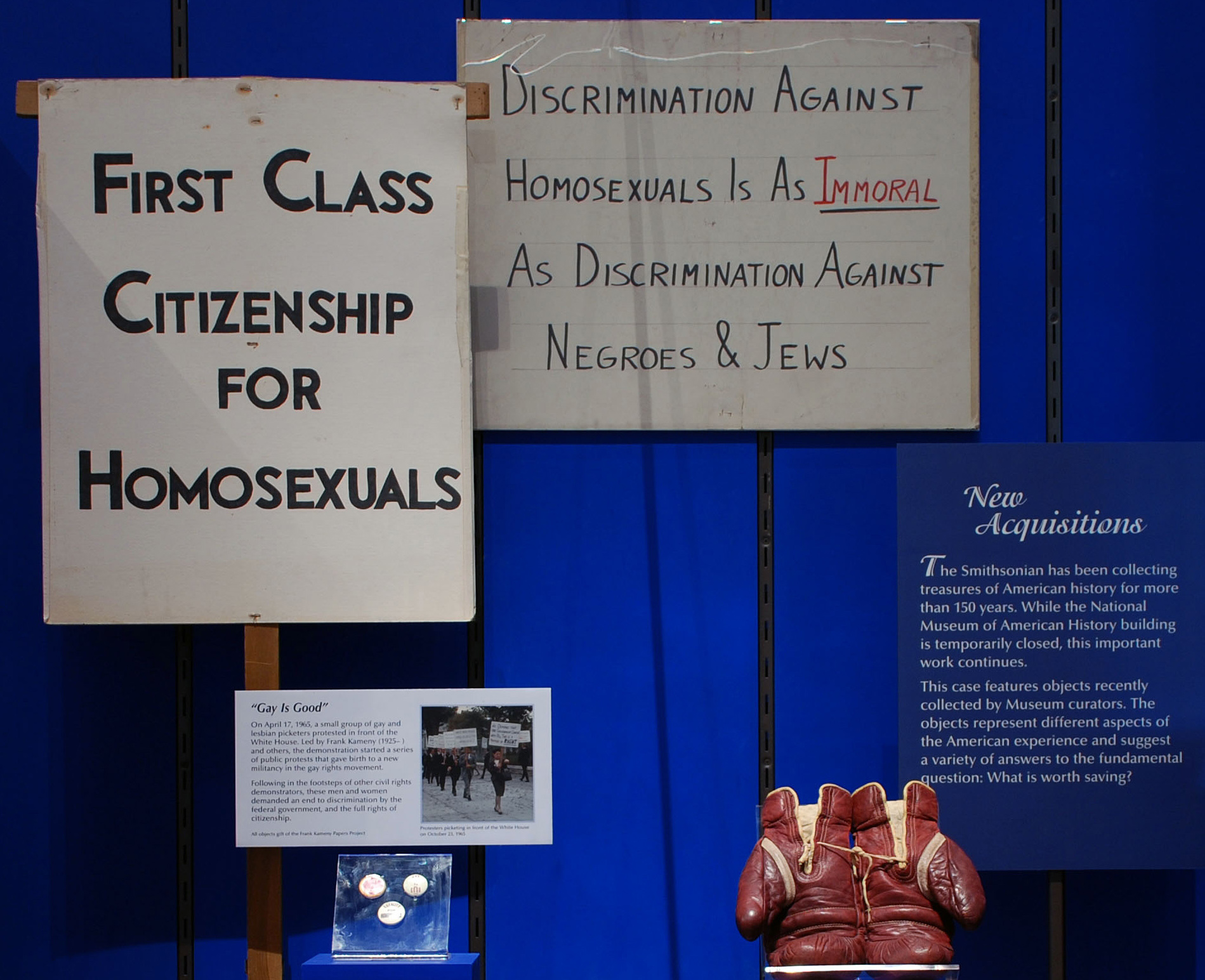
This amazing half-century:  April 17, 1965, was the date of the first gay-rights picket march in front of the White House, a silent protest led by Frank Kameny and Barbara Gittings, which for five years was repeated at intervals in Washington at the White House and the Pentagon, and at Independence Hall in Philadelphia. Below are some of Kameny's original signs carried in the 1965 picket line, as proudly displayed at the Smithsonian Institution.


And this week ABC published an interview, not embeddable, with Paul Kuntzler, 73, another participant in the picket march, which you can see here.

It's hard now to recall, and for the young'uns amongst us, nearly impossible to comprehend, the overwhelming homophobia of society in those days, and the unceasing, sweaty-palmed fear of being found out - or merely suspected - as a homosexual.  Here in the Deep South, at any rate, it was the Worst Thing in the World, worse than being a Communist, even: a traitor not merely to your country, but to God and the entire human race. Seriously - that was how people viewed gayness back then - the unmentionable, unforgiveable sin. Even when I came out at the end of the 1970's, all my good church friends who were "just like family" promptly dropped me like a hot potato, and shunned me ever afterwards.

And it truly boggles your Head Trucker's mind to look around and observe the vast difference in public acceptance that has occurred in just one lifetime - mine. We have lived through a slow-motion revolution these fifty years, with results like gay marriage that were merely daydreams, flights of fantasy, when your Head Trucker came out. It's been quite a journey; I'm glad I have lived to see this day.

Of course many others followed in the footsteps of Kameny and Gittings to lead the onward march for equality, justice, and dignity, and we owe everyone who has lent a hand to the struggle a continuing debt of gratitude for the rights and freedoms we now enjoy - and, we hope, will be enjoyed by many generations of LGBT people in years to come.

Here is Frank Kameny, the loud, proud, grand old man of the gay-rights movement, discussing how he came to be an activist after he was summarily fired from his civil-service job in 1957 for being gay, and took his case all the way to the Supreme Court a few years later:


After Kameny's death in 2011 at the age of 86, CBS's Mark Irvine commemorated his lfie and work with this report, which includes a clip of the White House picket line in 1965:


And here is the full 1984 documentary Before Stonewall, narrated by author and activist Rita Mae Brown, tracing the evolution of gay life and gay activism from the 1920's onward: a fascinating look at our people's recent past, the once-unspeakable history which ought to be required viewing for all the young folks before they get issued their pink cards:


As the film makes clear, where once to be gay and be yourself, it was necessary to be a disreputable denizen of the so-called underworld, now we can be happy, ordinary, boring middle-class folks just like our straight moms and dads and brothers and sisters, or for the politically ambitious, even Senators, Ambassadors, and perhaps one day soon, President - a refreshing and long-overdue change in my view.

Saturday, February 28, 2015

"I Thought I Was the Only One"

Some moving oral histories from the Los Angeles LGBT Center, 2013 - I only wish they were longer:


Saturday, November 29, 2014

Millions of Queers (Our Homo America)

There is no chief, sole reason for homosexuals. “God made them, as part of his universe” is still the best and blindest answer to “why”. Don’t call on an M.D.; knock at Heaven’s Gate for enlightenment. . . .

Why is there homosexuality? Because there is pleasure in it. Because it is natural. Because it always was and always will be, as part of the universe. Because God so wills.


--Allen Bernstein, 1940


The other day, while poking around the intertubes looking for something else, your Head Trucker stumbled by chance upon a remarkable document of gay history: Millions of Queers (Our Homo America), written in 1940 by Allen Bernstein, a 27-year-old Jewish gay guy from New England. Although it's a long read at 140-plus pages, I heartily recommend it to all my truckbuddies as a vivid time capsule from our gay past.

And yes, Bernstein uses the word gay, as well as gayness, exactly as we do today - proof positive that the word was indeed current among our kind in the 1930's, and probably well before that.

Why have you never heard of this work before now? Because although Bernstein wrote several essays and some poems on gay subjects, none of them were published in his lifetime. But after he was arrested and booted out of the Army in 1944 with a Section 8 (psychiatric) discharge, as was required by law at the time for anyone discovered to be a homosexual, he immediately wrote to Army authorities appealing the decision.  They turned him down, of course, but he kept on appealing for the next 37 years, until finally the Army relented in 1981 and granted him a retroactive honorable discharge. 

Along with his first appeal in 1944, Bernstein sent a copy of his magnum opus, which was of course ignored - and somehow ended up in the archives of the National Library of Medicine in Washington, D. C., where it was discovered in 2010 by Richard Sell, a professor at the Drexel University School of Public Health. The typescript was published on OutHistory.org last March, along with a biography by Professor Sell and an analysis by gay historian Jonathan Ned Katz.

Bernstein's life story is very interesting in and of itself: born in New Hampshire and growing up in Salem, Massachusetts, after graduating from high school he went on to college and after that to the University of Chicago, where he earned a master's degree in history in 1934. Somewhere along the way, he became familiar with
the nocturnal admirers of the juggling Jackson statue in front of the White House, the inhabitants of Boston's Public Gardens or Common, or of New York's or Chicago’s numerous parks, or the patrons of selected beer joints or restaurants in any large city, or the seatchangers in the grope theaters in every metropolitan area (viz. 42nd St.), many residents in Y.M.C.A. furnished rooms, . . .
and became what society would have called a practicing homosexual. In the introduction to his essay, he credits "a few close friends and many chance acquaintances whose phrases, experiences, or lives are included here."

But while he does limn the outlines of gay life in 1930's America, Bernstein also goes far beyond that. His wide research and reading in historical, literary, and legal sources shine from nearly every page of the typescript in quotations and references where he gives a broad outline of homosexuality in the Western world from ancient times to modern. As far as I know, such an extensive survey of gay life through the centuries was not attempted again until Katz published his landmark Gay American History in 1976, a work I have had on my bookshelves for many years, and I'm sure many of my truckbuddies have too.

Indeed, Katz himself in a review of Millions of Queers remarks:
Reading Bernstein’s rendering of homosexual American history in “Millions” I was personally and deeply moved to realize that he had found and consulted the same old, dusty bibliographies and quoted many of the same old documents that I had to rediscover three and four decades later . . . .
Bernstein's apologia has its flaws, though - as the much-marked typescript shows, it has the feel of a work-in-progress, a little rough around the edges and uneven in tone: sometimes erudite, sometimes slangy, and permeated with views long outdated now in light of our greater understanding of biology and psychology, and the progress we have made legally and socially. Katz observes:
Bernstein accepted many of the negative clichés about homosexuals, but argued that they should not be persecuted under the law. . . .

By calling “Millions” a homosexual defense I don’t mean that it’s a radical gay liberation manifesto of 1969, a liberal gay rights tract of the 1990s, or a 2014 critique of sexual neo-liberalism. Bernstein offers a libertarian argument that homosexuals don’t hurt anyone, should not be criminalized and stigmatized, and should be left alone to work out their difficult, non-conforming lives by themselves. Bernstein argues that the state (lawmakers, police, judges, and jailors), the medical establishment (doctors, psychiatrists, psychologists), the media, parents, and citizens, should stop harassing homosexuals.

Bernstein’s defense will disappoint anyone judging it against today’s dominant defense of homosexuals as “normal” exemplars of “mental health.” He takes seriously many of the damning judgments that cursed homosexuals in the U.S., in 1940. Bernstein’s essay documents an archive of bad feelings, the trauma of persons and a group despised and discounted, that he and other homosexuals suffered and had to transcend to survive
Thank goodness we got beyond all that; but this work, written long before "gay liberation" and all that followed from Stonewall, gives the reader a "You Are There" feeling - yes, you have all your modern ideas and attitudes about who you are as a gay man or woman, out and proud and a little bit loud sometimes - but would you really have felt the same way, truly, had you lived back in Bernstein's time? It's very, very hard to swim against the tide, to be the outsider, often isolated and alone, whom all the world hates and despises and quite literally damns to the fires of eternal hell - as some of us still remember from our youth, though the young people of today have no real clue about all that.

Bernstein married a woman in 1946, and told her when he proposed that he was gay; she accepted him anyway, and apparently they had a happy, harmonious marriage until her death in 1991. They also produced two sons, to whom Bernstein came out after their mother died, who have supported Professor Sell's research into their father's life and writings.

And there's an even happier ending to the story: Bernstein lived to age 95, and was able to see the progress of gay rights and even the first legal gay marriages in this country before he died in 2008. As Katz notes:
In 1940, speaking of the criminalization of homosexual acts and the imprisonment of homosexuals, Bernstein says:
It will probably be continued in most American communities for another century or three; let's be realistic, and stop day-dreaming about repeal of sodomy statutes.
Given his original pessimism, it’s nice to note that Bernstein lived long enough to witness the U.S. Supreme Court’s 2003 decision in Lawrence v. Texas, in effect, declaring U.S. sodomy laws unconstitutional.
But really, when you read between the lines of this cri du coeur, you see that, at bottom, Bernstein and his friends way back there in the 1930's felt pretty much the same way about themselves as we do - which I'll summarize as "we're not hurting anyone, what we do is none of your business, so leave us the hell alone." 

Well, enough prologue - go read the essay for yourself, a well-researched and candid contribution to gay history, which deserves to be part of the corpus of required reading for the gay generations to come.

Here's the link to the table of contents page at OutHistory, from which you can find the original typescript or, if you prefer, a cleaned-up, searchable and easy-to-read text version; Katz's critique is also listed on the table of contents. Enjoy.

Tuesday, August 19, 2014

Vito Russo's Our Time, Episode 6 - Writers

Broadcast on public television station WNYC on March 16, 1983.  Includes a tribute to Tennessee Williams, who had died just a couple of weeks previously.


Tuesday, August 5, 2014

Vito Russo's Our Time, Episode 5 - Parents

Nowadays, many among the younger generation may find it hard to believe that there was a time when gay people were rarely seen and never heard by most Americans, and coming out to your parents was a fearful thing requiring great courage. PFLAG was a great resource in those days, and although there was no local chapter where I lived, I did take my mom to hear and meet a guest speaker who came to my university campus about this point in time; though Mom was supportive of me from the get-go, I think it gave her a lot of reassurance to talk with another mother.

This episode, broadcast on WNYC-TV on March 2, 1983, is marred by some unfortunate skips in the videotape, which become less frequent as the episode proceeds.


Tuesday, July 29, 2014

Vito Russo's Our Time, Episode 4 - AIDS

This episode, which aired on WNYC-TV on March 3, 1983, focused on what was then the still-new epidemic of AIDS that was cutting a deadly swathe through the ranks of gay men. At this time, cases were still concentrated in big cities like New York and San Francisco, but the alarming news was filtering slowly into the hinterlands, where we were bewildered and afraid. As seen here, activists like Larry Kramer and Michael Callen were informing and organizing their brethren in the Big Apple - with the enormous help of our lesbian sisters, to whom we owe an enduring debt of gratitude - but between the coasts, rumor and confusion prevailed.

As you will see in the video, very little was known for sure about the HIV virus and how it was transmitted. Could you catch it by kissing someone? Hugging? Shaking hands? Breathing the same air? Sharing finger foods? Eating off the same plate, or drinking from the same glass? What about toilet seats? Not even the doctors were sure, and most doctors were themselves still uninformed of the latest research. News reports told of nurses and hospital staff refusing to touch or treat AIDS patients, who were sometimes flatly turned away from the hospital doors, or left to lie in hallways, unattended. Some funeral homes refused to accept the bodies of patients who died from the disease.

Politicians were starting to call for mass internment of people with HIV or AIDS, and your Head Trucker heard with his own ears the pontificating asshole and conservative pundit William F. Buckley calling for all men with HIV to be tattooed on their foreheads to warn the public to stay away from them.

All that seemed certain was that the virus was spreading among gay men, apparently like other sexually transmitted diseases. And yet, we read in the scanty, infrequent news reports, some men who had a "promiscuous lifestyle" seemed unaffected, while others who rarely had sexual partners were stricken. So what did that mean for us young gay men, newly out and relieved to be free from the soul-destroying closet of celibacy? Your Head Trucker remembers sitting in a gay rap group where this very topic was hotly discussed: some guys were ready to wall themselves away from all sexual contact, while others swore they would not change a thing they were doing until science had determined the exact cause - why go back to living like a lonely monk for no good reason?

And all this was before the concept of "safe sex," later cslled "safer sex," was really developed or publicized. The best advice the medical establishment could give in those early days, which most gay men in the provinces read in abbreviated news reports in gay porn magazines - even those were simply not available in most towns and cities or through the mail in most Southern states - was to "avoid exchanging bodily fluids" with other men. But what the hell did that mean, exactly? What is a "bodily fluid"? Blood? Cum? Piss? Spit? Sweat? Tears? For a long time, nobody bothered to clarify for us, and the national magazines and network news shows, when they did, at long intervals, mention the AIDS epidemic, were not about to descend into the gutter by specifying what was meant. Not even the word condom had ever yet been heard on American television.

Thus, many thousands of men died. It was a scary time to live through, a walk in the dark through a cemetery - no doubt unimaginable to the smartphone-toting, constantly linked-in younger generation. But important to remember.


Tuesday, July 22, 2014

Vito Russo's Our Time, Episode 3

Episode 2 is missing from this YouTube collection, but Episode 3 aired on WNYC-TV on January 26, 1983:


Tuesday, July 15, 2014

Vito Russo's Our Time: Episode 1

Hey guys, check out this fabulous buried treasure newly come to light.  Description:
In 1983, Vito Russo produced and co-hosted "Our Time," a television series focused on the gay community. The thirteen episodes that ran on public television station WNYC-TV tackled important issues such as gay history, drag, alcoholism, race, and a famous episode at the dawn of the AIDS crisis featuring Larry Kramer. On-air guests included luminaries such as Harry Hay, Rita Mae Brown, Tennessee Williams, Harvey Fierstein, Quentin Crisp, Lily Tomlin and many other notable public figures.


This first episode includes an interview with Harry Hay and Barbara Gittings, both important figures in the start of the gay liberation movement that I've read about many times but never seen on film. Groovy. I'll be posting a new episode each week.

Related Posts with Thumbnails