No comment.
Trump Names Himself Principal Ballerina
of Kennedy Center Ballet
-----
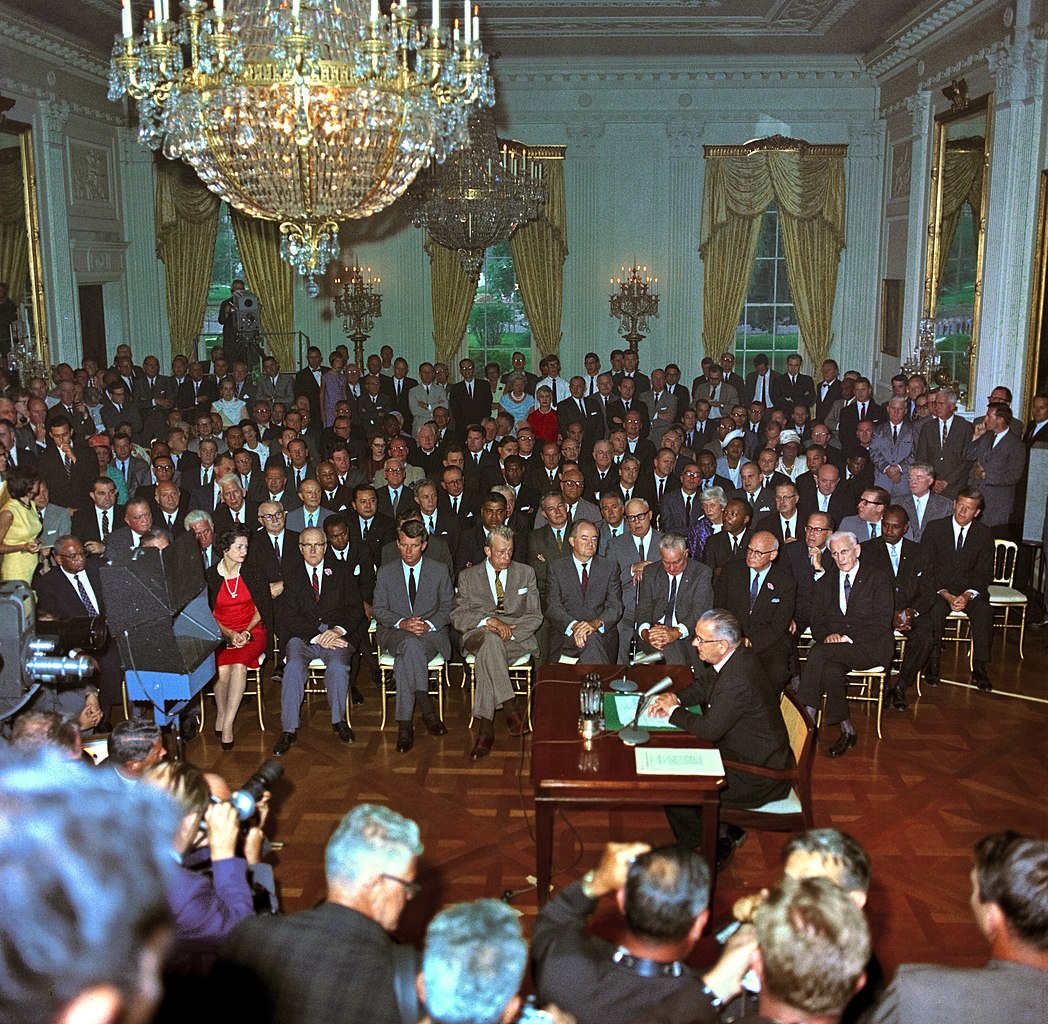 |
| President Johnson addresses a nationwide television audience during his signing of the Civil Rights Act in the East Room of the White House, July 2, 1964. Among the dignitaries in the front row are Lady Bird Johnson, Attorney General Robert Kennedy, Vice President Hubert Humphrey, and Senator Barry Goldwater. |


The Court is not aware of any legal authority that entitles a ballot-approved measure to special deference in the event it raises a constitutional question. On the contrary, the Supreme Court has clearly stated that if . . . an enactment violates the U.S. Constitution - whether passed by the people or their representatives - judicial review is necessary to preserve the rule of law . . . [t]he electorate cannot order a violation of the Due Process or Equal Protection Clauses by referendum or otherwise, just as the state may not avoid their application by deferring to the wishes or objections of its citizens. . . .
In attempting to define this case as a challenge to “the will of the people,” Tr. 2/25/14 p. 40, state defendants lost sight of what this case is truly about: people. No court record of this proceeding could ever fully convey the personal sacrifice of these two plaintiffs who seek to ensure that the state may no longer impair the rights of their children and the thousands of others now being raised by same-sex couples. It is the Court’s fervent hope that these children will grow up “to understand the integrity and closeness of their own family and its concord with other families in their community and in their daily lives.” Windsor, 133 S. Ct. at 2694. Today’s decision is a step in that direction, and affirms the enduring principle that regardless of whoever finds favor in the eyes of the most recent majority, the guarantee of equal protection must prevail.
The Court finds Regnerus’s testimony entirely unbelievable and not worthy of serious consideration. . . . While Regnerus maintained that the funding source [i.e., the Republican Heritage Foundation] did not affect his impartiality as a researcher, the Court finds this testimony unbelievable. The funder clearly wanted a certain result, and Regnerus obliged.Yeow!


I spoke to a different type of voter four years ago, when, two weeks before the 2008 election, energized by Barack Obama’s campaign, I joined several friends in Norfolk, Virginia, which is home to the largest naval base in the world. It was an ecstatic, optimistic time, and the Obama campaign offices were like college dorms—dozens, even hundreds of young volunteers passed through, not only canvassing but making phone calls, entering data, and determining strategy, subsisting on cold pizza and cold coffee. Upon arrival we were sent to some of the city’s poorest inner-city neighborhoods, composed almost entirely of black voters. We visited ramshackle, single family homes and vast concrete-and-brick housing projects; many of the people on our list had never voted before.
There were challenges, to be certain—because we were white, many people we met were convinced that we were spies for John McCain’s campaign, even though our arms were filled with brochures showing Obama’s face. Some well-meaning people, mostly older women, advised us to leave a neighborhood for our own safety. One group of teenagers drew me an intricate map of the route I’d have to follow in order not to stumble into the middle of a gang war. But over the course of a week we visited more than a thousand homes, speaking with hundreds of voters and, witnessing their enthusiasm, we became convinced that Obama would carry the state.
When I returned to Virginia to canvass last week, my friends and I went to Norfolk, excited to go back to the same neighborhoods we had visited in 2008. But the moment we entered the president’s local campaign office, we discovered how much had changed. We were informed by a campaign staffer that our services were not wanted. In fact there would be no canvassing for Obama during the week at all—and not only in Norfolk but in all of Virginia. Instead, all volunteers were asked to make phone calls to Obama’s most enthusiastic local supporters. The goal was to sign them up to canvass in the campaign’s final four days, beginning the Saturday before the election. We explained that we had not travelled considerable distances to Virginia only to make phone calls, which we could have done from our own living rooms. But the campaign would not budge. “I’m sorry,” said the young woman who greeted us in the Norfolk office, with a theatrical shrug. “I just work here.”
Here was the difference between 2012 and 2008. While the offices look the same—the young people making phone calls, the enervated chatter, the boxes of doughnuts—the underlying structure had been transformed. “I just work here.” This time around, the people in charge are not volunteers, but employees. Since 2010, when the Supreme Court overturned restrictions on private donations by corporations, the Obama campaign, flush with money, has increased its paid staff gigantically; there were three times as many employees in the Hampton Roads office as four years earlier. In 2008 the approach was politics from the ground up, by social network. This time, it was Obama, Inc., with strategy fixed at the highest level, by the campaign’s central headquarters in Chicago.
WASHINGTON (The Borowitz Report)—With only one day until the election, the Republican Party today released its official closing argument to the American people.
In its entirety, the argument read as follows: “We’re strongly opposed to FEMA and health care, but basically O.K. with rape.”
Reince Priebus, the chairman of the Republican National Committee, said that the Party’s message of “zero tolerance toward disaster relief combined with a more easygoing attitude about rape” would lead the Party to victory on Election Day.
“Our argument couldn’t be simpler: when God wants to create a hurricane or make a woman pregnant, big government should get out of the way,” he said.
The Party chairman said that the closing argument was part of its “expand the map” strategy: “We’re contesting every state, from Pennsylvania to Colorado to Iowa, where we believe there are voters who are in sync with our more advanced view of hurricanes and rape.”
Mr. Priebus also had this message for the American voter: “Your vote is important. We’ve spent billions trying to buy it.”

This is essentially a people's contest. On the side of the Union it is a struggle for maintaining in the world that form and substance of government whose leading object is to elevate the condition of men--to lift artificial weights from all shoulders, to clear the paths of laudable pursuit for all, to afford all an unfettered start and a fair chance, in the race of life. Yielding to partial and temporary departures from necessity, this is the leading object of the government for whose existence we contend.--Abraham Lincoln, Special Message to the People of the United States, July 4, 1861.