C I V I L    M A R R I A G E    I S    A    C I V I L    R I G H T.

A N D N O W I T ' S T H E L A W O F T H E L A N D.


Showing posts with label civil rights movement. Show all posts

Tuesday, June 16, 2020

Notes from the Revolution, 6/16/20

. . . a revolution of hearts and minds . . .

Police chief Joseph Wysocki marching with protesters
last week in Camden, New Jersey.

Starting Over:
"The City That Really Did Abolish the Police," at Politico. Excerpt:
As a movement grows in American cities and suburbs to overhaul police departments and confront their long records of racially unjust, violent enforcement, Camden [New Jersey] is one rare—and complicated—success story, a city that really did manage to overhaul its police force and change how it operated. And it took a move as radical and controversial as what some activists are calling for today: Camden really did abolish its police department.

And then the city set about rebuilding the police force with an entirely new one under county control, using the opportunity to increase the number of cops on the streets and push through a number of now-heralded progressive police reforms. And with time, the changes started to stick in a department that just years earlier seemed unfixable.

Over the past two weeks, Camden has become an example of reform that works—cited in articles, tweets and on network shows as an example of what can go right. And it’s true that the reforms produced real change in the statistics: The excessive use of force rates plummeted. The homicide rate decreased. And new incentives laid the groundwork for a completely new understanding of what it meant to be a good cop.

“You had to change the underlying principles of the way police officers were being trained and taught, and the culture in the department,” said former New Jersey Governor Chris Christie, who supported the changes in Camden. “The most effective way to do that was to start over.”


Then and Now: CNN asked black activists who were on the front line of civil rights protests in the 1960s to comment on the current demonstrations.  Excerpt:
It's not that things have gotten so much worse (now). It's just it is so much more obvious and apparent to everybody.--Charles Black, a leader of the 1960s Atlanta Student Movement

You've never seen as many white people marching (as now) -- never in history. We've been carrying this burden by ourselves, and you feel, they say, (like you are) carrying the cross. You feel like the cross is a little lighter today because you see other people carrying the cross with you.--Miller Green, one of the Freedom Riders

What's different is the variety of people at those marches, and that is sweet sunshine from heaven to me ... This is a wake-up call, and more people woke up this time than before.--Dr. Melba Pattillo Beals, one of the Little Rock Nine

The March on Washington, 1963


Dancing in the Street: Last week in Atlanta, National Guard troops and protesters danced together - something that never happened in the 1960s:


Also last week, Politico interviewed ten National Guard troops about their presence in Washington, D. C., in the now-notorious Lafayette Square photo op:
Many Guardsmen said they felt uncomfortable with the way they were used to handle the unrest because demonstrators lumped them in with the police. They felt that while they swore an oath to uphold the Constitution, their presence at times intimidated Americans from expressing their opinions and even escalated the tension.

And in the case of Guardsmen involved in the Lafayette incident, some felt used.

“As a military officer, what I saw was more or less really f---ed up,” said one D.C. Guardsman who was deployed to Lafayette Square last Monday and who, like some others, spoke on condition of anonymity to speak freely. The official line from the White House that the protesters had turned violent, he said, is false.

“The crowd was loud but peaceful, and at no point did I feel in danger, and I was standing right there in the front of the line,” he said. “A lot of us are still struggling to process this, but in a lot of ways, I believe I saw civil rights being violated in order for a photo op."

What I Say:  It has done my heart good to see the innate respect for civil liberties and American ideals shown by many police and military all across the nation, from the front lines right on up to the highest command levels.  Despite the killings and beatings and horribly bad decisions some have made, it does seem to me, surveying the scene from my seat high up in the digital bleachers, that the majority of police and military people are - like most civilians - aghast at George Floyd's brutal murder as well as committed to safeguarding every American's inherent right peaceably to assemble and to seek redress of grievances.

Last week, a two-block-long parade of demonstrators marched right by the house here, and the police were marching with them, escorting them through town with police cars fore and aft: protesters and police all moving together with a common goal of peaceful assembly at the town square - which is as it should be.  Unfortunately, your Head Trucker was asleep at the time; had I been awake, I would have gone out and waved my American and rainbow flags in support.

If you were to survey the list of recent protests all across the nation, especially in the South, as I have done over on Wikipedia, and if you were to take the trouble to look at the source citations, as I have done, and watch the local news videos from all sorts of small towns and small cities, as I have done, you would notice crowds of blacks and whites mingling freely with united purpose.   This would not, could not have happened in my childhood in the segregated South.

This is not to deny the existence of racist attitudes in all parts of this country, as the nightly news keeps reminding us.  To be sure, hateful bigots still infest the backwoods and back alleys of the South and North - some of them are highly placed, and some are even pillars of the church - but there are many good and decent folks in those small towns too.  And in almost every demonstration I looked at in those small Southern towns, the police, the sheriff's deputies, and often the mayor were out in force - not against the protesters, but in solidarity with them, guaranteeing their right to safely protest.

In other words, they and we are all one American people, in or out of uniform, regardless of race, creed, sex, or color: a government of the people, by the people, and for the people.  And that gives me hope that we will all get through this time of outrage and sorrow together, make right what is wrong, and build a more perfect union - the unending task and high duty of every generation in these United States.


Sunday, May 31, 2020

Rep. John Lewis: Be Constructive, Not Destructive


Congressman John Lewis, 80, one of the last surviving leaders of the Civil Rights Movement of the 1960s, released this statement yesterday on his official website:
Sixty-five years have passed, and I still remember the face of young Emmett Till.  It was 1955.  I was 15 years old — just a year older than him.  What happened that summer in Money, Mississippi, and the months that followed — the recanted accusation, the sham trial, the dreaded verdict — shocked the country to its core.  And it helped spur a series of non-violent events by everyday people who demanded better from our country.

Despite real progress, I can't help but think of young Emmett today as I watch video after video after video of unarmed Black Americans being killed, and falsely accused.  My heart breaks for these men and women, their families, and the country that let them down — again.  My fellow Americans, this is a special moment in our history.  Just as people of all faiths and no faiths, and all backgrounds, creeds, and colors banded together decades ago to fight for equality and justice in a peaceful, orderly, non-violent fashion, we must do so again.

To the rioters here in Atlanta and across the country:  I see you, and I hear you.  I know your pain, your rage, your sense of despair and hopelessness.  Justice has, indeed, been denied for far too long.  Rioting, looting, and burning is not the way.  Organize.  Demonstrate.  Sit-in.  Stand-up.  Vote.  Be constructive, not destructive.  History has proven time and again that non-violent, peaceful protest is the way to achieve the justice and equality that we all deserve.

Our work won't be easy — nothing worth having ever is — but I strongly believe, as Dr. King once said, that while the arc of the moral universe is long, it bends toward justice.

N.B.--As a young man, Rep. Lewis put his life on the line many times in the cause of non-violent protest.  He endured beatings by enraged mobs and rioters as one of the original Freedom Riders in 1961, and four years later, on what came to be called "Bloody Sunday," he received a skull fracture when truncheon-wielding police charged the peaceful protesters on the Edmund Pettis Bridge in Selma, Alabama.


Sunday, March 8, 2015

Sunday Drive: We Shall Overcome

The anthem of the Civil Rights Movement has carried the hopes of millions from the streets of Selma to the White House, and beyond.

1. As performed by the SNCC Freedom Singers for an anthology of civil rights songs, 1988:


2. As performed by Joan Baez (who sang the song at the 1963 March on Washington, and participated in the third Selma-Montgomery March in 1965) in concert in the East Room of the White House in 2010:


Saturday, March 7, 2015

Fifty Years Ago: Bloody Sunday


An excerpt from the PBS documentary Eyes on the Prize (1987) summarizes the Selma-Montgomery march, a landmark in the civil rights movement, which occurred fifty years ago today:


Sadly, we are still waiting for liberty and justice for all in the Heart of Dixie - but surely they will come, before too long.

But you know, human beings are funny creatures - everyone wants liberation and happiness for their group, but even when they get it that doesn't necessarily translate into support for other groups. Here's a letter from a black Alabama pastor who declares his vehement opposition to gay marriage, which he calls "not a civil right but a right to sin."


Update, 6:55 p.m.: Today, President Obama flew to Selma to commemorate the march, reminding us that "our work is never done" in advancing civil rights - there's a shout-out to the gays in here:


And at the height of the President's dramatic speech, he expatiates on "who Americans are" - this is a speech for the ages, and I defy any of my truckbuddies to listen to this part, beginning at the 5:30 mark, without a tear in their eyes. Yes, he includes the gays again, but it's about much more than that:


Full text of the President's remarks here.


Sunday, April 13, 2014

Civil Rights in America, Fifty Years On

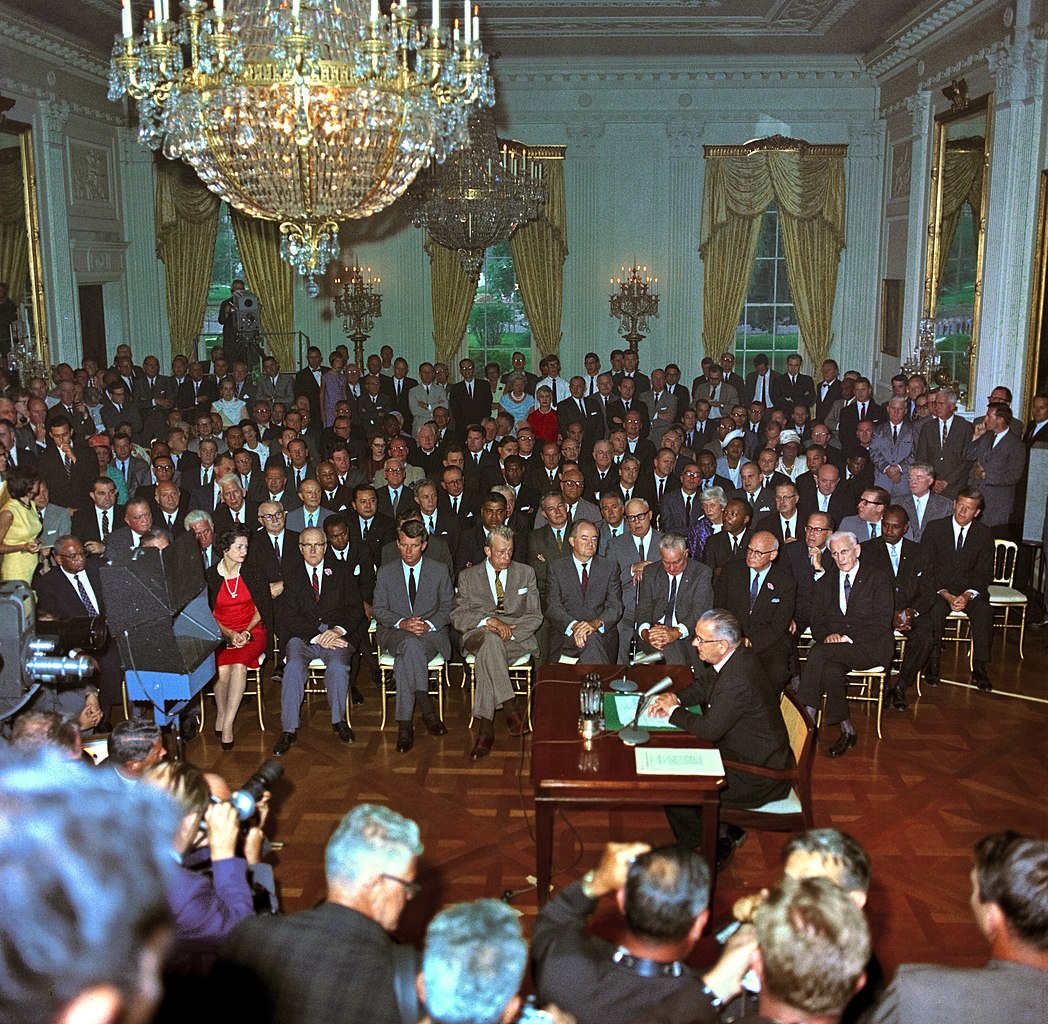
President Johnson addresses a nationwide television audience during his signing of the Civil Rights Act in the East Room of the White House, July 2, 1964.  Among the dignitaries in the front row are Lady Bird Johnson, Attorney General Robert Kennedy, Vice President Hubert Humphrey, and Senator Barry Goldwater.

President Obama spoke on Thursday at the LBJ Library in Austin, commemorating the fiftieth anniversary of the passage of the Civil Rights Act of 1964, a great turning point in American history that was largely the result of President Lyndon Johnson's strenuous efforts to ensure that Congress passed the bill, which he signed on July 2, 1964.  Notice what Obama says about gay Americans, and about the movement of history.


Full text and video of Obama's remarks are here.


Just to refresh your memory, here's a mini-documentary about LBJ's work on the Civil Rights Act, which was an uphill battle all the way - this Wikipedia article gives details on the votes in the House and the Senate.


And a short study of Barry Goldwater's attitude towards civil rights - notice at the 1:28 mark, the sign held by white protesters in New Orleans, 1960: "God Demands Segregation." Sound familiar?


And Andy Borowitz gets the last word:

Nation Stunned to Learn Congress Accomplished Something Fifty Years Ago

Sunday, October 7, 2012

James Meredith: Still at War, 50 Years On

James Meredith arrives on the Ole Miss campus, guarded by U. S. Marshalls

For us queer people, especially those like your Head Trucker who have lived well along into the afternoon of life, the progress of our struggle for equal rights and the equal protection of the laws often seems to be moving at a snail's pace. And yet we can take heart to some degree that such progress is always slow to come, for any group asserting its claim to the fullness of citizenship. The reason being, people in every age and clime are all too often fearful of losing their grip on the comfortable division of society into Us and Them.

This and other reflections may come to your mind too when you watch this excerpt from a BBC interview with James Meredith, who on October 1, 1962, became the first black person to register at the University of Mississippi, an event that was a major milestone in the Civil Rights Movement.


This excerpt from Episode 2 of the documentary Eyes on the Prize fills in the background of the Ole Miss riots, in which two people were killed, more than 300 injured, and 35 federal marshalls shot by snipers on campus.


Those of you who didn't grow up in the South should note that this kind of conflict and violence was local and infrequent - not an everyday thing, as you might think. Your Head Trucker remembers the days of segregation vividly from his childhood, the separate restrooms and drinking fountains and all the rest.

Yet, despite living, you might say, the first 20 years of my life in a small city of nearly a quarter-million population, there was never once any such demonstration or violent conflict as you see in documentaries of the period. All through the sixties, life went on as calmly and quietly as you could want - sometimes, to a kid, rather boringly so. (I was alternately excited and a bit ashamed of myself when one afternoon the oldest high school building in town burned down - of course, I had to go watch the flames and firefighters in person. What fun, in a place where everything was usually very routine and predictable.)

The big marches and demonstrations and riots and bombings, etc., that you see pictures of history books and films all happened far away. The grown-ups talked about those things sometimes, and of course they all deplored what Dr. King and other civil rights leaders were trying to achieve - the casual evil of indifference and ignorance - but the dramatic conflicts and violence were not an everyday sight for the vast majority of people living in the South at the time; it was something you read about in the paper, or saw on the evening news. The ironclad rules and customs of segregation kept everyone, white and black, in their places until, bit by bit, the laws changed, the schools integrated, and despite all the muttering and grumbling by whites, before you knew it, the seventies were here, and the revolution was over and done with, fairly painlessly in most places.

The old-time segregationist leaders sort of faded away, and the few who remained reinvinted themselves politically and began actively courting the black vote. All of this is not to say that there was no suffering and struggle on the part of black people - far from it. I'm just making the point that for most people the mainsprings of destiny lie somewhere beyond the confines of ordinary day-to-day life - the dramatic events, the turning points of history, tend to happen in a few specific points of space and time, not everywhere and at all times. And thank God for the courage of those who do take a stand when and where they can - otherwise, change and progress would never take place.


Friday, August 26, 2011

What Happened to That America? Part III


"That America" - the phrasing suggests a political answer, doesn't it?  The question is not "What happened to that time" or "What happened to that way of living," but rather focuses attention on the polity rather than the era or what we now glibly call a "lifestyle."

And your Head Trucker would have to say that in large part, what happened to change the political entity comes down, as suggested in the first two parts of this series, to two words:  television and mendacity.  Or to be more clear:  the ubiquitous medium of television exposed and brought straight into everyone's living room the mendacity, the pretenses, the lies which "that America" was based on.

"That America" - the one you see in the old commercials for shiny new Chevrolets and Frigidaires, Cheerios and Doublemint, the limpid vision of little pink houses and chummy small towns we can now conjure up at any time of the day or night to revisit - that America never existed.  It was a sanitized, spiffed-up, heavily censored imitation of the real America:  designed to entertain and reassure us, but also to sell products and prime-time minutes by stimulating our desire for more products, and more fashionable products, even ones we didn't know we wanted.

Now there's nothing wrong with entertainment and theatrical illusion per se - old Aristotle, who wrote the book on Greek drama way back there, and defined art as "the imitation of life," held that even the most gruesome of those tragedies had a beneficial effect on viewers by first causing them to feel pity and terror, and then allowing the purgation of those feelings, which he thought would have a good effect on their character, making the audience wiser, more thoughtful citizens.

But it's very important, especially in this era of non-stop entertainment and illusion by media of all kinds that we be able to distinguish the imitation from the life.  It may be that people who look back uncritically to those TV shows and commercials with a sentimental feeling, remembering at the same time how safe and lovely the world seemed through the eyes of their childhood, are failing to remember the many other facets of "that America" which were deliberately left out.

Continued after the jump . . .

Thursday, May 20, 2010

Exempt Private Businesses from Civil Rights Laws?

Hecklers pour sugar, condiments, and water over sit-in protesters at a lunch counter in Jackson, Mississippi, 1963.  Notice that the protesters are practicing nonviolent resistance, as Dr. King advocated.

Jeezus.  People who didn't pass high school American History really should not be allowed to run for public office.  Notice how this fuckweasel consistently avoids answering Rachel's direct questions about his real view on segregation:


What I Say:  Boys, I was there in the segregated South, and when I close my eyes I can see it all again just plain as day.  Hotels, movie theaters, restaurants, cafes, railroad stations, bus stations, gas stations, barrooms - all those private businesses were strictly segregated, often with separate restrooms for "Colored" and "White" and separate entrances - or, as in the case of hotels and motels, including the major chains like Holiday Inn and Howard Johnson's, simply did not take any black customers at all. 

I well recall that every place that served food - even down to the corner hot-dog stand or ice-cream parlor - had a sign prominently displayed behind the counter: 

We Reserve the Right to Refuse Service to Anyone

As a kid, waiting to be served or to pay for my hamburger, I often studied that sign and pondered what it meant.  Now I know:  "We Don't Serve Blacks" is the translation.

True, it was all required by law; but that law was the express will of the vast, overwhelming majority of white citizens of the South, too.  Even if the segregation laws had all been rescinded, I promise you that all those businesses would have kept the signs and policies in place - as a "business necessity," because white people, like my own family, I am sad to say, simply would not have patronized them otherwise - unless there was a positive law forbidding private businesses from discriminating, which is part of what the Civil Rights Act achieved.

And that is the America that dumbshit racist assholes like Rand Paul want to take us back to.  No thank you.  Here's a couple of clips to give you a little hint of what life was like under the segregation regime - imposed not arbitrarily by "big government," but directly at the hands of the white majority:


Tuesday, April 20, 2010

In Memoriam: Dorothy Height, 1912-2010

I'm astounded that I never heard of Dorothy Height - the "Godmother of the Civil Rights Movement" - until I saw this post about her death on Joe.My.God. today, but what a fascinating person.


A very interesting series of oral history interviews with her at this link:

Dorothy I. Height: Visionary Videos: NVLP: African American History

Posted using ShareThis

Thursday, February 4, 2010

Virginia Foster Durr: A White Champion for Southern Blacks


Virginia Foster Durr and Rosa Parks

Your Head Trucker once had the privilege to get a glimpse of a great civil rights champion whose name ought to be more famous than it is:  Virginia Foster Durr.

Back in the mid-1980's when I was dating a smart, sexy redheaded guy in Montgomery, we went to the Alabama Shakespeare Festival a few times to catch some plays.  On one of those occasions, as we were walking through the parking lot towards the theater building, he nudged me and said, "Look, that's Virginia Durr."  I turned and saw a very small, white-haired lady conversing animatedly with a friend as they strolled up to the entrance. 

No, I didn't go say hello or ask for an autograph or anything; I'm not that pushy.  Still, it was a memorable moment actually to see someone who, with her attorney husband, had figured so prominently in the civil rights struggle in Alabama.  Among other things, they are the ones who went and bailed Rosa Parks out of jail after her famous refusal to move to the back of the bus in 1955, and he represented her in court.

Well, while sitting here tonight waiting for my supper to cook, I was surfing around here and there, and came across the wonderful oral history interview she gave in 1975, now available through the awesome Documenting the American South online history collection from the University of North Carolina.  Tons of great reading there, if you like history.  Lots of stuff that ought to be required reading in school.

In particular, the extensive Durr interview is fascinating, and I hope some of my truckbuddies will dip into it.  Here I want to present just a little excerpt that illustrates what I was saying in my post the other day about how white Southerners felt about the blacks in their midst.  This excerpt and its continuation are about an incident in 1910, when Durr was a girl of 7, living on her wealthy grandmother's plantation in rural Alabama; but the racial attitudes illustrated by the story were still very much in operation fifty years later, when I was coming up.  Notice the part about venereal disease, which is something I was told, too, in all seriousness.
This time, I was seven years old and I was going to school the next fall. I always had my birthday in the back yard with the black children and we would have barbeque and they would let us barbeque over a little pit that they would dig for us. So, this time, my mother and grandmother and aunts and all said that I had to have it in the front yard and with just the white children, no black children could come to the party. Well, I got very angry about that and the main thing was that I wanted the barbeque. (laughter) You see, they would dig a pit in the back yard, which was sandy, and then the cook would give us chickens and we would build a grill over the hole and build a fire and then we were allowed to baste the chickens and turn them over and of course, by the time that we got through, they were full of sand, but to me, (this had been my usual birthday party) and to me, this was a great event. Here I was presiding over the chickens, you know. Well, anyway, I had a tantrum at breakfast and made strong protest about the party in the afternoon and no barbeque. So, they agreed that I could have the barbeque in the morning and the party in the afternoon. This was the compromise that they reached. . . .

Well, Elizabeth, Aunt May's daughter was there and Aunt May would bring a French maid with her when she came, if you can imagine. You can imagine how happy the French maid was. (laughter) Aunt May, as you could say, really put on airs. Anyway, Elizabeth was always dressed up in these beautiful dresses with sashes and everything matching and her hair curled . . . .

She was a little older than I was, about my sister's age. So, we had the barbeque and everything was going on fine and we were dividing up the chicken and one of the little black girls was tearing up the chicken and she offered a piece to Elizabeth and Elizabeth, who must have felt like an outcast in this group anyway, she all of a sudden said, "Don't you give me any chicken out of that black hand of yours. I'm not going to eat any chicken that your black hand has touched, you little nigger." . . .
Continued after the jump . . . .

Related Posts with Thumbnails