C I V I L    M A R R I A G E    I S    A    C I V I L    R I G H T.

A N D N O W I T ' S T H E L A W O F T H E L A N D.


Showing posts with label 1960s. Show all posts

Sunday, April 26, 2026

Sunday Drive: (You're My) Soul and Inspiration


This gold single by the Righteous Brothers was #1 this week in 1966 on the Billboard charts.  It holds up very well, I think.  They had a unique sound, a masculine sound that must have appealed to every gay boy and man in America.  It certainly appealed to me, just beginning the mysterious ascent to manhood.  Enjoy.

-----

Sunday, April 19, 2026

Sunday Drive: There but for Fortune

My dream girl once upon a time . . ..

Cher, 1967.  An old favorite of mine.  The message still resonates in today's world.

Backup music - by turns ethereal and dramatic - provided by the Wrecking Crew.

-----

Monday, March 2, 2026

When Woodstock Came to Texas

Poster for the Texas International Pop Festival,
August 30 - September 1, 1969.
(from Wikipedia)

It may surprise some of my truckbuddies to learn that Texas had its own hippie rock concert on Labor Day weekend, 1969, just a couple of weeks after the famous one in New York state.  I'm surprised, too:  I never heard of it, and neither did M.P.  We were both still in high school, far away from Dallas. And I was too square to care; still am. But as matter of social history in my own lifetime, it was interesting to stumble upon these news videos and reminiscences of the event, which some surviving participants say was life-changing.

First, an official video from the City of Lewisville, a little ways north of Dallas proper, where the festival was held in a large open field next to Interstate 35.  The site has been heavily redeveloped since then (see maps).  The promoter who first appears at 1:36 is a son of the founder of the Six Flags theme parks, Angus Wynn, Jr.

It says a lot about small-town Texas that the upright, God-fearing citizenry at the time were outraged, not by the long hair, rock music, and drugs, but by all the nekkid bodies skinny-dipping in the nearby lake in broad daylight!  The locals knew the kids were naked because they were out there in their motorboats, intently scrutinizing all that indecency through binoculars.

Notice what the newsman in the next clip says about "it's hard to know what to call these young people" - most of them were "weekend hippies" whose hair and clothes were still within the limits of respectability. In the next few years, what was strange and different, even shocking, in 1969 became ordinary:  that's how the fashion industry works. 

Just a couple of years after this event, I was sitting in a goverment class when the instructor posed a discussion question:  "What is a hippie?"  We all looked at each other mutely as we realized that "hippie" had become "normal."  Long-ish hair, flares or bell-bottoms, wide belts, long sideburns, mustaches, beards, and hip-hugging blue jeans - most young men dressed that way, at least for slogging around campus, regardless of their socio-political orientation.  The words "hippie" and "groovy" were already obsolete; but blue jeans - workman's clothing - became the default choice for casual wear, and remain so to this day. 

But 1969 was the starry-eyed Age of Aquarius:  harmony and understanding, sympathy and trust abounding.  It's poignant to hear the earnest young folks in these clips spout all those utopian sentiments of peace, love, and joy: "just be yourself, do what you want to do - people will love you for it." A happy thought, a hopeful thought - but mistaken. Human nature just doesn't work that way. But they surely found that out later on. 

This last video opens with a crotch shot that proves more than words ever could that rock and roll is all about sex, and vice versa.

-----

Thursday, October 30, 2025

Feel the Rhythm!

A lively excerpt from the Dean Martin Show, circa 1969:

Who knew Lee J. Cobb could dance?

-----

Saturday, April 26, 2025

Herb Alpert is 90

Alpert's fiftieth album, entitled 50, was released last fall.
From 1962 to 1969, he had 12 gold albums in a row,
5 of them reaching #1 on the
Billboard chart.

Would you believe that at age 90, Herb Alpert is still touring around and blowing a horn?  Wow.  My truckbuddies of a certain age will recall that the TJB sound was the bright, breezy background to the 1960ts, the sound of youth having fun in the sun  - at least, until everything turned ugly and went to pot.  This CBS report catches us up on the man with the golden horn:


BTW, I wrote about that album cover here a couple of months ago.

-----

Saturday, January 18, 2025

Farewell to Mike Stivic's World

All In the Family Cast

All in the Family was a sensation when it premiered in January, 1971.  Unlike all previous American sitcoms, it dealt with serious topics, including politics, war, sex, and race, and was rudely funny, too, setting the tone for many other 70's sitcoms to follow - and for the decade as a whole.  The look and feel of modern life changed noticeably around 1970, as elements of the counter-culture became the dominant culture.  I remember it well.

It was never my favorite show, but was good for some laughs at the expense of blue-collar conservative Archie Bunker, a buffoon character who was continually skewered for his out-of-date attitudes by his smart-mouthed, oh-so-liberal son-in-law, Mike Stivic - who, however, was not too proud to live off Archie's hard work and generosity while attending college.  (Hypocrisy comes in many guises.)

I haven't seen the show in many years, bur recently YouTube offered up this never-aired pilot episode from 1969.  Carroll O'Connor and Jean Stapleton play the parents, but Mike and his wife Gloria are played by two other actors, and it's interesting to see the show performed without Rob Reiner and Sally Struthers.  It's also much more risque than the broadcast show was, at least initially.  See what you think.


Notice that the "liberal" talking points Mike brings up are identical with the talking points of today, almost as if they've been, um . . . scripted.  And as if no progress whatsoever has been made since the 1960s.  Odd, isn't it?  And yet I vividly recall the segregated South of my childhood - separate schools, libraries, hospitals, movie theaters, restaurants, bars, hotels, and gas station bathrooms.  (And no homo, either - anywhere.)  The truth is, in many ways the world has changed beyond recognition from the 1960s.  So help me out here, fellas - what is a word that means deliberate denial of reality?
The worldview Mike Stivic was preaching so stridently is now in its closing days, it seems to me.  The broadly liberal movement of Western culture of the last 200-plus years - that is to say, an enlightened progress in politics and society towards freedom and fairness, liberty and justice for all - or as the French put it, liberté, égalité, fraternité - that movement has gone to seed, and picked out favorites for special treatment.  (Some animals are more equal than others.)  Consequently, there has been a great reaction against what liberalism became in the last 50 years.  Somehow, it's gone off track.

I read once where Bill Clinton said, "There are two kinds of people:  either you think that what happened in the 1960s was great, or you don't."  I remember the 1960s rather differently from the majority view, having grown up in a small Southern city (not a small town), which never had any civil rights protests; all that stuff was on TV, not where I lived.  There were two colleges there, but I only ever heard of one protest, probably after the Kent State tragedy, when the local paper reported a "die-in" on the college green.  The Vietnam War was just not a topic of conversation among us high-school kids, nor as far as I can recall, among the adults. There were military bases in the area, but antiwar protests were, as I said, far-away stuff you saw on TV.

The placid tenor of the 1950s lingered long in the South - politeness, not politics, was the rule in everyday life.  Apart from the newspaper headlines and the evening news on TV, the 1960s were a time of sunshine and blue skies, little homework and light household chores for a schoolboy, and should have been much happier for me - but sadly, my parents divorced in the middle of the decade, with all the tears and conflicts you might expect to follow.  My mom and I moved to a big city, and for the rest of the decade I was lucky to get to ride some of the fine old streamliners before Amtrak took over, as I shuttled back and forth between parents, about a thousand miles round trip.

It was on one of those long train rides that I applied my mind to solving the conundrum of what the big kids were doing - why all those protests, screaming and shouting?  What was that all about?  Of course I knew from TV, newspapers, magazines, that Civil Rights and Vietnam were the push-button issues, but I didn't really "get" the whys and wherefores.  All I saw were a bunch of college kids acting like babies, throwing tantrums and causing lots of trouble.  (It wasn't until many years later, when I read an oral history of the war, stories told by soldiers and nurses who were in it, that I finally "got" what the shouting was all about.  And yes, it was a sickening horror that was justly protested, though to little avail, it seems.)

After staring out the window of the train for many miles as I cogitated, it finally came to me:  they don't want to grow up.  They don't want to act like adults, but just stay kids.  That seemed to be a sufficient answer, so I quit puzzling over it.  Now you may smile, gentle reader, at this simplistic thought - but there is in fact an element of truth in it.  

The college kids of the affluent 1960s (the noisy minority, that is, living in the NY-LA axis) did not, in fact, want to become adults in the sense that their parents were, settling down to routine jobs, living quietly in suburbia, doing the ordinary grown-up things in conventional ways - wearing suits and ties, makeup and high heels, joining the PTA and the VFW.  In fact, many of them seemed to despise all that their parents stood for - if you try, you can easily google up journalistic references in the period to the "parent-hating generation" of that era, no doubt penned by reporters and columnists who were sick to death of Mike-Stivic style lectures from their offspring at home.  (Oddly enough, those same despised parents were later idolized as "the greatest generation," but that's another story.)

I never had that attitude.  This only child loved his parents dearly, and they loved me; they just couldn't live peaceably together under the same roof.  A great tragedy; an enduring grief.  My family was disintegrating; I tried in my childish ways to be a peacemaker, not a prosecutor.  So I never thought much of the counter-culture.  I was trying to hold things together, to grow up into a mature, capable adult and keep the train on the rails - not blow up the tracks, as many of my peers (in TV land, anyway) seemed to think was a very cool idea.

It's all water under the bridge now, and what's done is done.  I am not blaming anyone, just reporting what the view was from my corner of the world in the morning of my life.  Your mileage may vary, and that's just fine.  It is darkly ironic, however, to see that the groovy guys and gals, the fair-haired children of flower power who led the way to the Age of Aquarius, are now the despised, gray-haired, clueless "boomers" to today's young hipsters.  (What goes around, comes around.)  And yet I well recall the cool kids in the 60s raging against "the world our parents made."  

Well now, here we are at the end of the world Mike Stivic and his generation made, or so it seems.  What is there to say about that?  The curtain is rising on a new era, and we helpless spectators can only grip our seats and await with bated breath the entrance of the rough beast.  Be it good, bad, or ugly, this old man is near the end of his journey, anyway.  I'm just glad I have no descendants to worry about.


-----

Thursday, March 14, 2024

Flashback: Gary Puckett and the Union Gap, 1968

OMG, that voice.  I haven't heard these songs in years, but Gary's deep velvet tremolo still does things to me.  Wow. 


FYI, there was no lip-syncing on the Sullivan show; all vocals had to be performed live.  Imagine that.
-----

Sunday, July 30, 2023

Sunday Drive: Turn! Turn! Turn! / Mr. Tambourine Man

A favorite of your Head Trucker's since the first time I heard it on the radio - performed here by the Byrds on the Ed Sullivan Show, December 12, 1965:

 
The lyrics are, of course, taken from the book of Ecclesiastes, chapter 3, modified slightly for the song:
To everything turn, turn, turn
There is a season turn, turn, turn
And a time to every purpose under Heaven.

A time to be born, a time to die
A time to plant, a time to reap
A time to kill, a time to heal
A time to laugh, a time to weep . . .


Not my favorite group, but they had a memorable sound that calls to mind the jingle-jangle days of youth, when the endless road of life seemed to lead everywhere but the grave.


-----

Sunday, July 23, 2023

Sunday, July 2, 2023

Sunday Drive: The In Crowd

A groovy little tune to get the party started on your 4th of July weekend.  Crank it up and enjoy.

-----

Sunday, May 28, 2023

Sunday Drive: Time Is Tight (1969)

The sound of happiness from Booker T. and the M.G.'s:

-----

Sunday, January 29, 2023

Sunday Drive: Come September

From the 1961 romantic comedy starring Rock Hudson and Gina Lollobrigida, as performed by Billy Vaughn and His Orchestra:


-----

Sunday, January 22, 2023

Sunday Drive: Turn, Turn, Turn

From the Byrds' eponymous second album, released in December 1965; lyrics from Ecclesiastes.


-----

Sunday, October 23, 2022

Sunday Drive: Reach Out, I'll Be There

Something to take your mind off the troubles of the world for a few minutes:  Studly Levi Stubbs leads the fabulous Four Tops in one of their big hits on the Ed Sullivan show in October, 1966 - 56 years ago.


-----

Sunday, August 7, 2022

Sunday Drive: San Francisco


Back in 2015, my truckbuddy Frank published Did You Ever See a Horse Go By, his memoir of growing up gay and coming out late; now he has released it on his blog as a free PDF file, newly revised and complete with color photographs. 

The book is a vivid, poignant, sometimes funny, often brutally honest account of the fears, perplexities, and eventual triumphs of finding his way to adulthood as a gay youth in a straight world, before and after Stonewall - something we all had to go through in the 1960s and 1970s. Young gays today have no idea what a struggle it was.  But Frank surmounted all the difficulties and went on to lead a productive, fulfilling life as a proud gay man.

I admire Frank's courage and diligence in setting down his detailed memories so plainly, exposing his inner life for all the world to see. I can't do it - I have the memories, and our experiences paralleled each other's, but it's still just too hard to write about, even after all these years.  The scars have grown over, but they are still quite tender. 

I heartily recommend Frank's book to all my other truckbuddies and readers. And I hasten to add, it does have a happy ending - very much so. Click on the link below to go straight to the PDF. 


-----

Friday, April 1, 2022

Tired Old Queen at the Movies: The Chalk Garden (1964)

Click to enlarge.

Steve Hayes reviews the 1964 English drama:

A mysterious guest arrives and disrupts an already chaotic household, when Deborah Kerr, as a governess with a secret, is put in charge of delinquent teenager Hayley Mills, in Ronald Neame’s The Chalk Garden (’64). Also starring John Mills as a wise, ever faithful butler and Oscar nominee Dame Edith Evans as the domineering grandmother.  Based on the hit Broadway play by Enid Bagnold, The Chalk Garden is riveting drama from beginning to end.


What I Say:  Your Head Trucker loved Hayley Mills and always looked forward to those summertime Disney films that she starred in. But The Chalk Garden, produced by Universal, was a big disappointment - the story line and the dialogue were way over my head, and I was bored to tears. But when M.P. and I watched it online a few years ago, we were both impressed by the emotional depth of the screenplay and the brilliant acting by the whole cast. It's an odd story, but very moving and well worth watching. 

Catch more fabulous movie reviews at Steve's YouTube Channel.

-----

Wednesday, March 30, 2022

House Plans: Three Compact Ranches

As I said in a previous post, I've reached my fill line on war news, so I've been trying to think of more pleasant things to blog about.  One of my longtime hobbies was drawing plans for my dream house, which I started doing when I was about 21.  Nearly half a century later, I still have never finished the plans, mainly because there is no perfect plan.  Try as you might, you can never get everything you want to come together just right in a single plan; all you can do is come close enough.

I suppose it's the same with all our dreams and fancies here in this mortal life - you can never get all you want the way you want it.  You have to settle for the possible, and be grateful that it's close enough.

(Just between us, I really don't believe the propaganda all these slick, shallow, "empowered" people spew out on TV night and day about their wonderful lives.  They may have lots of dough in their pockets, by hook or by crook - but they still put their pants on one leg at a time.  They are not exempt from the human condition.)

Along with drawing my own house plans, I've studied many printed plans.  For years I used to buy those house plan magazines they sell at the grocery store.  One company that I always thought had the best plans was Home Planners, Inc.  I'm not sure they are still in business, though you can still find many of their plans for sale on various internet sites.  I like to look back through their 1950s and 1960s ranch style plans, which were "new and modern" when I was growing up.  They still seem so to me.

And I still like them very much.  Usually, the basic footprint is a simple rectangle - easy and inexpensive to build.  (The more corners, the more building costs.)  Having lived in several such houses over the years, I can testify that they are very comfortable and convenient to live in, if the floor plan is sensible, as it usually is.  They might not appeal to everyone, but they suit me to a T:  a quarter-acre lot of St. Augustine grass, a red-brick ranch with white trim, and someone compatible to share it with were always my idea of earthly happiness.  But I'm old-fashioned.

So I'm going to post some favorite Home Planners designs for a while, and you can let me know if you like them, too.  First up are three compact plans from 1959 and 1963 - just right for a young family, or a couple of gay guys who prefer a peaceful home life to crawling the bars.  But that came later.

BTW, it goes without saying that the exteriors could be anything you want - brick, stucco, wood, shingles, etc.  And you could easily add a front or back porch, or reverse the plans to suit your building site.  Some people are snapping them up now and remodeling them out of all recognition; but I prefer the simplicity of the original designs in most cases.  

1.  Home Planners 1959 - Design G759 

3 bedrooms, 2 baths - 38' x 28' - 1075 sq. ft.
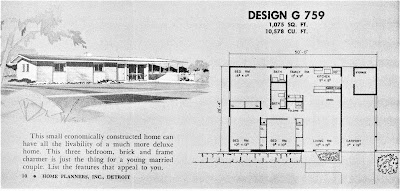
Click to enlarge.

This is plenty roomy for two quiet people, and perhaps a small child or two, even though at 1075 square feet it almost qualifies as a "tiny house" by today's standards.  The carport was quite a popular thing across the sunny South in the 1950s and 1960s.  Many houses very similar to this were built, and if you had one, you were doing well in life:  neither rich nor poor, but comfortably up to date.

I consider this a prime example of the simple, affordable ranch-style house, which came in many variations, larger and smaller.  Millions of people bought these houses on low-interest, low-down-payment FHA and VA loans.  Where I grew up, the price for this compact 3-bedroom, 2-bath house, depending on location, lot size, and options, probably would have been between $12,500 and $15,000 in 1960, or $110,000 to $130,000 today.  I vaguely recall that some smaller houses were sold for less than $10,000 in this period.

For comparison, you could get a Chevrolet sedan or a Buick station wagon for under $2500 then ($22,000 now).  And in the lower South and Texas, I recall that gas was around 22c a gallon (about $1,92 today).


Why do I say this is a good house design?  Let me point out some of the ingenious features of the layout.  
  • For one thing, it has two bathrooms - a rarity until the late 1950s.  Part of the reason is that until about 1956, FHA lending rules required every bathroom to have an outside window - when they started allowing interior bathrooms without windows, designers could more easily fit two into a small plan.  I used to own a house with a very similar floor plan, with a skylight over the hall bathroom.
  • The master bedroom is 13 x 11 - I can tell you from experience that this is the ideal size for a bedroom - big enough for a king-size bed and all the necessary bedroom furniture - but not so big that you feel you are sleeping in an airport terminal.  The second bedroom is big enough for twin beds; the third is small, but handy for use as a guest room or sewing room, or in today's world, a home office.
  • Notice also that the plumbing fixtures  (bathrooms, laundry closet, and kitchen) are all grouped at the back of the house - this saves a lot of money on piping in construction.  This arrangement of three bedrooms around two bathrooms is very clever and space-saving; I'll be showing more examples of this in future posts.  
  • Another brilliant feature is that each bedroom is insulated by closets from noise in other rooms - most important in a small house.  
  • The master bath opens into the "family room," which is a bit of advertising puffery - obviously, it's the logical place for a dining table, though it could be a play area for babies and toddlers under mother's watchful eye in the kitchen.  If you don't mind informality, a trendy breakfast bar could easily be built on the living room side of the kitchen wall, open to the kitchen. 
  • And finally, just look at that great big 7' x 8' storage room at the back of the carport, which could be anything you wanted it to be:  laundry room, workshop, garden shed, etc.  You could connect it to the house if you wanted, so you wouldn't have to step outside to use it.  I knew a couple of families where Dad turned this room into a hi-fi den, his private getaway.

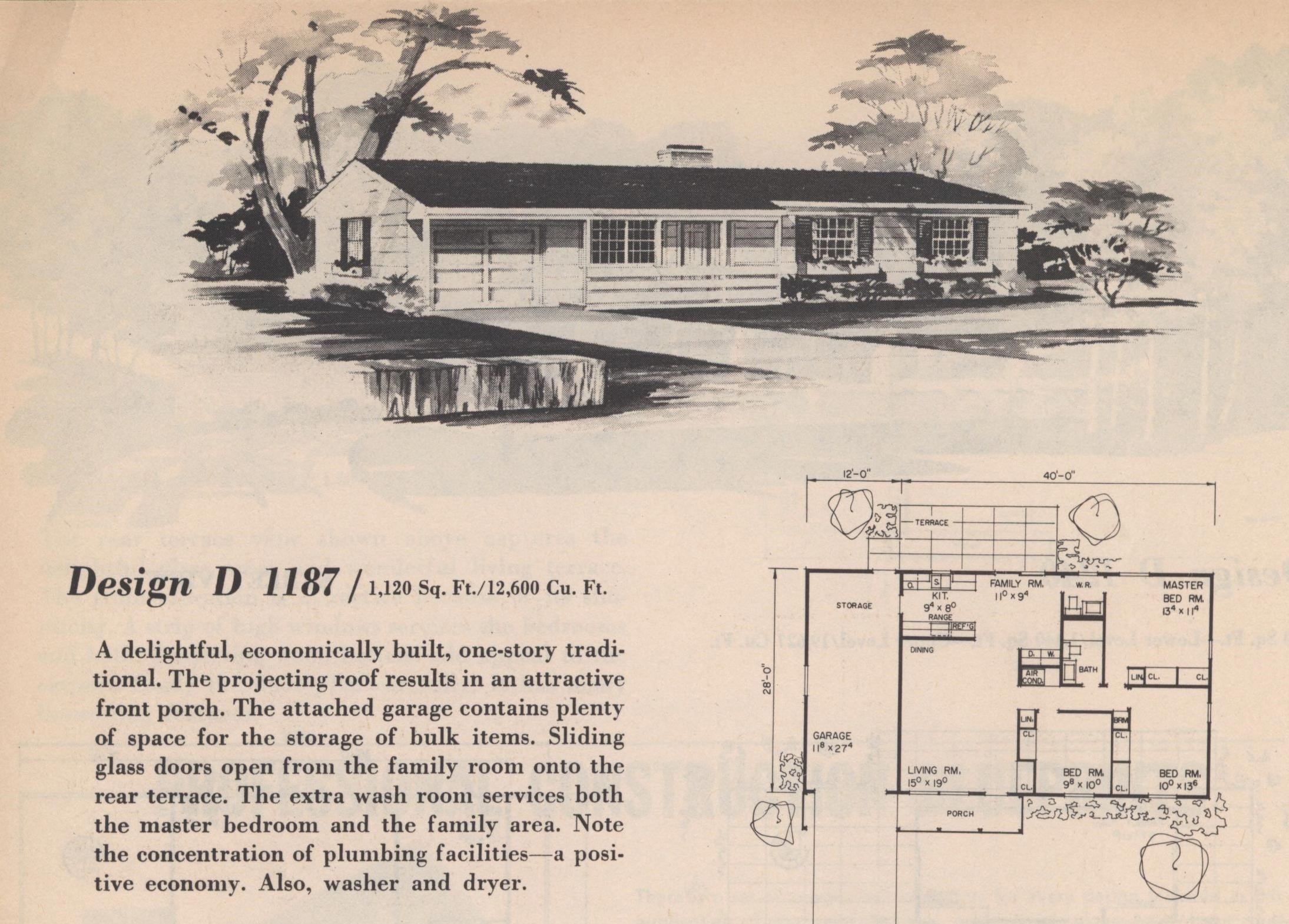
2,  Home Planners 1963 - Design D1187
3BR, 2BA - 40' x 28' - 1120 sq. ft.


The same plan as the first, but reversed and two feet longer, with a garage instead of a carport.  
  • The living room is larger, and so is the "family room" - I believe the dimensions of the latter room are mislabeled here, or on G759, as this is obviously a slightly larger room.  
  • The Pullman kitchen in both plans is quite small, but efficiently laid out; I'd extend the back kitchen counter two more feet to the edge of the sliding-glass doors, and extend the other by adding a 2-foot pantry closet, if I had my druthers.  
  • I'd also dispense with the trendy wall oven to get more counter space, and I would not have the range and the refrigerator jam up against each other - what a strange thing to do.  They should be at opposite ends of that counter, or one should be on the other side of the kitchen.

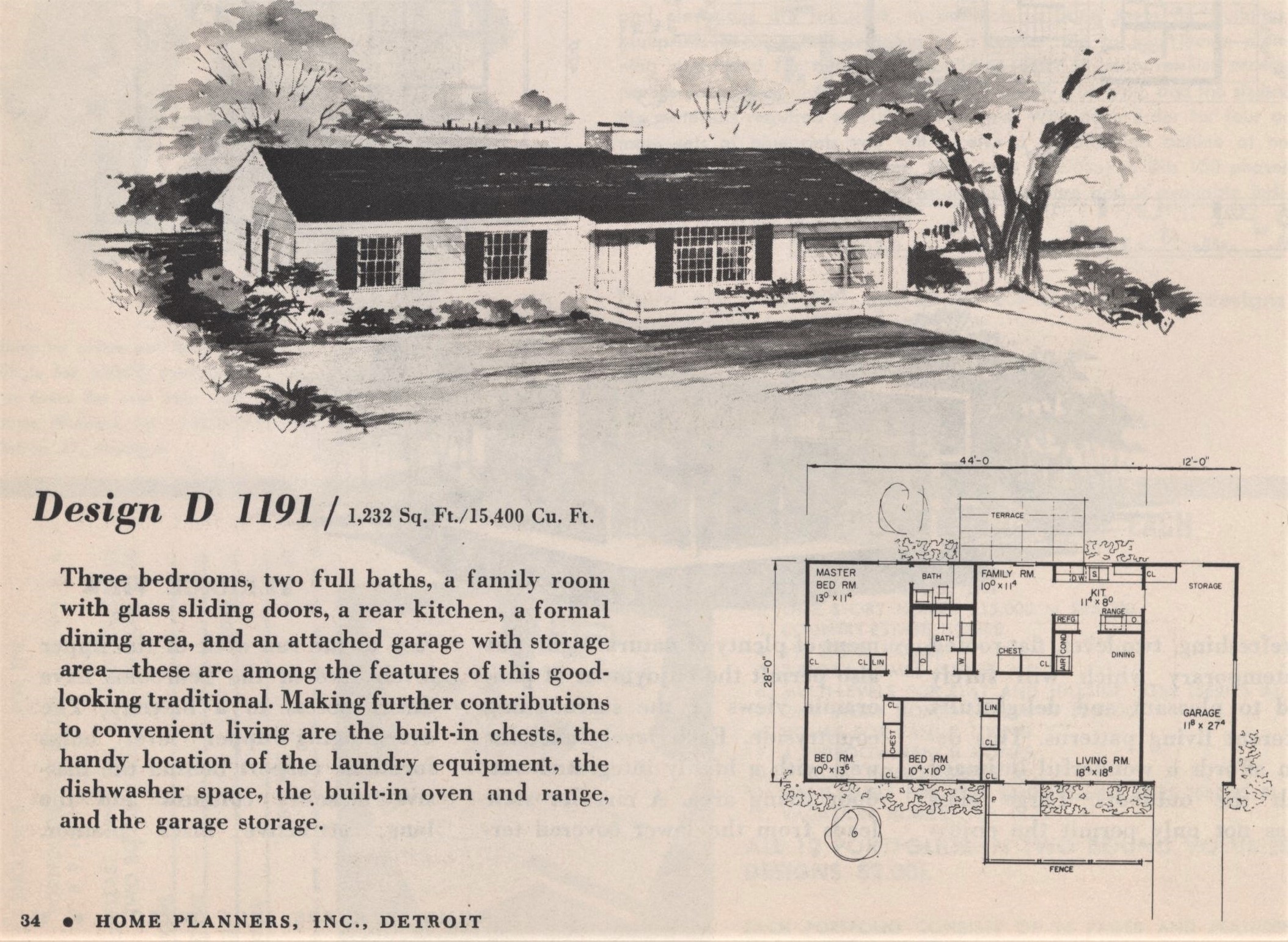
3.  Home Planners, 1963 - Design D1191
3 BR, 2BA - 44' x 28' - 1232 sq. ft.


Again, the same design but four feet longer and with some added features.  
  • Now you're talking - it's almost luxurious.  You're coming up in the world, making good money, and feeling fine.  The wife has more room to display her pretty furniture, draperies, and china.  The kids have plenty of indoor play room on rainy days.  The good traffic flow from room to room means you can entertain friends and family on weekends and holidays without crowding.  
  • The missus parks the new Pontiac in the garage overnight, while your ugly-cute VW bug waits patiently in the driveway for your morning run to the office.  All your hard work is really paying off now, with central air conditioning, wall-to-wall carpet in the living room, a console color television, a Barcalounger, and a big barbecue pit off the back patio.  It's the good life.
  • This plan has the same 3-2 plan of bedrooms and bathrooms, but notice that the master bath now has its own tub (I'd prefer a shower stall) and the washer and dryer are located outside the hall bath, convenient to the dirty clothes hamper, so no effort is wasted carrying clothes back and forth.  I'd rather put the machines in the garage, to avoid potential water-leak disasters, and use the two spaces for linen and towel closets instead.
  • The so-called family room begins to live up to its name, being insulated from the living-dining room by closets, and the kitchen is a bit bigger.  The back terrace is what everybody I grew up with called simply a patio - a slab of bare concrete.  This could be roofed over and even screened in, to make a more pleasant indoor/outdoor spot for patio furniture and outdoor meals.
  • I don't like the doorway that cuts through the kitchen into the living room, eating up precious counter space.  But I see no way to eliminate that doorway in this plan without completely redesigning the kitchen and family room.
I suppose it's obvious that all three plans are single-story and without basements, which was standard practice in my day.  Judging by plan books dating back to the turn of the century, it seems that basements were practically a sine qua non of northern houses, and perhaps still are - but they were rare in the suburban Deep South, as were two-story homes.  

By the way, central air conditioning was not a standard feature in most Southern homes, old or new, until about 1970 or after.  Before then, you opened the windows and ran electric fans to keep cool in summer.  In some localities, attic fans or swamp coolers were very effective.  Those who could afford to buy window-unit air conditioners typically used them to cool certain rooms - like the dining room at dinner time, or bedrooms on hot nights - not the whole house.

These ranch homes were typically built with crawlspaces underneath (pier-and-beam construction) or on concrete pads.  Rooflines of these one-story ranch homes were usually simple gables extending across the whole house, or hipped roofs, which were fashionable for a time.  Variations and elaborations did exist, though, and I'll show you some of those in future posts.

-----

Saturday, January 29, 2022

Commuting, 1964

These New York commuters going to and from work on July 17, 1964, remind me very much of the grown-ups in the world that I grew up in, down in a small Southern city (not a small town - there is a difference):  a world that was not quite ideal and certainly not perfect - but, as these mundane scenes suggest, an intelligible world that was still for the most part orderly and coherent, where grown-ups went off to work well dressed and well behaved, and just got on with the business of living.  Most of them, most of the time, anyway.  The contrast between then and now provides much room for reflection.  

Just mute the annoying soundtrack and enjoy a few minutes of time travel.  I wonder how many things you can spot that aren't around much anymore, like newspapers.


-----

Friday, August 6, 2021

Just for Laughs: Jack Benny at the Supermarket

We all love Lucy, of course, and her comic genius will live on as long as there is some kind of machinery to play her reruns.  But it seems to me that a number of other great comedians are most undeservedly forgotten in the modern world, and Jack Benny is one of the all-time funniest.  If you are in need of a laugh or two, this should do the trick; the best part is the second half, where Jack runs afoul of sarcastic store clerk Frank Nelson.


For the record, this episode of the Jack Benny Program was broadcast on January 22, 1961. 

-----

Sunday, September 1, 2019

Sunday Drive: Time Is Tight

Time flows on endlessly like a mighty river, and we small, frangible human beings mostly find ourselves drifting with the current, sometimes languorously over a broad stretch of placid water, and other times dashing and crashing through fearsome rapids that lead to who knows what on the other side.  All we can be sure of is that if we survive the rocks and shocks, we shall certainly be changed, for good or ill.

How short a span does fifty years seem in retrospect!  One can almost turn around and touch the past, it seems so near in memory.  The year 1969 was a turning point in American history in some ways, and certainly it was in my personal history:  the last golden, carefree summer before the hammer blows of life began to fall, forging childhood into adulthood in the years that followed.  There is a persistent myth that one's teenage years are the happiest of one's life.  I can testify that in my own case, they were anything but.

Nevertheless, for me this simple, lively tune by Booker T. and the M. G.'s from the spring of that watershed year perfectly expresses the exuberance of youthful, untroubled happiness.  I thought so then, and I think so now.  It always makes me smile.


Related Posts with Thumbnails