C I V I L    M A R R I A G E    I S    A    C I V I L    R I G H T.

A N D N O W I T ' S T H E L A W O F T H E L A N D.


Sunday, June 30, 2013

Late-night Thoughts


Five years ago tonight, this blog didn't exist, and same-sex marriage was available in only two states - Massachusetts (which had just revoked its 1913 law barring foreign couples from getting married if the marriage was illegal in their home state) and California, which had started marrying gay couples just six weeks before. A bare handful of other states offered civil unions or domestic partnerships. Gay couples in many places were still going off to Canada to get married, like Edie Windsor and Thea Speyer did.

I think too of all the quiet little commitment ceremonies - already now a dated phrase - that have taken place over the last forty years, all across the nation; usually in some private, secluded spot like a meadow, a beach, or a rented cabin in the woods, with a small group of friends to witness and celebrate. And I think of the many other couples, differently situated, for whom unwitnessed vows and private embraces had to suffice - like my late husband and I.

But what a stunning change in just five years: at midnight tonight, Delaware's new marriage equality law will come into effect, making a total of 12 states and the District of Columbia where gays can tie the knot - totally legal, just like the straights can, plus six more states that offer some kind of civil unions. On August 1st, Rhode Island and Minnesota will also become marriage-equality states, raising the total to 14, containing 30 percent of the U. S. population.

That's Change at a breathtaking speed. This is an historic period we're living through, folks, just like the late 60's/early 70's - as I well recall - when schools were integrating all across the South, and the "White" and "Colored" signs started to disappear. And suddenly, startlingly, there were black news anchors on TV, and female disk jockeys on the radio (that's right, children - there were no women DJ's before about 1972, not in my part of the world - radio was totally a man's business; and TV too, but they at least had the weather girls on some stations).

Of course we get frustrated now, as I'm sure progressive people were frustrated then, living with the day-to-day delays and surmounting the obstacles that remain - but it's all good. The tide is flowing in our direction now, and as Justice Scalia (who, make no mistake, has a brilliant legal mind, even if he is a bigot) said in his dissent this week, given the majority's ruling that marriage discrimination violates the Fifth Amendment, it's only a matter of time before we have marriage rights all across these United States.

For all this I thank, among others, our President, who despite some needless, equivocating foot-dragging, has delivered on DADT and is now making the federal government implement the post-DOMA changes as quickly as possible. Getting ENDA passed would be a great triple-play to cement his legacy as the Equality President, if he and our allies in Congress can get that done before his term ends. But just think, guys - how much of the last five years would have happened if McCain was president? Or Romney? Or, God help us all, Palin? What a chilling thought.

I still think it could be 2030 before the Deep South accepts the change - and here I mean the great red swath from Texas to South Carolina, which is the most conservative and most religious and most hell-no region in the country. The struggles will be fierce; there could even be scattered acts of violence and open rebellion. But in the next twenty years Change will come to my homeland too - if for no other reason than that the demographics make it certain. For example, whites in Texas are already only 48% of the population; in twenty years, Latinos will be over 50% and whites only 35%. Then too, the diehard, anti-gay, over-60 Bible-thumpers will be dying off.

Well I'm glad I have lived to see this much change in my lifetime. For me personally, nothing much actually changes out here on the prairie, but I do rejoice at the thought of the wonderful difference it all makes in the lives of others, whose pictures I've posted here on the Blue Truck, and for the generations yet unborn, who will take their freedom and equality for granted - and yawn over the history books, and wonder what was all the fuss about?

And won't that be fabulous.

Change you can believe in:
Edie Windsor as Grand Marshall in today's NYC Pride Parade.
When her car turned onto Christopher Street, the crowds roared,
"EDIE!  EDIE!  EDIE!"


Oh, Just Go Away


II.  Rachel and friends on Meet the Press this morning:

Visit NBCNews.com for breaking news, world news, and news about the economy
 
III.
 

Sunday Drive: From This Moment On

For all the happy couples in California, and everywhere, who at last can join two lives in one:


Saturday, June 29, 2013

Capping a Fabulous, Historic Week

The Empire State Building last night, lit for Gay Pride 2013


from Twitter via Joe.My.God.


CALIFORNIA MARRIES GAYS

San Francisco City Hall last night

Sandy Stier and Kris Perry are wed by the California Attorney General

Jeff Zarillo and Paul Katami are wed by the Mayor of Los Angeles


What a difference a day makes! While your Head Trucker slept Friday afternoon and evening, at around 3 p.m. California time the Ninth Circuit Court of Appeals lifted its stay in the Prop 8 case and allowed same-sex marriages to resume immediately in the Golden State. This surprise development caught everyone off guard, since it had been expected that the appeals court would wait out the 25-day period before the Supreme Court's ruling became effective. However, legal experts say the appeals court was well within its rights, and the law, to lift its own stay on its own ruling.

The plaintiffs in the Prop 8 case lost no time in getting hitched. In San Francisco, Kris Perry and Sandy Stier were wed by Kamala Harris, California Attorney General, at San Francisco City Hall, and likewise down in Los Angeles, Paul Katami and Jeffrey Zarillo were wed at City Hall by Mayor Antonio Villaraigosa. The timing is doubly delicious since it is Pride weekend in those cities, and Friday was the 44th anniversary of the Stonewall riots in 1969 that sparked the gay-rights movement.

Rachel reports on the breathtaking developments:

Visit NBCNews.com for breaking news, world news, and news about the economy

San Francisco International Airport

Friday, June 28, 2013

Waitin' for the Weekend

Private, consensual sexual intimacy between two adult persons of the same sex may not be punished by the State, and it can form "but one element in a personal bond that is more enduring." By its recognition of the validity of same-sex marriages performed in other jurisdictions and then by authorizing same-sex unions and same-sex marriages, New York sought to give further protection and dignity to that bond.

For same-sex couples who wished to be married, the State acted to give their lawful conduct a lawful status. This status is a far-reaching legal acknowledgment of the intimate relationship between two people, a relationship deemed by the State worthy of dignity in the community equal with all other marriages. It reflects both the community’s considered perspective on the historical roots of the institution of marriage and its evolving understanding of the meaning of equality.


--United States v. Windsor,
Supreme Court of the United States, June 26, 2013.


Upon hearing the news that DOMA has been struck down,
Michael Knaapen and his husband, John Becker, embrace 
outside the Supreme Court, Washington, D. C., June 26, 2013


Reaction to the Marriage Rulings: Anderson Cooper

Anderson discusses the effect of the rulings with Jeffrey Toobin, Andrew Sullivan, and Evan Wolfson:


Moment of Joy

Next week's New Yorker cover:

Reaction to the Marriage Rulings: David Cole

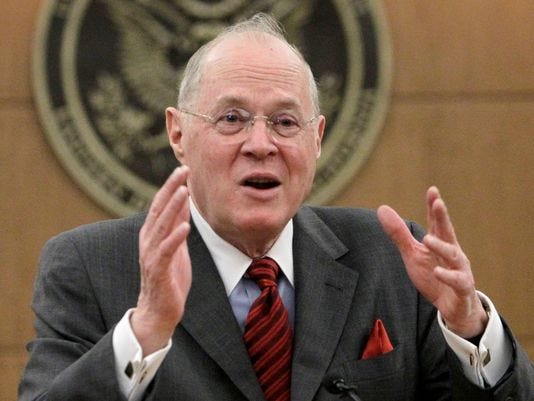
Justice Anthony Kennedy

David Cole, author, journalist, and professor of law at Georgetown University, writes in the New York Review of Books:
Together, these decisions are a consummate act of judicial statesmanship. They extend federal benefits to all same-sex married couples in states that recognize gay marriage, expand the number of states recognizing gay marriage to thirteen, yet leave open the ultimate issue of state power to limit marriage to the union of a man and woman. The Court took a significant step toward recognition of the equality rights of gays and lesbians, but by not imposing same-sex marriage on the three-quarters of the states whose laws still forbid it, the Court has allowed the issue to develop further through the political process—where its trajectory is all but inevitable.

What will the Court do when the issue of whether states can limit marriage to opposite-sex couples is put before it again? It is difficult to read Justice Kennedy’s opinion in Windsor without sensing, as Justice Scalia warned in his angry dissenting opinion, that the “other shoe” will drop eventually, and the Court will ultimately recognize that denying same-sex couples the right to marry violates the Constitution in the same way that denying mixed-race couples the right to marry does. (Significantly, in his opinion for the Court, Justice Kennedy cited Loving v. Virginia, the Court’s 1967 decision on interracial marriage, for the proposition that the state’s otherwise broad authority to define marriage is subject to constitutional limits.) But Kennedy’s opinion was nonetheless written in such a way to leave the question open while political thinking about gay marriage continues to evolve. . . .

So as a matter of pure judicial craft, Justice Kennedy could have been more clear and definite. But judging is not only a matter of craft. Justice Kennedy sought to walk a fine line—invalidating a federal law limiting marriage to opposite-sex couples without simultaneously resolving the question of whether similar state laws are constitutional. Had he pronounced that classifications based on sexual orientation are suspect and subject to heightened scrutiny, or had he held that the due process clause affirmatively protects the right of two committed adults to marry, regardless of sex, he would have, in effect, decided the broader issue. By focusing instead on the federal government’s unusual intrusion into a prerogative of state law, and its dramatic imposition of a double standard in states that recognize same-sex marriage, he wisely limited his decision to the federal law at issue. By allowing the transition to full recognition of same-sex marriage to take place gradually, Kennedy’s opinion avoided the backlash that a federal mandate to recognize same-sex marriage in every state might have triggered.

Ironically, Justice Kennedy did not join the majority opinion in Perry, the California case, which sent the issue back to district court. He dissented, joined by three other justices, and would have decided that case on the merits. Had he attracted a fifth vote for that view, it would have rendered all the care he took in the Windsor decision moot, because the Court would have had to address the question of state authority directly. The statesmanship of the two decisions, then, comes not from any one justice, but from the collective action of the court as a whole. There’s a reason we have nine justices. . . .

The justifications for denying a “dignity and status of immense import” to gay and lesbian couples are unpersuasive, whether at the federal or the state level. Same-sex couples, like opposite-sex couples, can and do make long-term commitments to live together as a family unit. They can and do raise children, pay taxes, care for dependent family members, and the like. The real reason so many states have denied marital status to same-sex couples is a sense, founded on tradition and moral disapproval, that these couples do not deserve it, simply because they are of the same sex. But the Court has already held, in Lawrence v. Texas, its 2003 decision invalidating state sodomy laws, that tradition and mere moral disapproval are insufficient grounds for differential treatment of gay and straight couples.

We will have to wait for the other shoe to drop, but drop it will.


FYI, from the Congressional Record, the Report of the House Judicial Committee, July 9, 1996, pp. 15-16, summarizing the principles and purposes of the Defense of Marriage Act then pending before the House:
Civil laws that permit only heterosexual marriage reflect and honor a collective moral judgment about human sexuality. This judgment entails both moral disapproval of homosexuality, and a moral conviction that heterosexuality better comports with traditional (especially Judeo-Christian) morality.
You can read the entire report here.

Thursday, June 27, 2013

Reaction to the Marriage Rulings: Sullivan


Last night, Andrew Sullivan summed up his thoughts about the momentous day:
Marriage is not a political act; it’s a human one. It is based on love, before it is rooted in law. Same-sex marriages have always existed because the human heart has always existed in complicated, beautiful and strange ways. But to have them recognized by the wider community, protected from vengeful relatives, preserved in times of illness and death, and elevated as a responsible, adult and equal contribution to our common good is a huge moment in human consciousness. It has happened elsewhere. But here in America, the debate was the most profound, lengthy and impassioned. This country’s democratic institutions made this a tough road but thereby also gave us the chance and time to persuade the country, which we did. . . .

So to those who are often tempted to write off America’s ability to perfect its union still further, to lead the world in the clarity of its moral and political discourse, and to resist the pull of fundamentalism when it conflicts with human dignity, let me just say: I believe.

Because I have seen.

And he quotes political theorist Hannah Arendt:
The right to marry whoever one wishes is an elementary human right compared to which "the right to attend an integrated school, the right to sit where one pleases on a bus, the right to go into any hotel or recreation area or place of amusement, regardless of one’s skin or color or race" are minor indeed. Even political rights, like the right to vote, and nearly all other rights enumerated in the Constitution, are secondary to the inalienable human rights to "life, liberty and the pursuit of happiness" proclaimed in the Declaration of Independence; and to this category the right to home and marriage unquestionably belongs.


Update: One of Sullivan's readers crystallizes a thought that was already forming in your Head Trucker's mind:
I don’t know about you, but my head explodes when I read the following from Scalia’s dissent: “We have no power under the Constitution to invalidate this democratically adopted legislation.”

You mean like you invalidated a whole section of the Voting Rights Act (just yesterday!) and tried unsuccessfully to sink the entire Affordable Care Act? I’m not a lawyer, and my lawyer friends assure me that Scalia is brilliant, if extremist, but I read that kind of head-turning inconsistency and all I see is a hack, not a brilliant legal mind. And again, I’m not a lawyer, but isn’t the entire purpose of the Supreme Court to review the constitutionality of legislation (democratically adopted or otherwise) and invalidate it when necessary? What a dipshit.

Power to the People

Amid our rejoicing over the marriage cases at the Supreme Court, your Head Trucker is sure that all his readers will admire what happened on Tuesday night in Austin:  the story of the triumph of Texas state senator Wendy Davis (D-Ft. Worth) and her legion of supporters over the pigheaded Republican good ol' boys who control Texas politics.  Rachel reports:


Visit NBCNews.com for breaking news, world news, and news about the economy
Related Posts with Thumbnails