From more than 60 years ago, I remember this fascinating photo of moving day in an American suburb that appeared in my World Book Encyclopedia, which my mom got me when I was 7. (The World Book was an education in itself - thanks, Mom!) I always did wonder how they got those all those big trucks in and out of that narrow street.
Now somebody has done the research to find out where this photo came from: it was taken in 1953 for an article in Life magazine about the booming Lakewood suburb of Los Angeles. The researcher uses Google Maps and his own video to show what the neighborhood looks like now. A fine job of sleuthing.
May 1st was moving day up north; I never heard of such a thing down south. This article from the Brooklyn Public Library gives the legal and historical background of the event, with some humorous period pieccs about the hustle and bustle. See also this Wikipedia article.
Photograph of a truck stop café in Washington, D. C., taken by Jack Delano for the Farm Security Administration, June 1940. See full-size photo at Shorpy
An evocative photograph of Israeli soldiers at chow, by Israeli photographer and gay veteran Adi Nes, that says something about the uncertainties of human life. To appreciate the details, click on the picture to see a large-size version.
I don't have much to say these days. I did my part to restore our democracy and decency by casting my ballot for Joe Biden; and thank God he was duly elected and is now our President. It's a big, big job to lead and heal this nation - especially in this new era of confusion and chaos, folly and fraudulence. May God bless and sustain him, and all who are working for justice, unity, and peace.
M.P. and I, though, have declared a moratorium on news-watching and discussion thereof. Even though good people are in power once again, the rising tide of arrogance, ignorance, and downright evil spreads so far and wide, like a second plague, that it just upsets us both out of all patience. But there is no point ranting and raving about it, disrupting the tranquility of our little home and our peace of mind. So although there are many things I could say about the insanity of the modern world, I prefer not to.
It was remarkable, a year ago, how palpably one felt a new era rumble into being: plague, poverty, riots, politics, all the hammer blows that changed the world happening at once. And all of it ghastly. I very much feel that I do not belong here: not a century I like or want to live in. The twentieth century was certainly not perfect; but in suburban America, at least, up until sometime in the 1960s, the world seemed to be operating on fairly stable, rational lines, faith in progress was still possible, and beauty was not yet an unspeakable word. And then somehow, though material things abounded, something of the spirit seemed to be withering away, and the center lost its hold. Let the reader understand.
Now the whole world seems a darkling plain, swept with confused alarms; when shall we wake from this nightmare? The future seems dim and doubtful to me; but in the midst of uncertainty we must hope for the best and do what we can.
Like many another old-timer, no doubt, I spend much of my time reading and thinking about the world that was, before everything got so very, very ugly: old trains, old cars, old houses, old movies, and so forth. I don't want to turn this blog into a "vintage" site - there are too many of those already - but in the absence of political talk, I may from time to time post some vintage things just to have something nice to show and tell, pleasantries which have nothing to do with present unpleasantness.
Here is a fascinating video about the photographer O. Winston Link, whom all railfans revere as the patron saint of the steam locomotive. In the latter half of the 1950's, he documented the last days of steam on the last major railroad to abandon coal-burners, and created a marvelous, magical record of a way of life now changed utterly, a time lost forever.
I was born just a few years too late to see steam locomotives at work, but Link's photography takes me back there - and away from this fierce, frightful modern world for a little while. I've known about Link's work for many years, but this is the first time I've heard him speak - a treat for me.
The video is blurry, unfortunately, but all of Link's original photos were quite sharp and clear as crystal. If anyone wants to see more of Link's superb photography, I can recommend his book, Steam, Steel, and Stars, very highly.
Researchers at Amherst College in Massachusetts, which has an extensive collection of manuscripts and other materials related to hometown girl and world-class poet Emily Dickinson, have released what seems to be, by all the evidence so far, a hitherto unknown daguerreotype of Emily and her friend Kate Scott Turner, taken in 1859.
Which is really big news in the literary world, since before now the only known photographic image of Dickinson is another daguerreotype made in 1847, when she was 16. In the teenage photo, she seems a bit shy and tense, but in the new image, she is fully grown up, confident and content, with just the barest phantom of a smile upon her lips.
Check out the two daguerrotypes, and the video comparison below, and judge for yourself whether it's really Emily or not.
In high school, your Head Trucker was quite taken by Dickinson's poetry, and she remains a lifelong favorite. When I got to college, I found the exhaustive 1955 complete edition of her poems, all 1,775 of them, and I think I must have read nearly every one of them. Wonderful stuff.
It also cheers me to think that the two greatest American poets of the 19th century - Emily Dickinson and Walt Whitman - were gay. In Whitman's case, most definitely. As for Dickinson - well, there's no proof, but it sure seems that way. Though of course not a word about their gayness was ever mentioned in any literature class I ever took, neither in high school or in college.
BTW - if you care about Dickinson at all, you simply must see the one-woman-show biography of her, The Belle of Amherst, played by the magnificent Julie Harris. It's a joyous, moving performance I think you will long remember, as I do.
Sanna Dullaway, a Swedish artist, has made a speciality of very carefully colorizing old photographs of famous scenes and people. Here's a couple of breathtaking examples that bring famous faces to life again - click to enlarge.
Last week I discovered that the Metropolitan Museum of Art has an online browsing feature where you can while away an afternoon or evening exploring their many and varied treasures from all over the world. I highly recommend it.
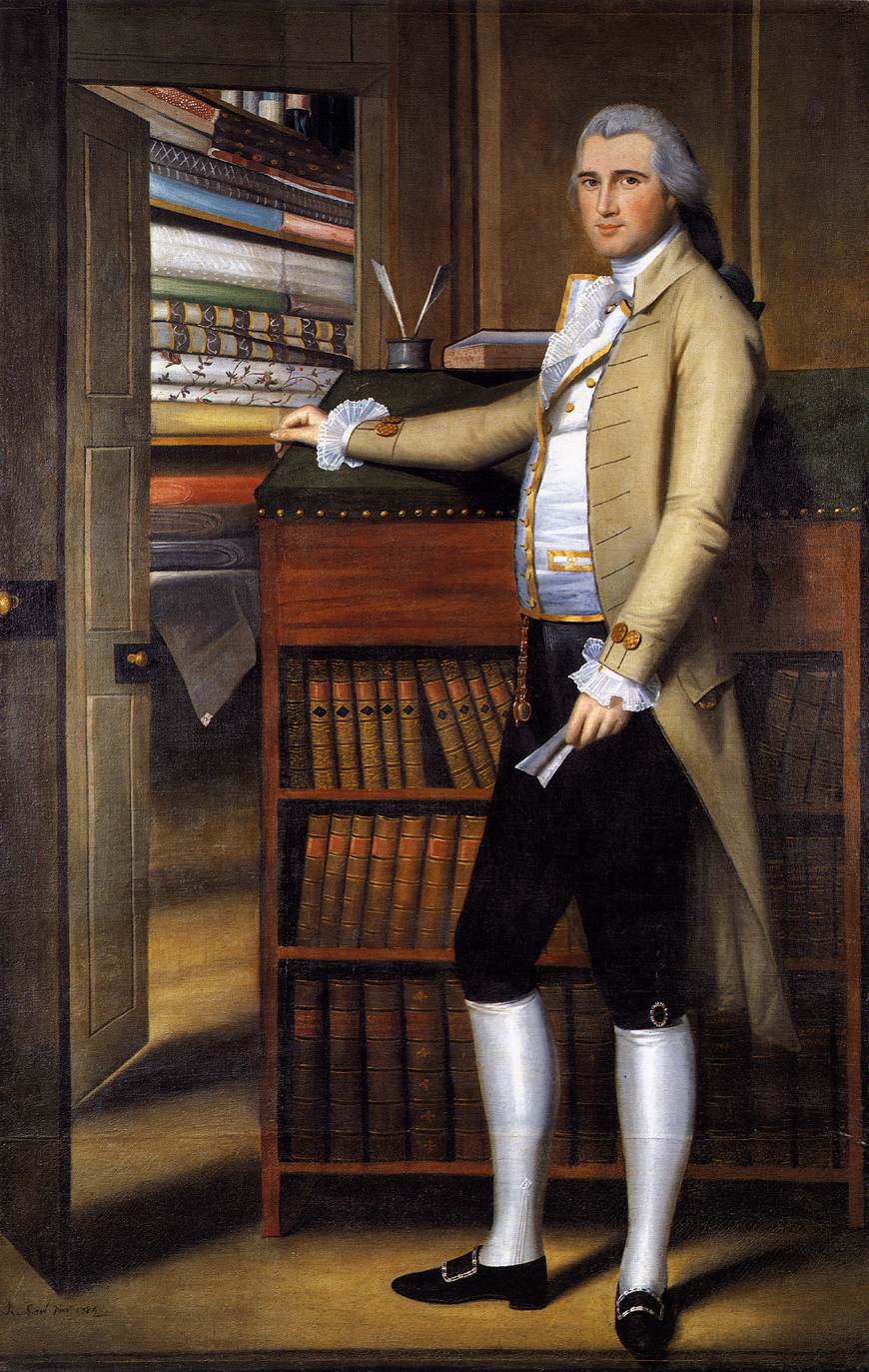
This portrait from the Met's American collection is one I have seen before, and I like it a lot. For one thing, unlike some colonial painters, this one is a master of realistic portraiture; and for another thing, the subject is quite a handsome fellow, don't you think, guys?
There's also a subtle trompe-l'oeil effect at work here, which is ingenious. Can you spot it?
Below the jump, a few more random pieces from the Met that caught my eye today; but do go make your own discoveries. What a wonder to be living in an age when you can enjoy so many beautiful things without having to make a long journey - or even change out of your pj's.
An awesome series of fly-by clips of earth and the aurora borealis, shot from the International Space Station a couple months ago. Pretty amazing. Use the full screen view on this one.
Americans are grappling with struggling markets, captured regulators, languishing employment, and rising inequality. Self-identified progressives, mostly found on or to the left of the Democratic Party, have for years made these issues central to their agenda. The moment seems ripe for the popular embrace of progressive policies. Instead, progressives find themselves embattled. "Voters feel ever more estranged from government -- and . . . they associate Democrats with government," explains Democratic pollster Stan Greenberg. The result is that "a crisis of government legitimacy is a crisis of liberalism."
Death doesn't change. But that doesn't mean that death escapes its time or culture. The older sections of Washington Cemetery have an identifiable style, too, Ciamaga said. The new stones are just the latest one. But if that's true, then these stones say something about the times in which we now live and die.
Our death stones are shiny and global and technologized to display high-resolution portraits of our loved ones. Our death stones are not quite as durable as the gray granite of the 20th century, but they are stitched between the rocks that came before.
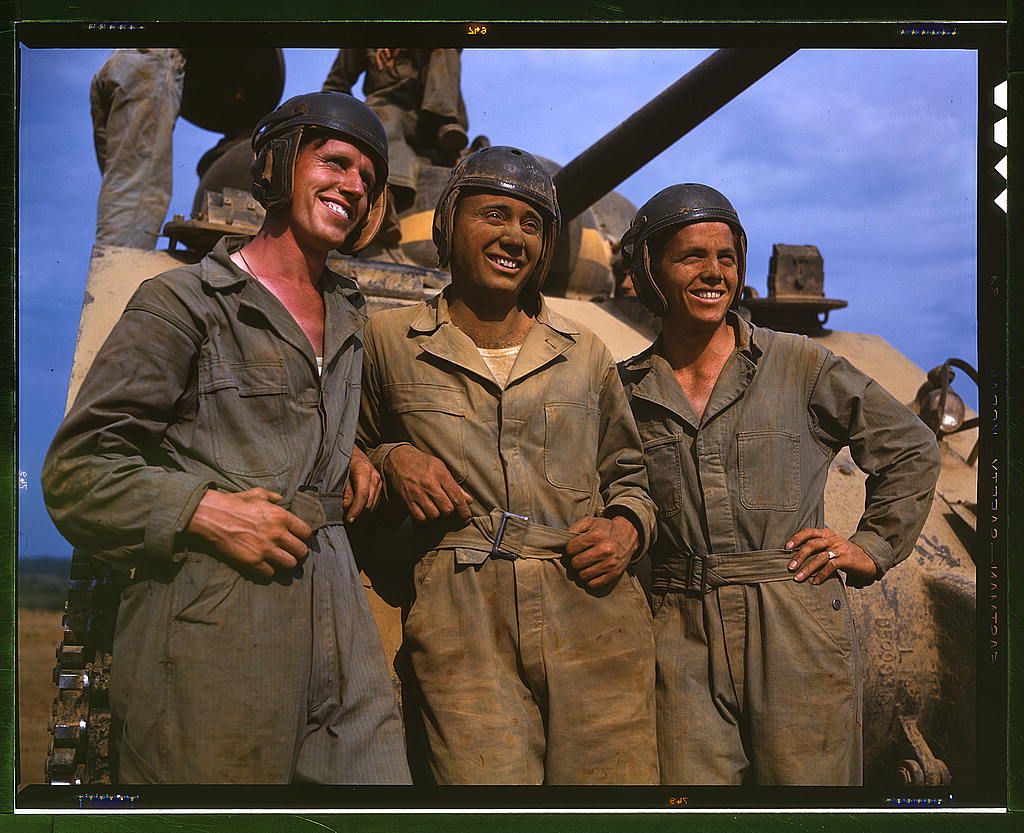
In 1942, soon after the United States entered World War II, President Franklin D. Roosevelt issued an executive order creating the Office of War Information (OWI). The new agency was tasked with releasing war news, promoting patriotic activities, and providing news outlets with audio, film, and photos of the government's war efforts. Between 1939 and 1944, the OWI and the Farm Security Administration made thousands of photographs, approximately 1,600 of them in color. OWI photographers Alfred Palmer and Howard Hollem produced some exceptional Kodachrome transparencies in the early war years depicting military preparedness, factory operations, and women in the work force. While most of the scenes were posed, the subjects were the real thing -- soldiers and workers preparing for a long fight. (45 photos)
Riots that erupted in London neighborhoods over the weekend spread to four other cities yesterday, as hundreds were arrested and at least one person was killed. What began as a protest against the police shooting of Tottenham resident Mark Duggan spread quickly into general rioting and opportunistic looting -- what Prime Minister David Cameron has called "criminality pure and simple." For three days now, buildings and vehicles have been smashed and set on fire, while stores and warehouses were looted. Police have been unable to do much to slow the mayhem. Tonight, some 16,000 police officers will be deployed to London's streets in an effort to quash the worst unrest in the city in decades. Collected here are images of the violence in the U.K. from the past several days. (41 photos)
"Why are there so many kids who have no ambition but to be horrible, criminal people that don't want to do anything other than cause misery for others? Their only aspiration in life is to be like someone in a rap video or to win the Lottery. All they want is a quick fix and that's fuelled by the media and by advertising.
And then there's all the good people out there who work hard and break our backs and do our best, and stay within the boundaries of what is right. I'm attempting to start my own small business but that's going to be even harder in this area now. I don't blame the police for not reacting fast enough. There are just thousands of scumbag criminals out there and not enough police," - Jon Davis, 32, an outraged resident of Croydon, South London.
Looters mugging an injured man:
Londoners volunteers turned out en masse today for cleanup duty in the debris-strewn streets:
It's been all over the news lately, but in case you haven't heard that Kodachrome film is no more:
Now, a note for posterity: Kodak made a number of varieties of film in addition to Kodachrome, which was used by people who could afford expensive cameras - the kind you can adjust the speed and aperture of - to take slides or movies or professional photos. Certainly a lot of middle-class people did, but some families, including mine, never had such fancy cameras. The Kodak film I always used to take snapshots with had a different name - and come to think of it, what was that? - Kodacolor, maybe. Not the same thing as the much-lamented Kodachrome, which was much more expensive.
In fact, my family never even used color film until the very late 60's - black and white film was cheaper, say $1.50 a roll compared to $2.50 a roll for color - so my parents stayed with that, and the black and white TV sets too, for a long time. It was what people were used to, you know, and for that matter, most magazines and books had only b&w pictures on the inside pages until the 1980's (except perhaps for colorful advertisements - and also excepting Playboy and that ilk).
So I never used Kodachrome, and its demise touches me only tangentially as a sign of the times, the inexorable flow of days and years, the unending loss of the present moment, the familiar, the expected. There's a comfort in the usual patterns of life which is always being eaten away at the edges, as the waves pull at the sands of the seashore. Everything in this mortal life is transitory, impermanent as a dream no matter how solid it may seem. Including our very selves and all that we hold dear.
Be that as it may, there are compensatory additions from time to time. Who now could do without a microwave oven? Which I recall was, forty years ago, strictly a luxury item, very expensive, which took me a couple of decades to see the use of. Now I use it all the time, practically every hour of the day when I'm at home: a most useful invention.
Cell phones are another great convenience - even though your Head Trucker still hasn't figured out how to take a picture with his, and doesn't much care. I marvel now that we used to take long road trips to see family and friends perhaps a thousand or more miles away - and embarked merrily on the journey, trusting only to God and Chevrolet against the chance of being broken down and stranded on some lonesome stretch of highway, far from any help. I don't even go to the grocery store now without my phone, but we were braver in those days.
Your Head Trucker has, however, gotten the hang of using a digital camera, and boy howdy, what a treat it is. I've had my little Kodak C-330 for five years now, and I dearly love it. In my teens and young adult years, I used to have a vague hankering to learn photography - at one time there was a PBS how-to show on the subject that I used to watch sometimes. But it required a really good single-reflex camera to start with, which was beyond my pocketbook for many years. Then too, it seemed to be de rigeur that to be a real photographer, you had to have your own darkroom and know how to use it - which required more expense, and space that I never had anywhere I lived. So that was a little daydream that never went anywhere.
But the digital camera was a revelation. Suddenly, for only $150 or so, I found I could take endless pictures from all angles in all kinds of light, and actually produce a few that were worth keeping - all quite easily and cheaply. You can even see the picture on your camera screen as soon as you take it, and know whether to try again. And no counting frames, or worrying about how much it would cost to develop all the photos you took - very liberating, and a new creative outlet that I've enjoyed immensely. A very good change, despite all the laments over the passing of film: the expense of film and equipment made it a hobby only for the affluent.
And then, of course, there's the internet, which is quite frankly a godsend to anyone who lives in the sticks as I do. And for people who live in town, too: an unending source of entertainment, communication, and creative endeavor that as far as I'm concerned is an unquestioned necessity now. In recent weeks, for unrelated reasons, both the ex-roommate and I have each experienced a few days without internet service. And we both agree, it was nearly unbearable - just as much as if the water were turned off.
Which is odd, when I stop and think about it. I perfectly recall life before home computers - I used them at work a long time before I got one of my own, in 1999 - and how I was quite content to come home and in my leisure time read a book, call a friend, or simply flop in front of the TV. But now times have changed, and I've changed. Life is that way; the tide is always tugging at you, pulling you on, whether you will or no.
So we must always be balancing the losses against the gains, and adjusting to the shifts and turns of life. And always, human life is a mixed bag of blessings and curses, advances and retreats. Just yesterday, for example, surfing through Wikipedia with no particular goal in mind, as I am wont to do, I stumbled across this paragraph in an article about a British politician most Americans have probably never heard of, Roy Jenkins:
As Home Secretary from 1965–1967, he sought to build what he described as "a civilised society", with measures such as the effective abolition in Britain of capital punishment and theatre censorship, the decriminalisation of homosexuality, relaxing of divorce law, suspension of birching and the legalisation of abortion.
Perhaps all that is well and good - but it did give me pause. More than four decades later, is our Western civilization really a more "civilized society" than it was before the 1960's?
PRR ad, 1948
Or merely different? Human nature never changes, merely the outward forms and fashions. All our scheming, inventing, and rearranging may make the world more comfortable in some ways - but convenience is not quite the same as progress - is it?
Only one thing is certain: you can't go home again.
These beauties from 1922 live again in this early test of Kodachrome motion picture film, newly scanned and digitized by Kodak. The first feature-length movie in color didn't appear till 1935.
Miraculous.
Honk to my truckbuddy dave for tipping me to this clip.
Not all these guys were necessarily gay. Some might have been brothers, or just good friends - in the pre-Stonewall world where nobody was out, the very idea of same-sex attraction was unspeakable: homos didn't exist in daylight but only in the dark corners of the imagination. Thus, straight boys could get away with more mugging for the camera than would be possible today, perhaps.
And then too, in some cultures it was just the custom for male friends to display affection more openly than in America; think of French men doing the double-kiss-on-the-cheek routine - or at least the way they used to in the movies, who knows what they do now.
Still, having said all that - these charming pics make you wonder. And some of them, at least, were undoubtedly gay. Even if they didn't know the word for it. Enjoy.
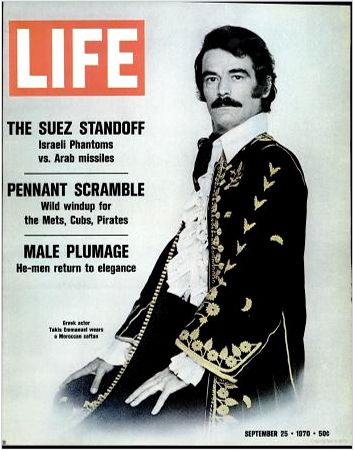
I reckon all you guys who ever use Google Images know that the Life magazine photo archives are available thataway. Today, I just happened to discover that the complete archive of every Life issue from the main run, 1936 to 1972, is also on Google. Pretty cool. Brings back memories of a time when the world in all its dizzying, glamorous, frightening, amusing complexity arrived at your house in the mailbox every week - in some ways more intriguing than television because you could sit and pore over the text and photographs, some of them quite large, for as long as you wanted, pondering the immensity of the world you were growing up into.
Below, three covers from May, August, and September 1970, respectively. I remember that summer well, I was 15: no longer quite a boy but not yet quite a man. Already aware quite definitely that I was a homosexual - that word is starting to have a bit of an archaic ring, isn't it? - and beginning the long, dark journey through years of isolation, guilt and depression, while my contemporaries were loving life and finding their places in the world.
An online exhibition at the Library of Congress with seventy color images of rural and small-town life taken for the Farm Security Administration and Office of War Information.
It was hard to choose just a few to show you here, nearly all of them tell a story. Go check it out for yourself: the world our parents knew, scenes that were rapidly fading away by the time we baby boomers came along - preserved here at the dawn of the Kodachrome era.
That's the title of this old favorite of mine, found again today at Iconic Photos:
Be sure to click and enlarge so you can drink in the details of this masterful, very shrewdly composed photograph. I think it speaks for itself, so I won't explain other than to say it was taken on August 2, 1956, by the great O. Winston Link, who famously documented the final years of steam on the Norfolk and Western.
I have a couple of books of his photos. Click here to view the entire collection online. Below, an N&W magazine ad from 1948 showing the territory it served.
Lord, make me an instrument of your peace. Where there is hatred, let me sow love; where there is injury, pardon; where there is discord, harmony; where there is doubt, faith; where there is despair, hope; where there is darkness, light; where there is sadness, joy. Grant that I may seek not so much to be consoled as to console; to be understood as to understand; to be loved as to love. For it is in giving that we receive; it is in pardoning that we are pardoned; and it is in dying that we are born to eternal life. Amen.
.
We cannot all do great things, but we can do small things with great love.
and welcome to the Blue Truck, a blog for mature gay men with news and views on gay rights, history, art, humor, and whatever comes to mind. Plus a few hot men. The truck's all washed and gassed up, so hop in buddy, let's go.
CAUTION: For mature gay men only beyond this point. Some posts and links may not be suitable for children or the unco guid. You have been warned.
Insert valid picture ID with date of birth now, or click here.
My Story
click photograph to read
Churches say that the expression of love in a heterosexual monogamous relationship includes the physical, the touching, embracing, kissing, the genital act - the totality of our love makes each of us grow to become increasingly godlike and compassionate. If this is so for the heterosexual, what earthly reason have we to say that it is not the case with the homosexual?
It is a perversion if you say to me that a person chooses to be homosexual. You must be crazy to choose a way of life that exposes you to a kind of hatred. It's like saying you choose to be black in a race-infected society.
If God, as they say, is homophobic, I wouldn't worship that God.