C I V I L    M A R R I A G E    I S    A    C I V I L    R I G H T.

A N D N O W I T ' S T H E L A W O F T H E L A N D.


Showing posts with label human nature. Show all posts

Tuesday, March 22, 2022

Soldier and Son

Karl Friedrich Deckler, The Farewell of Hector to Andromaque and Astyanax
The Farewell of Hector to Andromaque and Astyanax
by Carl Friedrich Deckler, via Wikipedia.
Click to enlarge.
 
This video of a Ukrainian soldier bidding goodbye to his wife and baby son is a striking reminder of a scene in the Iliada poignant moment set during the Trojan War, 1200 years before Christ - a scene which no doubt has been repeated in real life times without number in all the centuries since.


Homer, like Shakespeare and all the other great writers of the past three millennia, had the divine gift of capturing the telling moment that reveals the humanity of his characters, in common with us all.  We moderns are not different creatures from our Bronze Age ancestors, whoever they were - fashions of dress, art, music, and speech may ebb and flow, but human nature does not change.

Hector, eldest son of King Priam, was the crown prince of Troy.  His wife was Andromache, and their little son was called Astyanax.  The scene opens with Hector suited up in his shiny bronze armor and helmet, ready to lead the Trojan army into battle against the Greeks, encamped before the city.  

Before departing, he goes to his house, within the walls of Troy, to say goodbye to his wife and son - an excerpt from Book 6 of the Iliad, in the lucid translation by Robert Fagles (1990):

A flash of his helmet

and off he strode and quickly reached his sturdy,

well-built house. But white-armed Andromache--

Hector could not find her in the halls.

She and the boy and a servant finely gowned

were standing watch on the tower, sobbing, grieving.

When Hector saw no sign of his loyal wife inside

he went to the doorway, stopped and asked the servants,

"Come, please, tell me the truth now, women.

Where's Andromache gone? To my sisters' house?

To my brothers' wives with their long flowing robes?

Or Athena's shrine where the noble Trojan women 

gather to win the great grim goddess over?"


A busy, willing servant answered quickly,

"Hector, seeing you want to know the truth,

she hasn't gone to your sisters, brothers' wives

or Athena's shrine where the noble Trojan women

gather to win the great grim goddess over.

Up to the huge gate-tower of Troy she's gone

because she heard our men are so hard-pressed,

the Achaean fighters coming on in so much force.

She sped to the wall in panic, like a madwoman –

the nurse went with her, carrying your child."

At that, Hector spun and rushed from his house,

back by the same way down the wide, well-paved streets

throughout the city until he reached the Scaean Gates,

the last point he would pass to gain the field of battle.

There his warm, generous wife came running up to meet him,

Andromache the daughter of gallant-hearted Eetion . . .


She joined him now, and following in her steps

a servant holding the boy against her breast,

in the first flush of life, only a baby,

Hector's son, the darling of his eyes

and radiant as a star . . . 

Hector would always call the boy Scamandrius,

townsmen called him Astyanax. Lord of the City,

since Hector was the lone defense of Troy.

The great man of war breaking into a broad smile,

his gaze fixed on his son, in silence. Andromache, 

pressing close beside him and weeping freely now,

clung to his hand, urged him, called him: "Reckless one,

my Hector - your own fiery courage will destroy you!

Have you no pity for him, our helpless son? Or me,

and the destiny that weighs me down, your widow,

now so soon?" 


And tall Hector nodded, his helmet flashing:

"All this weighs on my mind too, dear woman.

But I would die of shame to face the men of Trpy

and the Trojan women trailing their long robes

if I would shrink from battle now. a coward.

Nor does the spirit urge me on that way.

I've learned it all too well. To stand up bravely,

always to fight in the front ranks of Trojan soldiers."


In the same breath, shining Hector reached down

for his son - but the boy recoiled,

cringing against his nurse's full breast,

screaming out at the sight of his own father,

terrified by the flashing bronze, the horsehair crest, 

the great ridge of the helmet nodding, bristling terror

so it struck his eyes. And his loving father laughed,

his mother laughed as well, and glorious Hector,

quickly lifting the helmet from his head,

set it down on the ground, fiery in the sunlight,

and raising his son he kissed him, tossed him in his arms,

lifting a prayer to Zeus and the other deathless gods:

"Zeus, all you immortals! Grant this boy, my son,

may be like me, first in glory among the Trojans,

strong and brave like me, and rule all Troy in power 

and one day let them say, 'He is a better man than his father'.


So Hector prayed

and placed his son in the arms of his loving wife.

Andromache pressed the child to her scented breast,

smiling through her tears.


-----

Thursday, March 12, 2015

Diana's Dresses


What kind of person would shell out a hundred grand or more for a second-hand dress? This 1999 BBC production takes a look at the designers, art collectors, Southern belles, drag queens, and shrewd millionaires who were involved in the hagiography of a troubled princess - which now, with the passage of time enabling a cooler look back at the frenzy surrounding Diana's death, provokes some profound reflections on fame, money, vanity, hero worship, and human nature.


Thursday, February 12, 2015

Alone in the Taiga

Smithsonian magazine published a couple of years ago this fascinating article about a Russian family who fled Stalinist persecution to live in a remote area of Siberia in the 1930's and remained there with no other human contact for four decades, grubbing a living out of the wilderness and practicing their fundamentalist Old Believer faith - they didn't even know that World War II had happened until they were found by a team of Russian geologists exploring the area by helicopter in 1978. But they still refused to return to "sinful" civilization - now only one is left, 70-year-old Agafia, who is shown in this 2013 video.


This story brings up many profound reflections on human nature, society, religion, and materialism - but I will leave you readers to explore your own thoughts on those things. Your Head Trucker will say only that on some days he can well sympathize with the desire to find a remote, happy little spot far from the madding crowd - but he would damn sure pick a warmer spot than Siberia to exile himself to! Aruba, maybe.


Thursday, June 7, 2012

You Just Can't Win

While the rest of the world looks on admiringly, the stalwart British public
turns out in the hundreds of thousands to pay their respects to the Queen
and show how much they care about their Royal Family.

As a public service, your Head Trucker would like to present the following items to illustrate the fickleness of crowds and the treachery of human nature:

(1)  Prince Charles: At ease with himself and the nation
The Diamond Jubilee celebrations have revealed a new and more loveable Prince of Wales who caught the public mood brilliantly. . . .

(2)  Prince of Wales presents a real danger to the monarchy
We know far too much about the Prince's foibles and past errors to revere him as we revere his mother. . . .


Both articles appeared in the same goddamn newspaper - the Telegraph - in the last 24 hours, with the last echoes of "God Save the Queen" still reverberating in the air over Britain. 

Which just goes to prove the truth of the utterance by the first Queen Elizabeth:  All affection is false.  And she knew what she was talking about.

I won't bother to analyze each article for you - you guys can read, can't you? - only to observe in passing that the first is based on an utterly false premise (i.e., that Charles has somehow had a magical change of personality in the last week, when this distant and disinterested observer can discern no change whatever in the way he's always been these last forty years or more).

The second, at bottom, is based on the unremitting woman-scorned attitude that utterly refuses to let Diana rest in peace.  The writer asks if she can be the only one who wondered "what that woman was doing in the Queen's carriage."  Which tells you all you need to know about the writer, who has spent the last few days turning out breathless encomiums on all the Queen's saintly virtues - and does not understand a single one of them.

To which I would only add, if Diana's own sons don't hold a grudge, who the hell are you to do so?  And just what kind of hell and high water has your own stumbling family been through?  And why don't 60 million of your fellow countrymen get to gossip all to hell and back about every single sin you've committed, in minute and intimate detail? World without end, amen.

Without saying a word, seems to me, the Queen made things perfectly clear this weekend what the programme is.  Just for the record, and to reassure all my British and Commonwealth truckbuddies, here is how it's all going down.  There is no point pissing and moaning about it, because there's just no point:

1.  No, the Queen will never abdicate.
2.  No, the succession will not skip a generation.
3.  Yes, Charles will be the next King and
4.  Yes, Camilla will be Queen - not Princess, not Duchess, but Queen.
5.  Barring unforeseen calamity, Wills and Kate will not reach the throne until they are a boring middle-aged couple that your kids will see no relevance in, until they get to be certified antiques too.

And that's it.  If you British bitches don't like it, well then - change it and be done with it, for fuck's sake.  God knows we Americans have amply proven that a monarchy is not a necessary thing, and so have the French.  Go ahead and get it over with:  pension the Queen off, give her a council flat in Bayswater, a commemorative tea cosy, and a nice thank-you card.  Then turn all the royal palaces into museums, or better yet, pull them down and build some nice, new football arenas and shopping malls.  Or, ooh, casinos! Screw Monte Carlo, just think what a shot in the arm that would be for your economy.

And maybe reserve some flats for various sheiklets willing to pay top dollar to live like Real English Gentlemen while their sons are at Eton and Harrow. It's all about having the right address, isn't it? And a golden statue of Diana and Dodi, together forever atop the former Victoria Monument. I mean, the Exchequer could use the cash, couldn't it? Then you could really tell Brussels to bugger off, and mean it.

Or consider long-term leases to multinational corporations. Wouldn't it be, like, totally cool to see a pair of Golden Arches stretching across what used to be Buckingham Palace? Or a giant KFC bucket rotating over Windsor Castle? Just think of the ad money and tax money your Inland Revenue could squeeze out of those deals. You could balance the budget in a trice, kit out the whole Fleet with new rowboats, and still have enough left over to pay poor little Princess Samantha the million quid she's owed as compensation for all the emotional pain and suffering of having to lower herself and wear an actual hat in public.

The Queen will be very disappointed, of course, but you know the old girl will buck up and obey your bidding as dutifully as she always has. I'm sure that nice Julian ("I-want-my-wife's-grandfather's-peerage") Fellowes could be prevailed upon to give her a bit part in Downton Abbey, to keep her occupied and feeling useful. Head housekeeper, perhaps, with Philip as the crusty old head gardener. (Wouldn't the Guardian pee all over itself?) And wouldn't it be kinder to let her know how you really feel, now, instead of giving her false hope for the continuing loyalty of her so-called subjects to her family and dynasty?

She won't try to stop you, you know.  As far back as 1969, Philip said in a famous American interview (maybe you didn't catch that one):  "We'll go quietly." And they would, too. They'd have no choice. Ever since 1689, you've been pulling the strings on the monarchy, and not the other way round. They did teach you that in school, didn't they?

While you're at it, you might as well go ahead and dismantle the Church of England too - and that will be such fun, gobbling up all that lovely, centrally-located property and repurposing it for pubs and betting offices and nail salons, etc. - Henry VIII would tell you that.  And for good measure, why not just go whole hog and rebrand the entire country - or what's left to you after the Scots and the Welsh and the Cornish and who knows who else, maybe Manchester United, get done carving it up.  Also, stop saying "British" this and "British" that - it's so old-fashioned, isn't it now?  And really rather racist too, when you stop and think about it.  I'm sure I heard Ed Miliband say that just the other day.

While you're at it, why not come up with a whole new name and logo for the country?  (I mean, lions and unicorns, seriously?  So last-millennium, isn't it?)  Utopia's been done, and Cool Britannia was a flop, but I'm sure if you all put your heads together, say at your next big karaoke party, you can come up with something really flash.  And then won't life be grand?  With no sodding monarchy to hold you back, exorting that crushing 77 pence a year from each and every one of you, why, England could become as great as . . . mmm . . . Alabama, maybe!   With nukes.  I can't wait to hear that phrase roll off President Blair's lips.

Or if you don't want to do all that - at least quit bitching about your own Royal Family.  Just as with your own relations that you didn't get to choose either, you get what you get, and that's life.  Deal with it.  It's like the wife who always runs down her husband, or the husband who always criticizes his wife in public.  It reveals so much more about the speaker than the object of the whining.  And what it reveals is really ugly.  You want a divorce, go get one, and more power to you.  But while you're together, don't advertise how unhappy you are:  it just makes you look fucking rude. Not to mention really rather dim.

Oh, and I forgot to add the last item on the list:

(6)  Yes, the Queen will be received straight into Heaven when she dies.  Because nobody else, and I mean nobody, would have put up with all you moaning bitches for half as long.  Oh yes, you saw the fireworks and the rock stars and the miles of bunting, and squealed with delight like teenage groupies - but this is the one essential thing that you lot, in the media at least, still haven't seen.

A life of heroic virtue, indeed.  You couldn't pay me enough to take the job.  Not even.

Sunday, November 20, 2011

Great Soul with Clay Feet


My favorite books tend to be histories and biographies.  Since childhood I have always been more interested in the past, which is to some degree certain and knowable, than in the future, which is anybody's guess, and probably best filed under "You Don't Want to Know."  I will admit to an adolescent fascination with science fiction - Heinlein was tops in my estimation, followed by Bradbury and Asimov, and of course, like every other 12-year-old, I had a passion for Star Trek - but somehow I grew out of all that. 

I suppose I became less enchanted with the possibilities of the future as it slowly dawned on me that I had little control over things to come, the wide, sunlit vistas of childhood anticipation shrinking inexorably into the narrow bounds of my small and somewhat weedy garden:  hard tilling much of the time with the limited tools available to me.  Of course other people, possessed of greater abilities and finer soil, may yet feel the unbounded possibilities of life well into middle age; but such was not vouchsafed to me.

Be that as it may, I find it endlessly intriguing to read of how other people - both the great and the good, as our British friends are wont to say, as well as the poor and the humble - have reacted to the storms and stresses of life, how they charted a course through gales and high seas to reach a safe port or deliver a rich cargo - or, contrariwise, how they lost their bearings and ended up aground or shipwrecked, as the case may be.  After reading a great many such stories, with a philosophic eye, one begins to notice certain recurring themes and patterns:  those who make a safe landing in the end, very generally speaking, tend to be well endowed with the qualities of persistence and self-discipline - they have a job to do, and they stick to it come hell or high water, always busy and always reaching a little further ahead or upwards; they do not give up and say, "Oh, what's the use." 

I think that very often, such folks attribute their success in life to the favoring motions of Providence, when in fact it is largely their own stubborn perseverance that sees them through - which success some of them, on some occasions, take too much pride in, and look down their noses at others less blessed than they with these inner qualities.  Your Head Trucker, most unfortunately, has more often than not fallen into the what's-the-use camp, to my great disadvantage, being more heavily freighted with passion than with discipline:  which, while the combination sometimes produces lovely things, has never been a recipe for great success in the material sense.

A couple of other adjuncts to success, which often lead straight to fame and fortune, may be noted. One is just the sheer dumb luck of being in the right place at the right time - the unknown understudy who steps in when the leading lady falls ill, the reporter who just happens to be on the spot when some disaster occurs, and so forth.  Another crucial adjunct is the invaluable faculty of - how to define it? - I'm not sure there's a single word in English which combines what I want to express here, the ineluctable combination of personal charm, a kind of social magnetism, with the ability to meet many people easily and make quick friendships - of the sort that, when somebody needs a thing done or a problem solved, they think, "Oh yes, X could do that . . . " and straightaway they pick up a phone or dash off a telegram, summoning you to the next big step in your career. 

Which never happens to your Head Trucker, and exactly why that is I really can't say.  No doubt the inadequacies of my own talents are only too obvious to others, so that when they think of me, they say to themselves, "Oh . . . him."  And think no more in that direction.  Just my personality, I suppose, probably more prickly than charming, and one that will never be the subject of a biography, rightly so.

Well, that's just the breaks; not everyone gets to live a fascinating life, and if they did, fascinating would quickly become banal, wouldn't it?  Still, as I said, it is rather interesting to read how various personalities in all sorts of positions and places have acted and reacted down through the years, some with more success - and honesty and effort - than others.  Likewise, it is instructive to read a well written and researched study that uncovers the face behind the mask, the man behind the curtain.  We all of us have a public persona, the mask we present to the world, delineated with confidence and certainty - but then there is the private reality, which may or may not accord very closely with our public face.  The difference between the two is magnified in the lives of the famous, sometimes amusingly so, sometimes shockingly.

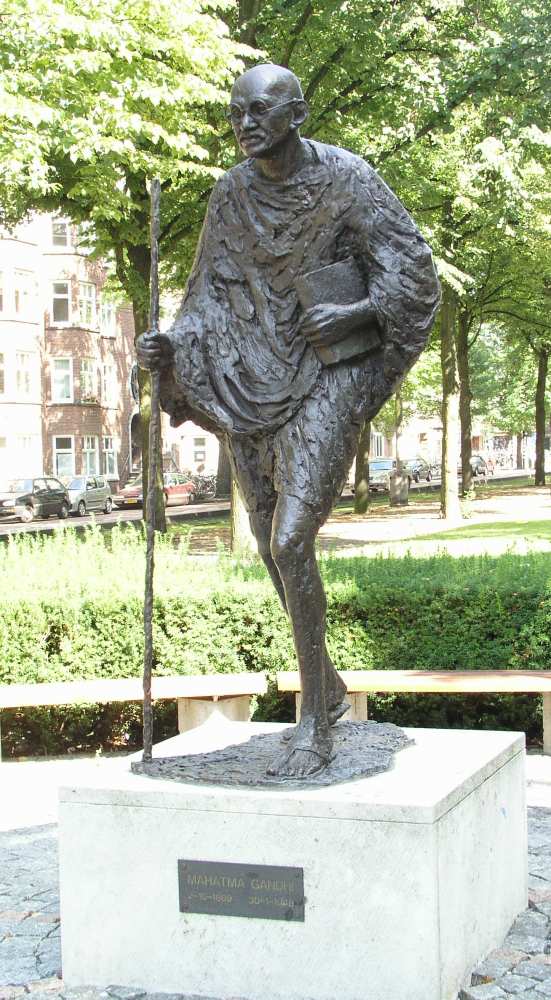
For example, I recommend to my readers this very interesting review of a recent biography of Gandhi, which seems to reveal a rather different person behind the mask of sainthood we have come to revere:
Joseph Lelyveld has written a ­generally admiring book about ­Mohandas Gandhi, the man credited with leading India to independence from Britain in 1947. Yet Great Soul also obligingly gives readers more than enough information to discern that he was a sexual weirdo, a political incompetent and a fanatical faddist—one who was often downright cruel to those around him. Gandhi was therefore the archetypal 20th-century progressive ­intellectual, professing his love for ­mankind as a concept while actually ­despising people as individuals.
And was Gandhi gay? Another excerpt:
the love of his life was a German-Jewish architect and bodybuilder, Hermann Kallenbach, for whom Gandhi left his wife in 1908. "Your portrait (the only one) stands on my mantelpiece in my bedroom," he wrote to Kallenbach. "The mantelpiece is opposite to the bed." For some ­reason, cotton wool and Vaseline were "a constant reminder" of Kallenbach, which Mr. Lelyveld believes might ­relate to the enemas Gandhi gave ­himself, although there could be other, less generous, explanations.

Gandhi wrote to Kallenbach about "how completely you have taken ­possession of my body. This is slavery with a vengeance." Gandhi nicknamed himself "Upper House" and Kallenbach "Lower House," and he made Lower House promise not to "look lustfully upon any woman." The two then pledged "more love, and yet more love . . . such love as they hope the world has not yet seen."
And despite his influence as a preacher of non-violence, it seems that Gandhi took the concept to quite fanatical extremes, monstrously so, as another reviewer notes:
Gandhi cannot escape culpability for being the only major preacher of appeasement who never changed his mind. The overused word is here fully applicable, as Gandhi entreated the British to let the Nazis
take possession of your beautiful island, with your many beautiful buildings. You will give all these but neither your souls, nor your minds. If these gentlemen choose to occupy your homes, you will vacate them. If they do not give you free passage out, you will allow yourself man, woman and child, to be slaughtered . . .
This passage is revealing, not so much for its metaphysical amorality as for its demonstration of what was always latent in Gandhism: a highly dubious employment of the mind-body distinction. For him, the material and physical world was gross and polluting and selfish, while all that pertained to the “soul” was axiomatically ideal and altruistic. (Let Hitler have Britain’s “beautiful buildings,” while their expelled inhabitants, even as they submitted to extermination, meditated on the sublime.) This false antithesis is the basis for all religious fundamentalism, even as its deliberate indifference permits and even encourages sharp deterioration in the world of “real” conditions. Not entirely unlike his contemporary fighter for independence Eamon De Valera, who yearned for an impossible Ireland that spoke Gaelic, resisted modernity, and put its trust in a priestly caste, Gandhi had a vision of an “unpolluted” India that owed a great deal to the ancient Hindu fear and prohibition of anything that originated from “across the black water.”
I don't know enough to judge for certain; I never saw the movie (not that Hollywood is any kind of dependable source), though in earlier years I have read about Gandhi's life, as well as some of his own writings. And of course it is possible for a man or woman to have some good ideas, even very good, mixed in with others less than good.  But I offer these excerpts as a way of making the point that public and private are often rather different things; and sometimes the most unlikely characters end up being idolized for imagined qualities rather than real ones.

We could, of course, continue this line of examination by starting with political figures in our own country, like the current Republican line-up . . . oh, but what's the use?

Saturday, July 9, 2011

Time and Again


Socrates:
For I do nothing but go about persuading you all, old and young alike, not to take thought for your persons and your properties, but first and chiefly to care about the greatest improvement of the soul. I tell you that virtue is not given by money, but that from virtue come money and every other good of man, public as well as private. . . . The unexamined life is not worth living.

Buddha:
One should seek for others the happiness one desires for himself. . . . Hurt not others in ways that you yourself would find hurtful.

Confucius:
Never impose on others what you would not choose for yourself.

Micah:
He hath shewed thee, O man, what is good; and what doth the LORD require of thee, but to do justly, and to love mercy, and to walk humbly with thy God?

Hillel:
That which is hateful to you, do not do to your fellow. That is the whole Torah; the rest is the explanation; go and learn.

Mohammed:
As you would have people do to you, do to them; and what you dislike to be done to you, don't do to them.

Jesus:
And as ye would that men should do to you, do ye also to them likewise. . . . Love your neighbor as yourself.

Rupert Murdoch:
The News of the World phone hacking scandal, which has heaped such disgrace not just on the paper but on Murdoch himself, making him the object of an entire nation’s disgust and anger, is at once inexplicable and predictable. On the one hand, reporters who work at pressure-packed scandal sheets quickly become inured to crossing lines and destroying lives; it’s what they do. On the other hand, it’s still hard to believe that not a single reporter or editor at The News of the World had the sense to realize that tapping into the cellphone of a murdered teenager was deeply wrong — no matter how many great scoops resulted. That, however, appears to be the case. The Murdoch culture had stripped them of their conscience. . . .

Most people outgrow their twentysomething selves. As they age, they realize that the impulses and excitements of youth need to be tempered with the judgment, empathy and caution that come with maturity. They get a better feel for the lines that ought not to be crossed. Journalists, in particular, learn that there are stories that ought not to be pursued. Not every scoop is worth it.

Murdoch’s essential problem is that he never grew up. His instincts as a journalist are the same as when he was 22. “I love competition,” he said at the end of that Esquire interview. “And I want to win.”

A little too much, it turns out.

(--Joe Nocera in the New York Times)

Wednesday, June 22, 2011

Note, Returned


My goal is to always come from a place of love . . . but sometimes you just have to break it down for a motherfucker.

--RuPaul

I was going to use that as the epigraph of a little essay on the faults and flaws of the modern world, and of LGBT people in particular. Being oppressed does not make you virtuous, ipso facto. There's a difference.

Oh but . . . skip it. Human beings have been repeatedly told, ad nauseam - and better yet, shown - how to live, from Socrates down to Mother Teresa.

But who really cares? Before you answer: circumspice.


ENVOI

For poetry makes nothing happen: it survives
In the valley of its making where executives
Would never want to tamper, flows on south
From ranches of isolation and the busy griefs,
Raw towns that we believe and die in; it survives,
A way of happening, a mouth.


--Auden

Saturday, June 18, 2011

The Neverdamnending Story


Sigh.  An excerpt from a very read-worthy essay at Daily Kos, check it out:
We as Americans often confuse technological progress with societal progress. Whether this is more pronounced in America than in other countries I have no idea, but it is difficult to sit in a state-of-the-art convention center and imagine a Roman-style collapse of the republic. We have HDTVs, damn it. We have iPhones. Surely we have advanced far beyond those past civilizations, yes? Surely we are better than any current country could be without those things? We have stealth bombers, you primitive bastards. That makes us better.

But people do not progress as fast as their tools, and societies do not even progress at the pace a single person might. Countries might have prodigious technology, and yet still harbor virulent racism. No matter what progress is made, we are still all subject to the self-inflicted effects of war. The environment itself still overwhelms our every invented protection, and easily, with a single tornado, flood, or earthquake, or volcano, or with a slight mutation to a random virus that has always been there, or with changes to the very climate of the planet. In the end we are the stuff of our biology, and harbor the same tribal suspicions and hatreds, the same greed and jealousies, and the same rough ambitions.

There is nothing that declares with (ahem) certitude that our society will always progress, and never regress. Or even collapse. There is no country that is immune to going batshit crazy, from time to time. We do it ourselves rather often: generationally, mostly. Each generation either repeats the same damn mistakes or, overcorrecting, repeats the mistakes from four or five cycles back. I expect we could mostly render history books as generic documents: During the year Y, an overwhelming fear of X assisted in Z's rise to power, after which all went to hell in a handbasket before the countering B movement succeeded in reversing the trend in year Y+N. Cut and paste, kids, cut and paste. All the rest can be done with footnotes.

Where was I? Oh, right. Progress. . . .

Saturday, May 7, 2011

Why I Am Blogging Less, and Enjoying It More


By way of explanation to my longtime readers:  when I started this blog on a whim in 2008, in the midst of an emotional election campaign in this country, I had no definite plan of what to say or do with it; but among other thoughts that came to mind, it did seem at that moment like a great new way to excoriate and expose the follies of the world in general.  And for a time I did enjoy having a place to vent and rant and sound off on things that seemed to deserve comment.

But now, with me it's more and more a case of passion spent:  once past the half-century mark, you begin to notice the shadows slowly lengthening as the road turns homeward, the great hopes and adventures of youth all lying behind you now.  And you come to realize that it gains you very little to be continually upsetting yourself over things you can never hope to change.  The world is what it is, and one might as well try to stem the ever-flowing tide as to divert the course of human nature.  Il faut cultiver notre jardin, said Candide, and there is a great truth there.  "Work without disputing, for it is the only way to render life tolerable."

A fatalistic attitude, to be sure; not one that will ever recommend itself to people younger, more idealistic, or better placed to make a difference in the world.  But for some of us, a necessary attitude to retain some semblance of peace of mind through whatever years are left to us to enjoy here.  Unlike Tennyson's Ulysses, most bloodied veterans who have somehow survived the strife and struggles of life are content to sit quietly by their own fireside at the end of the long, long journey - that is, if contentment can be found anywhere in this uncertain, tumultuous world.  The unexamined life is not worth living, most assuredly; but once you have thoroughly examined it - and seen through it - a rest of heart and mind is needed.

I haven't lost all interest in current events, of course, and sometimes I still feel a need to comment on something or other; but less so now than when I started out.  A blog makes a bully soapbox, a miracle that countless writers of all persuasions who lived before the Internet age would have dearly loved to make use of.  But there's not much I have to say to the world that hasn't already been very well said by much greater minds; and if the world at large has ignored their counsel - or indeed, rewarded their trouble with a cup of hemlock - it certainly will take no notice of my small, obscure voice.  Which perhaps is just as well.

So this blog is evolving into something different from what it has been; what that is remains to be seen, and I still have no definite plan.  It remains an amusing hobby, a toy to pass the time with, nothing more.  But I thank my faithful readers for their interest and comments from time to time; even when one is saying nothing of any importance at all, it's always nice to feel heard.

Below, a handful of links to stories that illustrate, in one way or another, the ignorance, the foolishness, the blindness, the ugliness, the cruelty, the unreflecting self-righteousness of the human animal:  the very same stuff that was grist to the mill for Swift, Johnson, Twain, and others so well suited to puncture the pomposity of human vanity.  But the more things change, the more they stay the same.  Another time, I might have commented at some length on the implications of one or more of these items; but now I leave the essential points to the discernment of the reader. 

And if you don't get the real point of these things, which lies somewhere beneath the surface of the texts, well then - why should I spend the better part of a sunny afternoon trying to convince you?  If people lack the wit or imagination or depth of soul to see truths that are self-evident . . . well that's just very sad, isn't it?  The long, sad, troubled story of mankind, which needs no comment from me in the late afternoon of a glorious spring day, with lillies and roses blooming just outside my front door.

The New York Times:  A smoking ban too far

Americablog News:  Coffee, sex, exercise, or blowing your nose can trigger a stroke

The Globe and Mail:  Why the 70s were the best time to be a mom

Andrew Sullivan:  The mindset of Jeffry S. Wiesenfeld


Friday, December 31, 2010

Lacrimae Rerum

I've been meaning to post this for some time now, but not until this minute have I gotten around to making the necessary scan.  The oldest thing I own is a scrap of paper:  a single leaf from a notebook kept by my great-grandfather nearly 140 years ago. 


He was 24 when he recorded these verses.
Click to enlarge.
I'll tell you how I came to possess this.  My grandparents were the sort of hard-working country-bred people who, though literate, were not the type to keep much reading material lying around, save for the daily newspaper and the family Bible which sat for years, largely unread, on the telephone table in the living room.  But behind the front door was an old homemade cabinet with doors that fastened by a chunk of wood that pivoted on a nail - a thing of utility, not beauty - repainted every few years in the same tan color as the living room walls, but mostly ignored. 

Until one day in my early adolescence, when I decided to explore the contents.  The cabinet held three shelves, full of old herb catalogs and physical culture magazines dating back to the 1920's - my grandfather was a great one for believing in home remedies, and was acknowledged by all to be the family expert on such things - as well as some dusty religious books and tracts, old letters, and the odd catalog of tools and useful implements.   And the stray outdated textbook or novel, doubtless acquired when my father and his sisters were young, and long since forgotten by them. 

Some of these things were interesting to read by themselves.  But the most exciting find I made was three books:  one seemed truly ancient, with what seemed a home-made black leather cover, cracked with age, the pages of which were nubbly, not smooth like more modern paper.  It seemed a book of songs or poems:  I remember one verse was in celebration of "Washington, and Adams too," so it must have been from somewhere around the year 1800.

The second find was a much-worn but still tightly bound copy of Noah Webster's famous blue-backed speller, from the mid-19th century.  It seemed that every lesson began with an illustration of a short morality poem; the one I remember drew a contrast between two schoolboys, Punctual and Dilatory I think.  Naturally, Punctual was the one who succeeded while Dilatory fell by the wayside.

And the third of these antique treasures was the little notebook of my great-grandfather's that I mentioned above:  made of ruled paper, no more than about 3 by 5 inches, missing a cover but painstakingly filled on nearly every page with neatly written quotations from poets and playwrights, along with the occasional note of the price of corn, a home remedy for some ailment, a remark on some unusual weather, or even the exact tally of the nationwide popular vote for a presidential election, culled from a New York paper he must have subscribed to:  the collected musings of a young man who, though he never got further than the 8th grade, if even that far, was nevertheless of keen mind and had an ear for a well-turned phrase, a pleasing poem.

As I do, though I lived in more fortunate times and was able to get a good education.  Which for me, looking at his jotted fragments of thought, reveals a link across the centuries, a testimony of the continuity of something human, some essence of spirit.  I never knew the old man - he died half a century before I was born - and I don't feel particularly sentimental about him.  There are others I might have ended this year's postings with, more near and dear to my heart, starting with my own dear parents and others.  But somehow it seems fitting to end the year with this small bridge across the river of Time. 

Alas, having made these rather exciting discoveries - for even then, I was more interested in the past than the future - I made the great mistake of telling everyone in the family what I had found.  It was not long before some more senior relation confiscated all three treasures - "for safekeeping," of course - and I never saw them again.  Doubtlessly, they have long since been bequeathed to some other descendant, who may very well care little for them and be unaware of their significance.  Since I am the last of my grandfather's line to bear his name, I would have felt it only right that they descend to me - oh but some things are not worth the fight and feud that would result, you know what I mean, fellas?

How this single page came to rest among my keepsakes, I have no idea now.  I certainly would not have torn it out of the notebook.  Perhaps it just came loose on its own, and I stuck it inside another book to preserve it.  Whatever the facts were, I'm glad I have this charming little memento of a bygone day.  The famous Lewis Carroll poem about the crocodile is just the sort of thing I delighted in as a child - and still do.  How gratifying to find that it appealed to my great-grandfather as well.

Tonight, I am struck by the last quotation on the back of the page, which is from Gray's Elegy, written in 1750 and immensely popular for the next two hundred years, until the advent of our jet-fueled, damn-fool era.  Since it is partly obscured, I reprint the stanza here; and if any of my truckbuddies is familiar with this classic work, or will take the trouble to read it, I think you will agree that it also is fitting to end the year, and these reflections, with.
Full many a gem of purest ray serene,
The dark unfathom'd caves of ocean bear:
Full many a flow'r is born to blush unseen,
And waste its sweetness on the desert air.

Monday, November 15, 2010

Dover Beach Revisited

A woman wades into the ocean at Venice Beach in Los Angeles, California, as waves driven from a Southern Hemisphere storm pound the coast, July 21, 2010. REUTERS/Lucy Nicholson (UNITED STATES - Tags: ENVIRONMENT SOCIETY IMAGES OF THE DAY)


Well guys, I've tried to think of something to blog about today, but even though I've found several things that are worth blogging here and here and here - criminy, I just don't feel up to the task.

There are some days, and more and more of them it seems, when all comment seems futile; as if I've got my finger in a dike that is being battered to pieces by a raging ocean on every side.

Not that I've ever believed for a minute that my obscure scribblings could make any more difference to the world than a very small pebble skipped across the surface of a very large lake.  But still, it would be nice to think that one's voice is part of a greater chorus swelling toward a tonic note of peace and harmony - a song worth singing.

Rather than a muffled cry "on a darkling plain, swept with confused alarms of struggle and flight, where ignorant armies clash by night."

When I was a wee lad, in the era of Telstar - amazing thing - all the predictions of the 21st century were of sweetness and light, I well recall.

Even so late as 2008, as all you will recall, there was a sense that things were really, truly, finally going to Change for the better.

Alas, it seems not.  Or not yet, anyway.  Who knows when, as humanity - that strange, obnoxious compound of good and evil - continues its blind, lurching path towards . . . whatever. 

And here I could list a lot of examples to illustrate just what I mean.  But I think you guys know what I mean without the list.  We could each make our own lists, and then what would we have - something to cry over, but what good would that do.

What good does anything do, but time and love? Or time alone - if loves are few.

In the face of the world's senselessness, I am speechless today.  And yet, no matter how bitter the taste of life, we cannot allow the note of goodness in the soul to fall utterly silent, even if words fail.  So I present to you, my truckbuddies, this song without words - and I hope it brings some slim ray of comfort to your hearts today, as it does to mine.

Saturday, November 6, 2010

150 Years Ago Today: Lincoln's Election


The New York Times is running Adam Goodheart's very interesting blog, Disunion, documenting day by day the Civil War period in this country, which was all set in train a century and a half ago by Abraham Lincoln's election.

In today's post, Goodheart makes a remarkable discovery:  though there are no photographs of Lincoln himself on Election Day, there are two dated photographs in the Library of Congress of a column being raised into place on the Capitol, then under extensive reconstruction.  Go check out the 1860 and 2010 comparison photographs that Goodheart has placed side by side:  most interesting.

History buffs should also be aware that Chapel Hill's Documenting the American South collection has a complete online edition of Mary Boykin Chesnut's famous A Diary from Dixie, which is truly fascinating reading.  Chesnut, a cultivated and insightful writer, was the wife of a Senator from South Carolina, and vividly recorded the political and personal triumphs and defeats of the Civil War years in her diary, which was first published in 1905.  Had she lived in today's world, I could easily see her as an Elizabeth Edwards type - though to her good fortune, Mary had a devoted, not a philandering, husband.

Here's Chesnut's very first diary entry, beginning with the first news of the election results:
CHARLESTON, S. C., November 8, 1860. - Yesterday on the train, just before we reached Fernandina, a woman called out: "That settles the hash." Tanny touched me on the shoulder and said: "Lincoln's elected." "How do you know?" "The man over there has a telegram."

The excitement was very great. Everybody was talking at the same time. One, a little more moved than the others, stood up and said despondently: "The die is cast; no more vain regrets; sad forebodings are useless; the stake is life or death." "Did you ever!" was the prevailing exclamation, and some one cried out: "Now that the black radical Republicans have the power I suppose they will Brown us all." No doubt of it.

I have always kept a journal after a fashion of my own, with dates and a line of poetry or prose, mere quotations, which I understood and no one else, and I have kept letters and extracts from the papers. From to-day forward I will tell the story in my own way. I now wish I had a chronicle of the two delightful and eventful years that have just passed. Those delights have fled and one's breath is taken away to think what events have since crowded in. Like the woman's record in her journal, we have had "earthquakes, as usual" - daily shocks.
What I Say:  As a native Southerner, with at least four great- or great-great-grandfathers who fought in the War, I could say many things here about history, identity, race, religion, and politics - and folly.

But for today, I'll say only that history keeps on repeating itself because we human beings are always the same inside, and unlike fashions in dress, speech, politics, and religion, human nature does not change. 

Millions of people, then as now, can be completely, thoroughly, unshakeably convinced that they are divinely right about any number of matters - when they are, in fact, tragically misinformed and misguided.

And notice that our ancestors didn't need a 24-hour propaganda cycle broadcast on television to be so damn foolish and so very ignorant of what is good and true.  It's just the long, sad story of mankind:  Us versus Them.

The more things change, the more they stay the same.

Sunday, August 22, 2010

The Great Agnostic: Robert G. Ingersoll

Happiness is the only good.
The time to be happy is now.
The place to be happy is here.
The way to be happy is to help make others so.

Reason is the highest attribute of man.

The truth is, our government is not founded upon the rights of gods, but upon the rights of men. . . .  It is the only nation with which the gods have had nothing to do.

Argument cannot be answered with insults. Kindness is strength; anger blows out the lamp of the mind.

Happiness is the only good, reason the only torch, justice the only worship, humanity the only religion, and love the only priest.
The other day, while doing a little research on the history of divorce laws in this country - which just goes to show that the straight boys have been changing the rules of marriage all the time, just as they pleased - your Head Trucker happened to stumble upon this very interesting work:  Is Divorce Wrong? 

Written in 1889, it is a response to the question by three well-known public figures of the time:  Archibishop Cardinal Gibbons of Maryland, who naturally condemns the very idea out of hand, holding squarely to Roman Catholic teaching on the sanctity of marriage; Episcopal Bishop Henry C. Potter of New York, who as a good Anglican naturally waffles a good deal about it, pro and con; and finally Colonel Robert G. Ingersoll, known as "The Great Agnostic," who ringingly denounces the tyranny and injustice of religious precepts against divorce, which cause so much needless harm to innocent people, though at the same time very warmly and rather poetically defending the sanctity of marital love and the family home.

Somewhere along the line I had heard of Ingersoll's name before, but couldn't remember anything about him.  So a little further googling turned up the very interesting facts of his life, and his numerous speeches and writings, which you can browse through at your leisure if you have nothing better to do after brunch.  Many of which are quite good, and even amusing at times.  "The Most Remarkable American You Never Heard Of" - yes, and I can see why he was never, ever mentioned in the history books down here in the Bible Belt when I was a schoolboy.  Or if you don't have time for reading today, at least check out this video, I think you'll be amazed for one reason or another:

[For some strange reason, none of Ingersoll's videos will display here - how odd. But try this link for an overview of his life and work:]

What I Say:  Ingersoll was a man of great intelligence, and of great compassion for the human race.  It seems to me that he is a more outspoken proponent of Thomas Jefferson's famous vow of "eternal hostility to every form of tyranny over the human mind."  And I agree wholeheartedly with Ingersoll's great aim of removing the shackles of ignorance and superstition from the human race.  Quite an admirable man, who deserves to be better remembered than he is.

Yet from reading a few of his works, I think Ingersoll, in his zeal to bring light and freedom to his audiences, sometimes overstates his case - as all zealots do.  Just as Ingersoll inveighs against ever placing "unquestioning faith" in any scripture or supernatural authority, so your Head Trucker would offer a gentle warning against placing the same kind of blind faith in any one remark of Ingersoll's.  To take just one example, in one of his writings he heaps great scorn upon the book of Job and condemns it as essentially worthless.  Perhaps so, if you think it was written to be taken literally.  On the other hand, if you approach it as a work of fiction - moral fiction - to begin with, then you may take an entirely different view of its worth.

Continued after the jump . . .

Tuesday, June 8, 2010

Us versus Them


Quotes from two posts on Sullivan's blog illustrate the old, old story, the sorry human condition - which is the cause of so much suffering in the world and always has been.  And that, at the hands of "good" people too - like you and me.

1. From a reflection by Robert Ebert on that school mural in Arizona:
I began up above by imagining I was a student in Prescott, Arizona, with my face being painted over. That was easy for me. What I cannot imagine is what it would be like to be one of those people driving past in their cars day after day and screaming hateful things out of the window. How do you get to that place in your life? Were you raised as a racist, or become one on your own? . . .  The hard-won social struggles of the 1960s and before have fundamentally altered the feelings most of us breathe, and we have evolved, and that is how America will survive. We are all in this together.

But what about the people in those cars? They don't breathe that air. They don't think of the feelings of the kids on the mural. They don't like those kids in the school. It's not as if they have reasons. They simply hate. Why would they do that? What have they shut down inside? Why do they resent the rights of others? Our rights must come first before our fears. And our rights are their rights, whoever "they" are.
2.  Sullivan recounts a conversation with a friend over the Israeli attack on that flotilla:
I grabbed some food the other night with a longtime Jewish friend. We had an honest conversation - the kind you cannot have on US television. He's a big liberal but strongly sided with Israel in this latest incident. Why? "They're my people." But you're an American, I countered, you're not an Israeli, let alone a supporter of Netanyahu. None of that mattered to him. His attachment to Israel was indistinguishable from his attachment to America, and, if push came to shove, Israel came first, right or wrong. This had been dinned into him since childhood. His iPhone was deluged with texts from relatives and friends all appalled by any criticism of the commando attack, and immediately seeing it as anti-Semitic or designed to end the state of Israel for ever.

To charge dual loyalty is described as a blood libel, a vile anti-Semitic charge, and it often is. But my friend was very frank about it and unapologetic. That's just the way it is, he said. It was deeply ingrained. . . .

No decent human being who has a grasp of history, let alone the enormity of the Shoah, can fail to have a deep sympathy for the Jewish people, Israel, and respect for its enormous achievements. But the fanaticism and emotionalism that many Jewish Americans have with respect to Israel is so intense that, for some, it overwhelms rationality, and makes a cool strategic analysis of America's national interest close to impossible. Their total identification with Israel is often emotionally as strong, if not stronger, as their identification with America. . . .
That tribal loyalty - my country, right or wrong - is a very human but very insidious thing.  As we have seen, it will cause "good," upstanding, devout citizens of this or any other land to perpetrate and justify every evil under the sun, not excluding the most extreme reaches of torture and murder and genocide.

It makes me remember a conversation nearly forty years ago with a great-aunt, now long deceased - the very upright sort of Sunday-go-to-meeting old-fashioned Southern lady.  She told me the story of how back in the 1920's in a small Arkansas town, a black man had shot her brother, the local sheriff, to death in some altercation.  Whereupon the entire town immediately turned out to hunt down the culprit and hang him in broad daylight in the public square.  About which my great-aunt said, with quiet pride, "I was there, I watched it all."  And never turned a hair.

Us versus Them.  If They get out of hand or overstep the line, no punishment, no retribution is too awful for Them, the nasty beasts.  Even elderly Southern ladies who crochet lace antimacassars and have their blue curls shampooed and set every Thursday afternoon agree, without the slightest hesitation.  Or shame.

A very human thing.  And very ugly.  The quiet cruelty, the everyday evil that we all are capable of, potentially. 

And yes, I mean evil in the full philosophical and theological sense of the word.  Evil is no monster of awful aspect and frightening mien - evil looks just like the people you see on the street every day:  driving to work, shopping for groceries, going to church.  Evil looks just like that man in the mirror, bud - just exactly like him.

Which is something none of us likes to realize or remember.  So on and on the long, tragic story of humanity goes.  Right here, right there, wherever we are, all over the globe:  except where those few scattered points of spiritual light shine through humble, chastened souls.

And I could tell you other stories - like the one of the old gentleman I happened to meet once when I was in high school who recounted with great amusement, laughing, how when he was a boy in rural Mississippi attending a one-room schoolhouse, they used to use the scalps of lynched Negroes as erasers for the blackboard - and swore to the truth of it.  Laughing.  He was a nice old guy, very friendly, would help a neighbor with any job, give you the shirt off his back if you needed it . . . . you, of course, being one of Us, not Them --

But I suppose you get the point.

Photo:  Barry Somers Photoblog.

Friday, April 23, 2010

Writer's Lives

Found on Sullivan's blog::
The intimate lives of writers have always had a special attraction for readers, perhaps because we imagine that people who can shape ideas and arrange scenes on the page should be able to offer us some special insight into how to order our messy off-the-page lives. This has rarely been proven the case—writers often seem less, rather than more, gifted at the mechanics of everyday existence; all the same it has not stemmed our interest in finding out what Sylvia said to Ted or why Simone pimped for Jean-Paul. This interest speaks, I think, to a dream of coherence—a matching-up of intellect and emotion, of romance and reason—that continues to inspire us even as it eludes our grasp.
And of course, that idea that we can truly know someone merely through what they write is utterly fallacious.  As anyone who's ever tried online dating knows, or ought to know.

Thursday, April 8, 2010

Harry Truman on the Underdog


President Truman has always been a great favorite of mine for several reasons, not the least of which are his great common sense and his clearsighted understanding of human nature.  I just happened to come across this remark by him from his 1947 diary, at a time when the world was much exercised over events in the Middle East - and isn't it always.  Nevertheless, this particular remark, I think, has much wider application.
Put an underdog on top and it makes no difference whether his name is Russian, Jewish, Negro, Management, Labor, Mormon, Baptist he goes haywire. I've found very, very few who remember their past condition when prosperity comes.
Now insert the word Gay into Truman's list, and you'll have something to think about.

Saturday, December 26, 2009

Your Questions Answered

My truckbuddy Dave poses the deep, essential questions of life that philosophers and poets have debated for centuries.  But not to worry, guys:  your Head Trucker has thunk long and hard about all this, and has come up with the definitive answers.  No thanks necessary, just glad to help out. 

Though if you just wanted to leave a 20 on the mantel before you go, I'd be much obliged. 

1. How to attract the attention of someone you are crushing on? It seems I've forgotten how to flirt, make friends, or otherwise engage other people.

Express a sincere interest in that person’s wellbeing, activities, and thoughts. Without expressing the slightest degree of pressure that your interest be returned; no expectations of “I like you this much, so you have to like me the same way.” Which is almost impossible to do if you are crushing on him.

2. What makes my blog interesting? The pics, writing, or something else? Anything you would like to suggest?

Speaking only for myself, your blog is lighthearted and gay fun, a quick read and cool pics. It makes me smile, which is no small thing in this world of woe.  It’s also interesting to hear about your life, your struggles and triumphs, which I think most guys over 40 can relate to.  What I would like to suggest can't be printed in a family blog.

3. Are bad people born or created? Do they know they are bad?

Answer 3A: Both. All human beings are a mixture of good and bad, we’re born that way: the human condition. Badness, when you boil it down to essentials, is selfishness (theologians call it Pride); every baby and toddler is extremely selfish, the center of the universe – he thinks. If you have good home training, you learn to think of others. The degree of badness in a grown-up increases, the more selfish you are.

Answer 3B: The badder you are, the gooder you think you are. The great saints are all very aware of their limitations, and admit them; evil people have no limits. Just like a baby, who will keep you awake all night just because he can.

4. How do you tell if someone is just being nice or friendly or really interested in you? Are there signs to watch for? Is it possible to move from friendship to romance and how?

When his hand is on your crotch, that’s a super good sign, Dave. Unless he’s just horny. The rest of your questions on this one – who the hell knows, it’s all a crap shoot, son. Go with the flow and deal with it. And don’t set your heart on anything until he puts a wedding ring on your finger. Up to that point, it’s all just talk and hormones and wishful thinking.  Come on, you’ve done the same, admit it. We all have.  It's only human.

5. Why is everything that is yummy and tasty, filled with so many calories?

Because among all His many other attributes, God is a great practical joker. And besides – “thin people are crunchy and dull, like carrots.” (Suzanne Britt)


Got questions of your own?  Write to Dear Russ, care of this blog.  For quicker response, include pictures.

Monday, December 21, 2009

The Unique-ierest Species

Men and monkeys, science and faith:  World-renowned neurobiologist Robert Sapolsky gives the commencement address at Stanford University.  This guy is the professor you wish you had for Biology 101:   sharp, witty, down to earth, and speaking plain English.

(I also totally love the beard, woof.  I just might get mine out that long one of these days.  The hair is groovy too, but I sure don't want to have to wash and dry it every day:  been there, done that.)

Skip the intro remarks, the speech starts at exactly the 5:00 mark.  Listen to the first minute, and you'll be hooked till the end.  Closing concept, paraphrased by your Head Trucker:
The more you realize it's impossible for one person to make a difference, to make the world better - the more you realize that you must try to do just that.


(Honk to Andrew Sullivan)

Tuesday, November 17, 2009

Yikes Again


From the Yahoo news page, photo of generic shoppers somewhere in the USA.  Do my old eyes deceive me, or do I really see a young woman wearing high heels with big rolled-up jeans cuffs, a la the 1950's?  Is this a joke, or is this really the current fashion?

Once upon a time, in the days of my (sadly) well-spent youth, your Head Trucker was known for a snappy dresser.  But I haven't really paid much attention to the details of fashion since graduating from college, which was about the time Urban Cowboy was the current picture show, and yeehaw! - suddenly it was cool (as it had never been in my young lifetime) among city folks to go everywhere in your boots and jeans and cowboy hat.

And I still do.  It suits me.  And the cool, the very cool thing about Western style is that it's timeless, pretty much always the same.  You can dress it up or dress it down.  Here in Texas, where it's the national dress, so to speak, you can wear it 24/7 anytime, anyplace:  hell, with a decent sportcoat and bolo, you can wear cowboy boots and jeans and cowboy hat to dinner at the Adolphus in big D, and nobody will look twice at you. (But take your hat off when you get to the table, son; were you raised in a barn?) 

And speaking from my own point of view, it's a very masculine look.  Which some of us old boys think is kinda important when it comes to clothes.

But who can keep up with the ins and outs of women's styles, even if you wanted to?  A while back an elderly cousin wrote me that her granddaughters used to tease her about her bright red lipstick in old photographs; now the young'uns are in college, and wearing bright red lipstick themselves, just gotta have it.  It's just so cool, you know.

Which just goes to show, as I made remark in a comment post the other day, fashion is silly.  Damned silly, much of the time.  The herd instinct, first of all:  and deeper than that, the desire to fit in.  Deeper still, the terrible, blinding fear of being rejected - and worst of all:  ridiculed.  Physical courage is an admirable trait, but relatively common; very few people, however, have the moral courage to endure the ridicule of their peers.

Which is why the fashions you laugh yourself silly at today, you'll be wearing tomorrow.  And vice versa.  Your very own opinion of yourself, which at this second you think is entirely the product of your own judgment and reason, will be changed for you, 180 degrees.  It has nothing at all to do with what looks good on you, what flatters your face or your physique, what's convenient or comfortable.  And everything to do with what the people whose opinion matters most to you - and despite all your protests, that's usually not your nearest and dearest - what they are wearing. 

In other words:  the cool people; depending on the decade and the century, they might be rich or they might be poor, but they are always the people you would give your right arm if only you could be like them; better yet, please God, be one of them.

Right there is the ultimate, though often unconscious, motivation that underlies half the human activity on this planet at any given moment.  Think about it. 

Continue reading after the jump . . .

Tuesday, September 9, 2008

Today's Rant: "Just Say Yes"--the new "Just Say No"?

Human beings are so silly. So self-righteous, whether religious-minded or not. And so downright stupid about some things.

For the last twenty years or so, people have been giving me grief about my smoking. And getting ruder than hell all the time. Things have gotten to the point that nowadays, any stranger walking by feels no hesitation, no compunction, about telling me what I should or shouldn't do; as if they have some divine right to control my life and give me orders, out in the wide-open air.

Though God forbid I should do the same. Imagine what the reaction would be if I went around telling people, "You need to lose some weight," or "You shouldn't be eating that" or "That drink is bad for you." Or even, "Girlfriend, have you looked in the mirror lately? I wouldn't even think of wearing that if I were you . . . ." Just imagine!

Oh yeah, people are so quick now to dish out the criticism on the nasty smoker; but so very sensitive about themselves these days. For my part, I've stopped complimenting ladies on how they look, which in my Southern upbringing I learned was a polite and gallant thing to do. But no more.

A while back, I passed a colleague about my age in the hall at work one Friday; she was wearing red platform sandals, bright-orange highwater pants, and a yellow silk Hawaiian blouse with a vivid floral print. Truly an eye-popping combination, not something you could miss from a mile away. I thought it looked more like beachwear than professional wear, but it was Friday, after all, so as I passed her, I just smiled and said, "You look comfortable!" in what I thought was an admiring tone of voice.

Not five minutes later, as I retraced my route down the hall, she seemed to suddenly materialize out of nowhere and got up in my face, demanding "Say, was that supposed to be some kind of crack?!?" I should have said, "No honey, I stiffled what I really thought and gave you a compliment instead," but I let it go.

But as I said, there's a very rude, very sanctimonious, very intolerant spirit abroad when it comes to my favorite habit. Everybody just loves to throw the first stone, it seems. Yet at the very same time, all these precious people are guilty as sin . . . but in the fashionable ways.

Because it really all does come down to the fashion of the times; there are fashions in morality just as there are fashions in dress, speech, entertainment, cars, cuisine, and so forth.

The profound but overlooked truth is this: in the main, our idea of "right" and "wrong" all comes down to majority vote at a given time and place.

Oh, people will say--and they will argue the point all day long, in fact--that they are acting on eternal, unchanging principles, deeply rooted and unquestionably sacred. They may truly believe that; but much of the time, maybe most of the time, we are fooling ourselves.

Case in point: In the Bible, God says straight out, "I hate divorce." Jesus allowed it for only one reason, adultery; and to divorce and remarry for any other cause was to commit another adultery, He said. Google up the phrase "the divorce evil" and you will see that 100 years ago right now, it was considered a grievous sin by all the religious leaders of this country, and by much of the population. Yet when was the last time you heard a preacher going on at length about the sinfulness of it, not merely the unhappy effects? We all know plenty of Bible-believing, hallelujah Harrys and Harriets who have divorced, remarried, and are filling the pews every Sunday, living prosperous--and apparently God-blessed--middle-class, respectable lives, don't we?

Another case in point: Google up "the drink evil" or "temperance movement," and you will see much the same story. A hundred years ago right now, it was considered The Worst Thing In The World to sip so much as one cold beer on a hot afternoon. "Demon rum"; "Lemonade Lucy"; "lips that touch liquor will never touch mine"; am I the only one who remembers these quaint phrases from our history? Obviously so, because now you can't open a newspaper or magazine, turn on the TV, or drive down the street without being slammed in the eyes with big, lapel-grabbing ads telling you to drink, drink, drink our booze! Buy, buy, buy our beer! I don't watch much TV, but I'm told they are even advertising hard liquor on the tube now. And yet this was once considered to be such a huge, enormous evil that it threated to destroy the family, ruin the country, bring God's wrath down upon the world if left unchecked. (Sound familiar?)

I got nothing against alcohol, btw; I very much enjoy a cold one on a hot afternoon, I'm just making a point here.

And then of course, there's plain old fornication; a thing practically unmentionable in print a hundred years ago, but now considered extremely socially acceptable by every level of society; and yes indeed, even by our good, pious, Bible-thumping neighbors. What family in America today does not have at least one member, young or old, "living in sin" with a member of the opposite sex? What family has not had at least one out-of-wedlock pregnancy? What family does not have at least one "illegitimate child"--politically incorrect term now--to raise? Indeed, far from hiding them from public view, they show them off now; a thing unthinkable in our grandparents' time.

Oh but that's just all right, you know. Naw, don't bother me with that line about "fornicators . . . will not inherit the kingdom of God"; St. Paul wasn't talking about my family; it's okay. They're straight! They had a baby! Babies make everything all right! Get out of my face with that sin talk!

You see how people are. If I do it, well that's just fine then. If you do it, oh you are so bad bad bad bad BAD!

And I'm just talking about social mores in the United States in recent years. We could go on and on, surveying customs and ethics around the world in all ages of recorded history, and still find the same double standards, the same blatant hypocrisy, the same self-serving, slippery morality repeated endlessly. Priests, prophets, and philosophers notwithstanding, the approval of the majority--the fashion--in every time and place is the largest determiner of right and wrong. That's human nature, to approve one's own vices and condemn everybody else's; though of course, not very enlightened human nature.

So I keep puffing away on my Marlboros and let the naggers go by; for I know damn good and well they are not nearly as pure of heart as they want me to think they are. Not by a long shot. Whether it be in their marital and sexual relations, their diet and obsesity level, or their drug use. Yeah, their drug use. According to a report by the Cato Institute, "Towards a Culture of Responsible Psychoactive Drug Use", emphasis mine:


Psychoactive drugs are everywhere. Any discussion of drug use needs to take this into account. The broad category of “psychoactive drugs” consists of natural and synthetic substances that alter a person’s thoughts or feelings. There exist hundreds of plants, which, if eaten, smoked, snorted, or injected, will affect the mind—whether acting as a stimulant, depressant, or psychedelic. Thousands of known chemicals will do the same. Used recreationally, medicinally, or for work, some are illegal and others not: They include coffee, wine, and tobacco; prescription pain medications, sleep aids, and antidepressants; as well as cannabis, LSD, and heroin. Psychoactives are in the kitchen, in the hardware store, in the greenhouse, in home medicine cabinets, and in fuel tanks across the country.

Everyone uses them. Would you believe that nearly 90% of 45-year-olds in the United States have tried an illegal drug in their lifetime? As of 2006, more than 35 million Americans had taken an illicit drug in the previous year. Monitoring the Future (MTF), the best current survey about illegal drug use in the United States, reports that one in five college students used an illicit drug in the past month. Nearly all adults in the U.S. have tried alcohol, while over 80% use caffeine daily. Last year there were over 180 million prescriptions written for opiates alone, and a diverse assortment of psychoactives are increasingly used by older Americans from coast to coast.

They are not going away. Humans have used psychoactive substances for as long as we have records and some of the largest corporations in the world are actively developing new ones for the future. There is no magic bullet that will suddenly make these compounds disappear from our society. If there were, the past century of ever-increasing penalties for possession and sale of recreationally used drugs, along with massive anti-drug “education” campaigns, would have reduced use. But they have not.

This Cato Institute is a libertarian think tank. Libertarianism doesn't appeal much to me; seems terribly naive about letting everybody do their thing with no intervention from government, but that just does not work well: can you say Enron? But when it comes to personal habits, I would say they seem to agree with me that in the absence of clear, direct, immediate harm to others, we all should stop throwing stones and just live and let live.

Life is short, terribly short. You'd damn well better enjoy it while you have it.

If my enjoyment doesn't interefere with yours to any significant degree, who are you to stop me from the pursuit of my own happiness? If I want to climb Mt. Everest, swim with sharks, wear a kilt, or smoke a Marlboro, what is that to you? As long as I pull my weight, pay my bills, and swim at my own risk . . . ?

Russ predicts: within the next 10 years, probably, and certainly within the next 20, marijuana will be legalized in this country. That's just the way things are going.

Check out this article, "Alcohol 'is more dangerous than ecstacy'"; and this one, "Scientists want new drug rankings." The infamous "studies show"--which is always so convenient for any argument, because as every scientist knows, studies can be made to prove any point you want to make--studies show that "alcohol and tobacco are more dangerous than ecstasy and marijuana."

So you see which way the wind is blowing. Which brings me no particular comfort, not being a druggie. (Yeah, like everybody else under 60 in this country except Bill Clinton, I inhaled; but beer was better, cheaper, and legal, so why bother?) The whole pot culture is alien to me. But then, as a young man of my acquaintance asked me recently, "When's the last time you heard of someone smoking marijuana and then going out and causing a fatal car wreck?" I had to admit I couldn't remember ever hearing of such a thing. Which of course we can't say for alcohol, but as far as I can tell, nobody, nobody at all, is campaigning to eliminate beer and booze!

While just a century ago it was so important to eradicate alcohol, the temperance Tillies kept on and on until they actually changed the Constitution of the United States--the Eighteenth Amendment. Which of course was a stupid damn thing to do, and a spectacular failure. (Except for bigtime bootleggers like Papa Joe Kennedy--did you never stop to wonder where the Kennedy millions came from? Look it up. His sons made better use of the family fortune, though.)

From caffein to cocaine, people are always going to use one drug or another; better to keep this human flaw, if flaw it is, within the bounds of tolerant moderation than to try to eliminate it altogether--because human nature does not change. The more you forbid something, the more people want it. Something the righteous among us just don't understand or won't admit. Especially about themselves.

Righteousness, as commonly practiced, is a very ugly thing.

I don't know about the other currently illicit drugs, but legal marijuana is definitely coming, I see that. Oh but my tobacco is The Worst Thing In The World. Right.

I remember going to parties in my college days where people actually had "Thank You For Not Smoking" signs stuck all around the house . . . oh but how the virtuous householders beamed with anticipatory delight when the joints started being passed around!

I've been friends with enthusiastic cigar smokers who waxed eloquent about the joys of a fine Maduro, but could barely restrain their sneering contempt for my humble Marlboros.

What I like is a Good Thing. What you like is Bad, Bad, Bad.

You see how people are?

Related Posts with Thumbnails