C I V I L    M A R R I A G E    I S    A    C I V I L    R I G H T.

A N D N O W I T ' S T H E L A W O F T H E L A N D.


Showing posts with label atheism. Show all posts

Wednesday, May 22, 2013

The Pope and the Atheists


Pope Francis, in a homily he gave today in Rome (found via Andrew Sullivan):
"The Lord created us in His image and likeness, and we are the image of the Lord, and He does good and all of us have this commandment at heart: do good and do not do evil. All of us. ‘But, Father, this is not Catholic! He cannot do good.’ Yes, he can. He must. Not can: must! Because he has this commandment within him. Instead, this ‘closing off’ that imagines that those outside, everyone, cannot do good is a wall that leads to war and also to what some people throughout history have conceived of: killing in the name of God. That we can kill in the name of God. And that, simply, is blasphemy. To say that you can kill in the name of God is blasphemy.”

“Instead,” the Pope continued, “the Lord has created us in His image and likeness, and has given us this commandment in the depths of our heart: do good and do not do evil”:

"The Lord has redeemed all of us, all of us, with the Blood of Christ: all of us, not just Catholics. Everyone! ‘Father, the atheists?’ Even the atheists. Everyone! And this Blood makes us children of God of the first class! We are created children in the likeness of God and the Blood of Christ has redeemed us all! And we all have a duty to do good. And this commandment for everyone to do good, I think, is a beautiful path towards peace. If we, each doing our own part, if we do good to others, if we meet there, doing good, and we go slowly, gently, little by little, we will make that culture of encounter: we need that so much. We must meet one another doing good. ‘But I don’t believe, Father, I am an atheist!’ But do good: we will meet one another there.”
This does sound like a different kind of Pope.


A further thought: Turning from the contemplation of these high and lovely thoughts to the utterly barbarous and demonic beheading of a British soldier in the streets of London in broad daylight, your Head Trucker finds no room in his heart to countenance any further shilly-shallying with the violent and the malign among us. This sickening act, like that of the bombing in Boston last month, is beyond all decency, a crime against humanity, and it must be stopped now - by whatever means necessary.

The crazies and the fanatics must not be allowed to roam freely among us and kill us at their whim; the Constitution is not a suicide pact.

.

Sunday, August 22, 2010

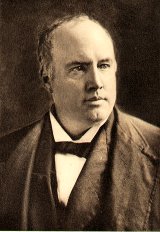
The Great Agnostic: Robert G. Ingersoll

Happiness is the only good.
The time to be happy is now.
The place to be happy is here.
The way to be happy is to help make others so.

Reason is the highest attribute of man.

The truth is, our government is not founded upon the rights of gods, but upon the rights of men. . . .  It is the only nation with which the gods have had nothing to do.

Argument cannot be answered with insults. Kindness is strength; anger blows out the lamp of the mind.

Happiness is the only good, reason the only torch, justice the only worship, humanity the only religion, and love the only priest.
The other day, while doing a little research on the history of divorce laws in this country - which just goes to show that the straight boys have been changing the rules of marriage all the time, just as they pleased - your Head Trucker happened to stumble upon this very interesting work:  Is Divorce Wrong? 

Written in 1889, it is a response to the question by three well-known public figures of the time:  Archibishop Cardinal Gibbons of Maryland, who naturally condemns the very idea out of hand, holding squarely to Roman Catholic teaching on the sanctity of marriage; Episcopal Bishop Henry C. Potter of New York, who as a good Anglican naturally waffles a good deal about it, pro and con; and finally Colonel Robert G. Ingersoll, known as "The Great Agnostic," who ringingly denounces the tyranny and injustice of religious precepts against divorce, which cause so much needless harm to innocent people, though at the same time very warmly and rather poetically defending the sanctity of marital love and the family home.

Somewhere along the line I had heard of Ingersoll's name before, but couldn't remember anything about him.  So a little further googling turned up the very interesting facts of his life, and his numerous speeches and writings, which you can browse through at your leisure if you have nothing better to do after brunch.  Many of which are quite good, and even amusing at times.  "The Most Remarkable American You Never Heard Of" - yes, and I can see why he was never, ever mentioned in the history books down here in the Bible Belt when I was a schoolboy.  Or if you don't have time for reading today, at least check out this video, I think you'll be amazed for one reason or another:

[For some strange reason, none of Ingersoll's videos will display here - how odd. But try this link for an overview of his life and work:]

What I Say:  Ingersoll was a man of great intelligence, and of great compassion for the human race.  It seems to me that he is a more outspoken proponent of Thomas Jefferson's famous vow of "eternal hostility to every form of tyranny over the human mind."  And I agree wholeheartedly with Ingersoll's great aim of removing the shackles of ignorance and superstition from the human race.  Quite an admirable man, who deserves to be better remembered than he is.

Yet from reading a few of his works, I think Ingersoll, in his zeal to bring light and freedom to his audiences, sometimes overstates his case - as all zealots do.  Just as Ingersoll inveighs against ever placing "unquestioning faith" in any scripture or supernatural authority, so your Head Trucker would offer a gentle warning against placing the same kind of blind faith in any one remark of Ingersoll's.  To take just one example, in one of his writings he heaps great scorn upon the book of Job and condemns it as essentially worthless.  Perhaps so, if you think it was written to be taken literally.  On the other hand, if you approach it as a work of fiction - moral fiction - to begin with, then you may take an entirely different view of its worth.

Continued after the jump . . .

Saturday, January 16, 2010

God's Control Panel

Honk to Joe.My.God. for posting this bit of hilarity (enlarge to get the full effect):


But there's also a serious point to be made from this.

If this is your concept of God, please - throw it out, it stinks.  This is utterly childish and primitive; better you should be a cool, logical atheist than believe a preposterous superstition like this.

Which, alas, so many people do believe:  a child's God, a genie, a thunder-maker, a cosmic sadist.  An arbitrary, unloving deity with no more compassion or conscience than a two-year-old.  And thus, such people utterly, utterly miss the point of every faith worthy to be called a religion.

Better not to believe in any kind of God at all than to believe in one like that:  a pyschological projection, an embodiment of brute, unreasoning force.  A fulminating, tyrannical Wizard of Oz behind an impenetrable curtain.  A devil, not a god.

But I submit for your consideration these words, which in your Head Trucker's opinion, come much closer to the heart of what religion means than what many people call by that term:
Ye have heard that it hath been said, Thou shalt love thy neighbour, and hate thine enemy.  But I say unto you, Love your enemies, bless them that curse you, do good to them that hate you, and pray for them which despitefully use you, and persecute you; that ye may be the children of your Father which is in heaven:  for he maketh his sun to rise on the evil and on the good, and sendeth rain on the just and on the unjust.

For if ye love them which love you, what reward have ye? do not even the publicans the same?  And if ye salute your brethren only, what do ye more than others? do not even the publicans so? 

Be ye therefore perfect, even as your Father which is in heaven is perfect. 

(from the Sermon on the Mount, Matthew 5)
Note the difference between this picture and the cartoon:  a loving, merciful Father who sends the needful blessings of rain and sun upon both the good and the evil - for all humankind are His children.

And we, His children, are all brothers and sisters here on this little blue marble.

Just a thought.

Sunday, November 1, 2009

Manners and Miracles

Andrew Sullivan quotes atheist Christopher Hitchens:
Usually, when I ask some Calvinist whether he is really a Calvinist (in the sense, say, of believing that I will end up in hell), there is a slight reluctance to say yes, and a slight wince from his congregation. I have come to the conclusion that this has something to do with the justly famed tradition of Southern hospitality: You can't very easily invite somebody to your church and then to supper and inform him that he's marked for perdition.
Well, no, of course not.  That would be rude.  Along with so many other things that damnyankees our friends from the frozen North just don't get about the South is that in these parts, rudeness is an even greater sin than atheism.  We learn that at our mothers' knees.

Atheism is very much the vogue now in the blue states, it seems; and believe me, I do get the why of that.  After half a century of living here, where old times are damn well not forgotten, and the terms Christian and American are considered to be exact synonyms - it's quite plain to me that religion as commonly practiced has very little to do with God, and everything to do with man.  And this conclusion is readily confirmed by even a cursory survey of other cultures, other peoples, from the earliest times down till now.

Though of course it's always easier to see the principle at work in other cultures, not our own.

And yet - and yet.  Despite all the evidence of humans fashioning God(s) in their own image, time and again - and despite all the evidence of an apparently indifferent universe - still, what the glib atheists overlook, like the glib religionists, is the evidence in their own hearts - a truth within that no microscope can ever reveal.

Feelings are not facts; I know this.  I'm talking about something that lies much deeper than the ebb and flow of emotion:  a Something that glows faintly at the end of the corridors of consciousness, a white pebble at the very bottom of a long, dark well.  Something I can perceive but not grasp, always there, still and patient and good.

And then beyond that, there are those few, those very few times in life where Something greater than me, and definitely not me, has directly intervened in my life, and effected a good result that I could not accomplish at all, myself.  I'm not talking about the cozy, cloying Jesus-came-and-sat-on-my-couch-and-talked-to-me kind of things you read in some silly religious magazines; nor am I talking about ecstatic visions or angels crashing through the ceiling.   That's so amateurish, so Hollywood.

No.  A miracle, when it happens, is the most ordinary thing in the world.  Seamless, smooth, and silent.  You are bumping along through the minutes of your life, this and that happening as usual, and then one time a certain thing happens, or doesn't happen.  That's all.  Though the effect, the result, is much to your benefit, or someone else's.

The most ordinary thing in the world.  As it should be.  One minute, standing in the familiar confines of your own kitchen, you reach your ladle into the jar and dip up a cup of water.  You turn around, and dip up another cup:  wine.  Just like that. 

No horns, no bells, no voices.  Just wine.  Just like that.

As you would expect, if you stopped and thought about it, from Someone to whom matter and time are simply draftsman's tools.  A master artist leaves no trace of his minor corrections.

Not an everyday occurrence, far from it.  And not something I can command, not hardly.  In my experience, these corrections, if you will, come only at the extremities of life, the moments of most desperate need, and not always then.  But sometimes they do come, invited or not.

None of which, I realize, will make the slightest sense to anyone who has not experienced the workings of a higher power.  Some atheists - such is the fallible human condition - are as shrill, as obnoxious, as some fundamentalists, and use evolution in exactly the same way that the other camp uses the Bible - as if that explains everything.  (Hint:  it doesn't; neither the one nor the other.)

And yet - this is not merely what I believe, but what I know from concrete experience.  Not meditation, not theorizing, not ecstasy - but cold, hard experience.  Like holding a pebble in my hand:  an unremarkable reality.  And yet from another point of view, quite remarkable and quite real.

There are myths, religious and otherwise, and some of them are lovely, and some of them are useful - for children and for adults.  And then when all the myths are said and done, there is still to be learned the incomprehensible, inexpressible reality of things unseen.  Something known to thoughtful, humble people throughout all times and in all lands.  Something far above and beyond all creeds, doctrines, and scriptures.

I don't know much, but I know that much.

Photo swiped, with apologies, from rayraydel at flickr
Related Posts with Thumbnails