A few years ago I came across the site of the Vindolanda Tablets, a huge cache of what we might call postcards written by Roman soldiers and their families who were stationed along Hadrian's Wall in the north of England. And it's an absolutely fascinating story, this astonishing find of all sorts of everyday communications between Roman citizens in the heyday of the Empire, at a remote outpost on the far frontier.
Party invite from Claudia Severa to her sister, Lepidina
And yet, as humans always manage somehow to do, they made the most of it. Here's a link to one of the most charming messages, a note from one officer's wife to her sister, saying in effect, "Do come to my birthday party, it'll be fun." These are everyday messages, not formal inscriptions or ponderous manuscripts, but scratched out with pen and ink on little thin slips of wood: nothing meant to be saved for the ages, although by great good luck, they were.
On that same site is a little crib sheet to help you decipher the Roman cursive handwriting - one of their least successful inventions, I might add - and I have to tell you, fellas, it was a real hair-on-end moment when, poring over the letter with the help of the crib and my long-ago high-school Latin, I suddenly realized I was able to actually read it - and in that moment, the veil of antiquity fell away and it seemed the lady herself was right in the room with me, no distance between us. Sperabo te soror: "I'll be looking for you, sis."
If your Latin is even rustier than mine and you can't make heads or tails of the letters, here's a very cool BBC video that gives you the whole picture of where and why the wall was built, and who lived there and how they lived - which was pretty comfortably for the times, with running water, central heating, designer shoes, and everything. Enjoy.
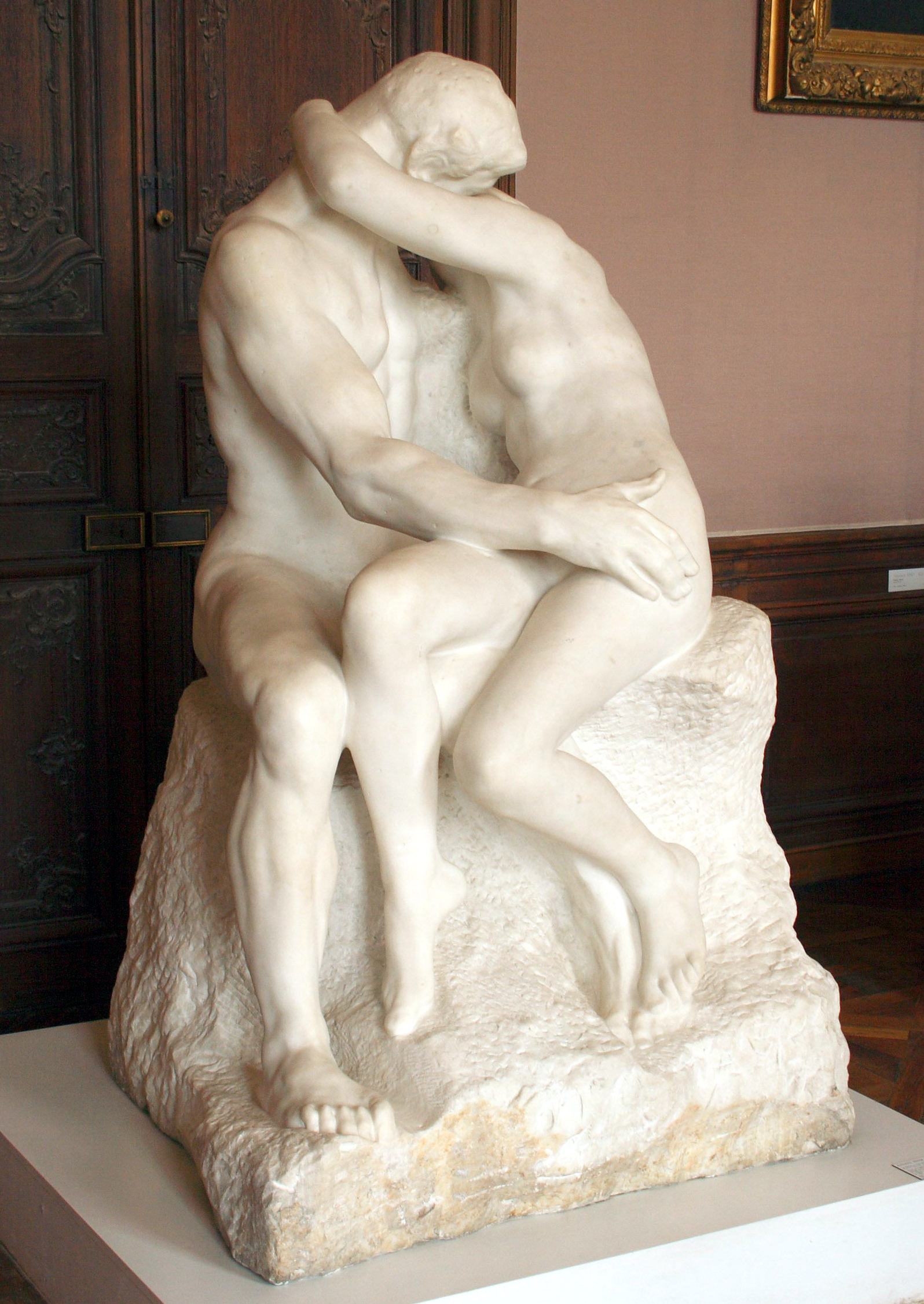
First, a little background: In 1900, Edward Perry Warren - a wealthy gay "American collector who lived in Lewes in Sussex, England, with his collection of Greek antiquities and his lover John Marshall," according to Wikipedia - gave a commission to the sculptor Rodin for a marble copy of his exquisite statue The Kiss, the contract specifying that "the genitals of the man must be complete." Figures.
Having obtained the statue, in 1914 Warren lent it to the Lewes town council, to be put on public display at the town hall. It is a lovely thing, isn't it?
Oh but - Horrors! The local prudes were all up in arms, and managed to get the statue hidden away from public view. Musn't encourage that sort of thing, you know.
This much of the story I already knew most of. Tonight I was cheered to discover that Warren was also the owner of another work of fine art that bodes well to become even more famous than Rodin's - it is certainly more explicit, which you might expect from the collection of an artsy old queen, right?
In 1998, the British Museum paid £1.8 million for this other highlight from Warren's collection: a silver Roman drinking cup dating from about the year ten, supposedly found near Jerusalem and bought by Warren in 1911. Of course, for most of the twentieth century, such a frankly homoerotic piece of work could not be openly displayed or discussed at all; but now it is on permanent display at the British Museum.
Do click here for an even better, zoomable photograph to explore the fine details of this piece; and while you're there, listen to the very insightful BBC Radio 4 commentary on the cup.
Paul Roberts, curator of the British Museum:
To the Romans it was a drinking cup to be used not just admired. Picture a dinner party, course after course of exotic food and lots of fine wine. The guests talk about politics and love as they pass round the table this luxurious, tactile silver cup. Their host is delighted that they admire its decoration (and its value).
As a work of art it’s a masterpiece – its fine decoration achieved by beating the silver into shape from the inside using fine hammers and chisels. Luxuriant fabrics and musical instruments indicate a world heavily influenced by Greek culture, which the Romans admired and adopted.
So what is so special about the decoration that made it one of the British Museum’s highest-profile and most controversial acquisitions? What kept the piece out of permanent museum collections until 1999, and ensured that its purchase by the British Museum earned it a place in all the British media?
It's a day that marks a historic step towards the changes we seek, but I think we all have to acknowledge this is only one step. Among the steps we have not yet taken is to repeal the Defense of Marriage Act. I believe it's discriminatory, I think it interferes with states' rights, and we will work with Congress to overturn it.
We've got more work to do to ensure that government treats all its citizens equally; to fight injustice and intolerance in all its forms; and to bring about that more perfect union. I'm committed to these efforts, and I pledge to work tirelessly on behalf of these issues in the months and years to come.
Anderson Cooper with Richard Socarides and Dustin Lance Black:
Keith Olbermann with Joe Solmonese:
Rachel Maddow with Rep. Tammy Baldwin:
Rep. Barney Frank, in an official statement, amazingly changes his mind about the matter:
It is the President’s job to try to change the law, but it is also his obligation to uphold and defend it when it has been enacted by appropriate processes. It would not be wise, in my judgment, for those of us who are gay, lesbian, bisexual or transgender, or who sympathize with the fight for our rights, to argue for a precedent that says that executives who disagreed politically with the purpose of the law should have the option of refusing to defend it in a constitutional case. . . . after rereading this brief, I do not think that the Obama administration should be subject to harsh criticism in this instance.
And don't forget the wingnut right is still very much with us and they are eating up this story, as Pat Robertson once again goes into Jeezusbabble mode: on the one hand, LGBT people are such a tiny part of the population, they are totally insignificant; on the other hand, they are so dangerous that they are sending this country straight to destruction:
BTW - if anyone pulls this argument on you, remind them of two things. First, every nation or empire of the past has risen and then eventually fallen; nothing lasts forever in this world, and the success of nations depends on money and might, not sex. And Two, the Roman Empire, to take the most famous example, fell apart a hundred years or more after Christianity was made the state religion, and homosex was outlawed.
So much for that theory. In fact, Gibbon, who wrote the famous The Decline and Fall of the Roman Empire in the 18th century, still in print today, came under great criticism for that book's thesis, which was that it was the adoption of Christianity more than anything else that led to the Empire's ruin.
But back to reality, and the present day. What to do next? Seems obvious to me that the President and his White House crew are not going to do anything for us just out of the goodness of their hearts. Left to their own devices, they will do something if and when they get around to it. They felt the heat this week, and they responded with a tiny scrap of equality - and note that Hillary beat the President to the punch, over at the State Dept., by a month on that, for her employees.
The political system doesn't run automatically, throwing out good things all by itself, as you may have imagined when you were nodding over your civics textbook in junior high. Politicians may have good intentions, but that's not enough to get the job done; those intentions have to be turned into action, and that happens when they realize they have to act to keep their jobs, or their campaign funds.
So how to turn up the heat on Congress and the President? I don't know exactly, lots of other people have ideas on that, some good, some silly. But we all need to be thinking about it, and working for equality as best we can. It won't just happen, guys; we have to push and shove and dig and sweat for it, that's all too clear after this week's revelations.
Marble sarcophagus relief AD 160 - 80, of Roman marriage ceremony. The couple are observing the solemn ceremony of clasping right hands, while the groom holds in his other hand the marriage contract. Between them is the matron-of-honour.
I've been meaning to blog about this for some time now. There seems to be a lot of confusion in people's minds over the word "marriage." The other day, surfing around the Net, I noticed someone said on a blog that "marriage is a sacrament, so let's not use that word; give everybody, straight or gay, a civil union instead."
Wrong. What you need to understand, guys, and be able to explain to people who use this line of argument, is that marriage was around a long, long time before the Church took it over and started regulating it; and in fact a little reflection, from those dim memories of history class, will bring to your mind the fact that people were marrying many centuries before Christ, in all kinds of cultures and on all continents. Those marriages may have looked pretty different from what we have in 21st century America, but they were lifelong unions that had no need of approval or blessing from the Christian Church - which didn't exist back then, anyway.
You also need to get clear in your mind that when two people get married here today, if it is a legal marriage - according to the laws of the state they reside in - then it is a civil marriage, which is a legal contract.
Now, if the couple gets married in a church, then at the same time they are also taking on a religious marriage - which some churches call a sacrament; so that the civil marriage and the religious marriage are happening at the same time.
But for all practical purposes, the government takes no notice of the religious aspect of a couple's marriage; for example, good Catholics cannot divorce and cannot remarry in the eyes of the Church; but they certainly can in the eyes of the law of their state. That's because the state recognizes only the civil marriage; what goes on with the religious aspect of their marriage is between them and the Church.
So there's no point calling it by another name, like civil union, as I see it: all legally married couples in this country have a civil marriage; and nobody has to get married in church and have a religious aspect as well. Even two atheists can get married at the county courthouse.
To reiterate: civil marriage and religious marriage are not the same thing. Marriage is not by definition a religious term only.
Marriage, as we know it in our Western civilization today, has a long history with roots in several very different ancient cultures, of which the Roman, Hebrew, and Germanic are the most important. Western marriage has further been shaped by the doctrines and policies of the medieval Christian church, the demands of the Protestant Reformation, and the social impact of the Industrial Revolution. . . .
The marriage laws and customs of ancient Rome are not easily summarized, because they were rather varied and underwent significant changes in the course of time. Still, without simplifying the issue too much, one may say that marriage and divorce were always personal, civil agreements between the participants and did not need the stamp of governmental or religious approval. Early in Roman history, a husband had considerable power over his wife and children, whom he could punish, sell, or even kill as he saw fit. However, eventually women came to enjoy a better legal position and gained more and more control over their lives and property. Thus, in imperial times husband and wife approached marriage as equals. Yet it seems that there was also a decline in marriage and birth rates, since the emperor Augustus found it necessary to pass drastic laws compelling people to marry and penalizing those who remained single.
There were several forms of marriage, the first of which (by usus) involved no ceremony at all. It was established simply by the couple's living together for one year. Divorce was just as informal. A more formal kind of marriage (by coemptio) began with a ceremony in front of witnesses and was also dissolved with a ceremony. Members of the upper classes usually preferred an elaborate ceremony and thus married by confarreatio in front of ten witnesses and a priest. In the case of a divorce, another great ceremony was required. However, all three forms of marriage and divorce were equally valid. All marriages were monogamous. Both men and women usually entered their first marriage in their late teens.While the Romans tolerated prostitution and concubinage, and had no qualms about homosexual relationships, their marriage laws were remarkably fair to women and thus greatly contributed to their emancipation. . . .
The rise of Christianity produced a profound change in European marriage laws and customs, although this change came about only gradually. The first Christian emperors were more or less content with the traditional Roman law. However, under varying political and religious pressures, they alternately broadened and restricted the divorce regulations. They also repealed older laws which had penalized the unmarried and childless, since the new Christian asceticism favored virginity and sexual abstinence over marriage. In most other respects they resisted change. Marriage and divorce continued to be civil and private matters. . . .
According to Roman law and Christian belief, marriage could be built only on the free consent of both partners, and this doctrine was bound to raise the status of women. Furthermore, theologians increasingly found a religious significance in marriage and eventually even included it among the sacraments.
This also endowed a formerly rather prosaic arrangement with a new dignity.Unfortunately, at the same time the church created two new problems: It abolished divorce by declaring marriage to be insoluble (except by death) and greatly increased the number of marriage prohibitions. . . .
The growing church involvement in marriage could further be seen in the development of a special religious wedding ceremony. In the first Christian centuries marriage had been a strictly private arrangement. As late as the 10th century, the essential part of the wedding itself took place outside the church door. It was not until the 12th century that a priest became part of the wedding ceremony, and not until the 13th century that he actually took charge of the proceedings. . . .
The Catholic church, in response to the Protestant challenge, took its stand in the Council of Trent and, in 1563, confirmed its previous doctrines. Indeed, it now demanded that all marriages take place before a priest and two witnesses. Among other things, this virtually eliminated not only secret marriages, but also the formerly common informal marriages. These, similar to the old Roman marriages by usus, were based simply on mutual consent without formal ceremony. In England they came to be called "common law marriages", and since Henry VIII had broken with Rome, they continued to be permitted until 1753, when the Church of England was put in charge of all marriages (including those of Catholics, but excluding those of Quakers and Jews). This development did not affect the English colonies, however, and thus common law marriages remained possible in America. (As recently as 1970 they were still recognized in several states.)
In most of Europe marriages continued to require a religious ceremony until the French Revolution in 1792 introduced the compulsory civil marriage. Germany followed suit in the 19th century when Bismarck diminished the influence of the Catholic church. Eventually, marriage before some magistrate or government official became the only valid form of marriage in most of the Western world. Religious weddings were still permitted, but only after the civil ceremony had taken place.
Of course, in the United States, religious officials are allowed by the government of every state to officiate at weddings - but afterwards, when they sign the marriage certificate and mail it off to the state, they are fulfilling the requirements for a civil marriage, regardless of what the requirements of their church may be for a religious union.
Lord, make me an instrument of your peace. Where there is hatred, let me sow love; where there is injury, pardon; where there is discord, harmony; where there is doubt, faith; where there is despair, hope; where there is darkness, light; where there is sadness, joy. Grant that I may seek not so much to be consoled as to console; to be understood as to understand; to be loved as to love. For it is in giving that we receive; it is in pardoning that we are pardoned; and it is in dying that we are born to eternal life. Amen.
.
We cannot all do great things, but we can do small things with great love.
and welcome to the Blue Truck, a blog for mature gay men with news and views on gay rights, history, art, humor, and whatever comes to mind. Plus a few hot men. The truck's all washed and gassed up, so hop in buddy, let's go.
CAUTION: For mature gay men only beyond this point. Some posts and links may not be suitable for children or the unco guid. You have been warned.
Insert valid picture ID with date of birth now, or click here.
My Story
click photograph to read
Churches say that the expression of love in a heterosexual monogamous relationship includes the physical, the touching, embracing, kissing, the genital act - the totality of our love makes each of us grow to become increasingly godlike and compassionate. If this is so for the heterosexual, what earthly reason have we to say that it is not the case with the homosexual?
It is a perversion if you say to me that a person chooses to be homosexual. You must be crazy to choose a way of life that exposes you to a kind of hatred. It's like saying you choose to be black in a race-infected society.
If God, as they say, is homophobic, I wouldn't worship that God.