Lord Kenneth Clark (1903-1983) was a renowned British art historian, perhaps best remembered for his 1969 BBC series Civilisation, at the conclusion of which he made this statement:
At this point, I reveal myself in my true colors as a stick-in-the-mud. I hold a number of beliefs that have been repudiated by the liveliest intellects of our time. I believe that order is better than chaos, creation better than destruction. I prefer gentleness to violence, forgiveness to vendetta. On the whole I think that knowledge is preferable to ignorance, and I am sure that human sympathy is more valuable than ideology.
I believe that, in spite of recent triumphs of science, men haven't changed much in the last two thousand years. And in consequence, we must still try to learn from history: history is ourselves.
A fascinating BBC series first shown in 2012. Description:
Historian Ruth Goodman and archaeologists Alex Langlands and Peter Ginn face up to the challenges of the biggest revolution ever seen in the history of the British countryside as they turn Manor Farm back to how it was run in the Second World War. When Britain entered the war, two-thirds of all Britain's food was imported - and now it was under threat from a Nazi blockade. To save Britain from starvation, the nation's farmers were tasked with doubling food production in what Churchill called 'the frontline of freedom'. This meant ploughing up 6.5 million acres of unused land - a combined area bigger than the whole of Wales.
In this first episode, the farmers find themselves in a new location, a new time period and with a new team member. There is a new farmhouse to modernise, strict new rules to abide by and air raid precautions to contend with.
Bonus: A charming little teaching film produced in 1941 by the British Ministry of Food to teach home cooks the tastiest way to prepare a cabbage, with no waste of vitamins:
The late, delightful Clarissa Dickson Wright elucidates the history of the meal your grandmother told you was the most important one of the day, in part 1 of this 2012 BBC documentary:
The second episode in the BBC color series, written and presented by fashion expert Doris Langley Moore. First broadcast on April 28, 1957, using all original costumes from the various periods.
It's not every day that there's something newsworthy to report here on the Blue Truck, or something I want to write about. So it occurs to me that some few of my readers might enjoy watching some of the videos I pass the time with here - nearly all of them factual history stuff or biographies. So this might be the start of a regular feature, or not, but it may give you some insight into your Head Trucker's mind - which could be a little scary, I don't know.
First up, here's a fascinating look at the history and development of something we all can relate to: the ordinary family home. It's written and narrated by Dr. Lucy Worsley, Curator of Historic Royal Palaces (yes, those royal palaces) in London, and she does a lively, sometimes irreverent job of walking us through the centuries. See what you think.
I know all you boys are gearing up for your big Mardi Gras celebrations tomorrow . . . aren't you? While you're picking out beads and feathers and dusting off your sequined pants (use a little club soda on that embarassingly stubborn stain), here's a few educational clips for you to think on.
First, there's still time to get your king cake made, and don't forget the plastic baby:
And if you really want to know, here's the scoop on those Mardi Gras colors:
And remember, all you city boys: it ain't no real Mardi Gras without a chicken chase:
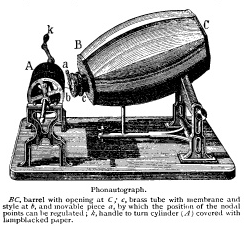
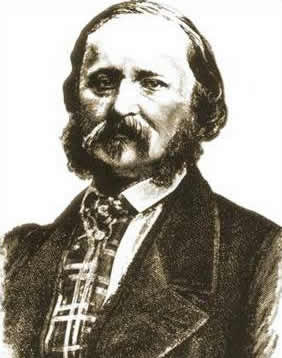
Stumbled across this intriguing website yesterday, about the work of Édouard-Léon Scott de Martinville, a French inventor, who in 1857 received a patent for the phonautograph - twenty years before Edison invented the phonograph. And now, by means of 21st century wizardry, de Martinville's primitive sound tracings on blackened paper enable us to hear the human voice - not very clearly, but recognizably human - out of the long-silent past.
Last year, however, Giovannoni and crew realized that they had been playing the recording too fast; on their website, they offer a revised version which sounds more like a man's voice, probably the inventor's own. Listen to it and more sounds re-created from de Martinville's phonoautograms here.
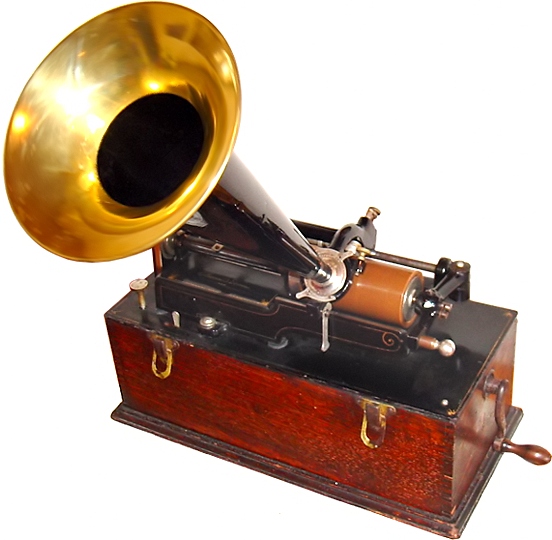
Unfortunately, de Martinville was merely looking for a way to make a graphic representation of the human voice, with perhaps a view to creating a kind of automatic stenography one day; apparently, it didn't occur to him to pursue sound reproduction, which had to wait until Edison had a stroke of genius in 1877. Here's a short overview of the phonograph's origin, an invention that amazed the world - a talking machine!
Edison phonograph, circa 1899
Read more about the Edison phonograph and listen to sample recordings at the American Memory collection of the Library of Congress.
Early films are wonderful to watch because they happily correct the erroneous impression we all get from looking at old black-and-white photographs in books: our great-grandparents looked rather solemn when they put on their formal faces for the still cameras, for dignity's sake - "say cheese" didn't really become the norm until after World War I.
But as these clips by Edison and others show so vividly, our collective ancestors were not carved out of stone, but just as human as we are. Young women were just as silly and giggly then as now, and young men just as silly and show-offish as today. Human nature does not change. And this ought to correct another wrong idea: just because you are loaded down with every technological gadget you can afford, and think nothing of jetting across the continent or around the world whenever the whim strikes you, does not mean you are one whit different from, or intrinsically better than, your ancestors. Quite the opposite.
You are still just a human being, as they were. Think about it.
Do not frickin' believe anybody who yells about a "rush" to reform healthcare in this country. The struggle, continually defeated by the medical profession (can you say AMA?), the insurance industry, and scaremongering "anti-communist" demagogues, has been going on for nearly a century now, people. Yup. And the opposition is still using the very same tactics and the very same overwrought end-of-the-world rhetoric they browbeat our grandfathers with.
I like this quote from the first source (it's in the footnotes):
One Canadian lesson — the movement toward universal health care in Canada started in 1916 (depending on when you start counting), and took until 1962 for passage of both hospital and doctor care in a single province. It took another decade for the rest of the country to catch on. That is about 50 years all together. It wasn’t like we sat down over afternoon tea and crumpets and said please pass the health care bill so we can sign it and get on with the day. We fought, we threatened, the doctors went on strike, refused patients, people held rallies and signed petitions for and against it, burned effigies of government leaders, hissed, jeered, and booed at the doctors or the Premier depending on whose side they were on. In a nutshell, we weren’t the sterotypical nice polite Canadians. Although there was plenty of resistance, now you could more easily take away Christmas than health care, despite the rhetoric that you may hear to the contrary.
OMG, I almost wish the can't-see-you-now, country-club-loving, cocaine-snorting doctors would go on strike in this country. Can you think of anything that would get healthcare reform passed any quicker? People would be so flamin' outraged at them . . . .
N.B. - Ex-president Teddy Roosevelt - yup, ol' T.R. himself - first brought the idea of national health insurance to Presidential politics when he ran for election on the Progressive ticket in 1912. Yes, 19-fucking-12, people. At the time, he argued that America should not lag behind Imperial Germany, which had instituted national health insurance under Bismarck in 1883, with other European countries soon following suit.
And the first sitting President to fight for national healthcare reform was Harry Truman, who sent an extensive legislative package on this subject to Congress in 1945. (FDR had briefly considered such a proposal when he brought in Social Security and workmen's comp, back in 1934, but pragmatically allowed it to wither so he could get the other proposals passed.)
And still, after all these many years, half the country thinks like this - and they aren't all living south of the Mason-Dixon line, either:
The fact of the matter is that other democracies, in fact everyother industrialized, developed nation in the Western world has had some kind of national healthcare plan for the last fifty to a hundred years or even longer.
So can we ple-e-e-e-e-a-se drop the stupid-ass, backwoods-Baptist idea that the world will come to a thundering, crashing halt if America has it, too?
I thank you.
Propaganda posters from the national creepsite Free Republic. I'm going to go scrub my computer with Lysol now.
Found on Joe.My.God. today: Dan Savage gets right to the heart of the marriage argument.
All that Dan says is correct. Until straight people changed the laws - with no little opposition from conservatives, mind you - in the late 19th/early 20th century, women in the English-speaking world who married lost their legal identity, being subsumed into that of their husbands': a single woman, in legal terms, was a femme seule (single woman); a married woman, however, was a femme couvert (hidden woman). A woman's property, with rare exceptions for very wealthy women, belonged entirely to her husband, down to her smallest personal possessions. If a husband wanted to, in theory he could sell all her dresses - though of course, I doubt any man who enjoyed three homecooked meals a day and some nookie at night would be that stupid. But realistically, women had no legal say in the disposition of their money or property: a husband, for example, could demand that an employer pay his wife's salary to him, not to her. And so forth.
The point being, until the laws on property and divorce were changed, women were in a legal sense owned by their husbands: I don't have time now to go look up the references, but I can tell you that both Queen Victoria and Virginia Woolf - and it's hard to think of two more contrasting personalities - at different times in their writings made the identical statement: women are slaves to men.
But most people's historical knowledge does not extend any further back than their parents' time or their grandparents'; yet they believe that the way mama and daddy lived is the way people always lived, as far back as Adam and Eve.
It just ain't so. Marriage in the Old Testament often included multiple wives: go look it up. But oh my goodness, you never hear the Bible-thumpers arguing to bring back polygamy, do you? A while back, I wrote a lot more in my post about the history of marriage, and the difference between civil marriage and religious marriage, if anybody wants to read it. Bottom line: just as Dan said, straight people have been redefining marriage for centuries, millennia, as it pleased them. But people forget that: it didn't happen in mama and daddy's time, so they don't know anything about it.
Legal marriage serves a number of very useful, necessary purposes for society and for individuals. There's room enough for gay people - my God, it's not like we're asking to abolish it, we just want to get on board with it!
Not that everybody needs to be married: I'm thinking of some straight and some gay people. Some folks are just not equipped for the job, some just can't stand to be "tied down," and some just don't want that much responsibility. But for those who do, it should be an equal opportunity institution.
Marble sarcophagus relief AD 160 - 80, of Roman marriage ceremony. The couple are observing the solemn ceremony of clasping right hands, while the groom holds in his other hand the marriage contract. Between them is the matron-of-honour.
I've been meaning to blog about this for some time now. There seems to be a lot of confusion in people's minds over the word "marriage." The other day, surfing around the Net, I noticed someone said on a blog that "marriage is a sacrament, so let's not use that word; give everybody, straight or gay, a civil union instead."
Wrong. What you need to understand, guys, and be able to explain to people who use this line of argument, is that marriage was around a long, long time before the Church took it over and started regulating it; and in fact a little reflection, from those dim memories of history class, will bring to your mind the fact that people were marrying many centuries before Christ, in all kinds of cultures and on all continents. Those marriages may have looked pretty different from what we have in 21st century America, but they were lifelong unions that had no need of approval or blessing from the Christian Church - which didn't exist back then, anyway.
You also need to get clear in your mind that when two people get married here today, if it is a legal marriage - according to the laws of the state they reside in - then it is a civil marriage, which is a legal contract.
Now, if the couple gets married in a church, then at the same time they are also taking on a religious marriage - which some churches call a sacrament; so that the civil marriage and the religious marriage are happening at the same time.
But for all practical purposes, the government takes no notice of the religious aspect of a couple's marriage; for example, good Catholics cannot divorce and cannot remarry in the eyes of the Church; but they certainly can in the eyes of the law of their state. That's because the state recognizes only the civil marriage; what goes on with the religious aspect of their marriage is between them and the Church.
So there's no point calling it by another name, like civil union, as I see it: all legally married couples in this country have a civil marriage; and nobody has to get married in church and have a religious aspect as well. Even two atheists can get married at the county courthouse.
To reiterate: civil marriage and religious marriage are not the same thing. Marriage is not by definition a religious term only.
Marriage, as we know it in our Western civilization today, has a long history with roots in several very different ancient cultures, of which the Roman, Hebrew, and Germanic are the most important. Western marriage has further been shaped by the doctrines and policies of the medieval Christian church, the demands of the Protestant Reformation, and the social impact of the Industrial Revolution. . . .
The marriage laws and customs of ancient Rome are not easily summarized, because they were rather varied and underwent significant changes in the course of time. Still, without simplifying the issue too much, one may say that marriage and divorce were always personal, civil agreements between the participants and did not need the stamp of governmental or religious approval. Early in Roman history, a husband had considerable power over his wife and children, whom he could punish, sell, or even kill as he saw fit. However, eventually women came to enjoy a better legal position and gained more and more control over their lives and property. Thus, in imperial times husband and wife approached marriage as equals. Yet it seems that there was also a decline in marriage and birth rates, since the emperor Augustus found it necessary to pass drastic laws compelling people to marry and penalizing those who remained single.
There were several forms of marriage, the first of which (by usus) involved no ceremony at all. It was established simply by the couple's living together for one year. Divorce was just as informal. A more formal kind of marriage (by coemptio) began with a ceremony in front of witnesses and was also dissolved with a ceremony. Members of the upper classes usually preferred an elaborate ceremony and thus married by confarreatio in front of ten witnesses and a priest. In the case of a divorce, another great ceremony was required. However, all three forms of marriage and divorce were equally valid. All marriages were monogamous. Both men and women usually entered their first marriage in their late teens.While the Romans tolerated prostitution and concubinage, and had no qualms about homosexual relationships, their marriage laws were remarkably fair to women and thus greatly contributed to their emancipation. . . .
The rise of Christianity produced a profound change in European marriage laws and customs, although this change came about only gradually. The first Christian emperors were more or less content with the traditional Roman law. However, under varying political and religious pressures, they alternately broadened and restricted the divorce regulations. They also repealed older laws which had penalized the unmarried and childless, since the new Christian asceticism favored virginity and sexual abstinence over marriage. In most other respects they resisted change. Marriage and divorce continued to be civil and private matters. . . .
According to Roman law and Christian belief, marriage could be built only on the free consent of both partners, and this doctrine was bound to raise the status of women. Furthermore, theologians increasingly found a religious significance in marriage and eventually even included it among the sacraments.
This also endowed a formerly rather prosaic arrangement with a new dignity.Unfortunately, at the same time the church created two new problems: It abolished divorce by declaring marriage to be insoluble (except by death) and greatly increased the number of marriage prohibitions. . . .
The growing church involvement in marriage could further be seen in the development of a special religious wedding ceremony. In the first Christian centuries marriage had been a strictly private arrangement. As late as the 10th century, the essential part of the wedding itself took place outside the church door. It was not until the 12th century that a priest became part of the wedding ceremony, and not until the 13th century that he actually took charge of the proceedings. . . .
The Catholic church, in response to the Protestant challenge, took its stand in the Council of Trent and, in 1563, confirmed its previous doctrines. Indeed, it now demanded that all marriages take place before a priest and two witnesses. Among other things, this virtually eliminated not only secret marriages, but also the formerly common informal marriages. These, similar to the old Roman marriages by usus, were based simply on mutual consent without formal ceremony. In England they came to be called "common law marriages", and since Henry VIII had broken with Rome, they continued to be permitted until 1753, when the Church of England was put in charge of all marriages (including those of Catholics, but excluding those of Quakers and Jews). This development did not affect the English colonies, however, and thus common law marriages remained possible in America. (As recently as 1970 they were still recognized in several states.)
In most of Europe marriages continued to require a religious ceremony until the French Revolution in 1792 introduced the compulsory civil marriage. Germany followed suit in the 19th century when Bismarck diminished the influence of the Catholic church. Eventually, marriage before some magistrate or government official became the only valid form of marriage in most of the Western world. Religious weddings were still permitted, but only after the civil ceremony had taken place.
Of course, in the United States, religious officials are allowed by the government of every state to officiate at weddings - but afterwards, when they sign the marriage certificate and mail it off to the state, they are fulfilling the requirements for a civil marriage, regardless of what the requirements of their church may be for a religious union.
Those of you who get a kick out of historical stuff should go check out the new World Digital Library site:
The WDL makes it possible to discover, study, and enjoy cultural treasures from around the world on one site, in a variety of ways. These cultural treasures include, but are not limited to, manuscripts, maps, rare books, musical scores, recordings, films, prints, photographs, and architectural drawings.
Items on the WDL may easily be browsed by place, time, topic, type of item, and contributing institution, or can be located by an open-ended search, in several languages. Special features include interactive geographic clusters, a timeline, advanced image-viewing and interpretive capabilities. Item-level descriptions and interviews with curators about featured items provide additional information.
Navigation tools and content descriptions are provided in Arabic, Chinese, English, French, Portuguese, Russian, and Spanish. Many more languages are represented in the actual books, manuscripts, maps, photographs, and other primary materials, which are provided in their original languages.
The WDL was developed by a team at the U.S. Library of Congress, with contributions by partner institutions in many countries; the support of the United Nations Education, Scientific, and Cultural Organization (UNESCO); and the financial support of a number of companies and private foundations.
Here's a quick sampling, there's lots more where this came from.
Andrew Sullivan makes a brilliant metaphor, thinking of Obama's inaugural express and Robert Kennedy's funeral train, which rolled down the same track forty years ago:
For me it feels as if history is undoing itself, as if some great, dark wound has somehow returned to be healed, before it is too late.
Also, a link to a brief but poignant audio-visual recollection by Robert Fusco, the NYT photographer on Kennedy's train; well worth watching and listening to.
For the younger folks among us: Bobby Kennedy had something of the same charisma that Obama has; he also symbolized the hope of millions for change. He was tragically murdered five months before the presidential election, however - just two months after the assassination of Dr. King.
Lord, make me an instrument of your peace. Where there is hatred, let me sow love; where there is injury, pardon; where there is discord, harmony; where there is doubt, faith; where there is despair, hope; where there is darkness, light; where there is sadness, joy. Grant that I may seek not so much to be consoled as to console; to be understood as to understand; to be loved as to love. For it is in giving that we receive; it is in pardoning that we are pardoned; and it is in dying that we are born to eternal life. Amen.
.
We cannot all do great things, but we can do small things with great love.
and welcome to the Blue Truck, a blog for mature gay men with news and views on gay rights, history, art, humor, and whatever comes to mind. Plus a few hot men. The truck's all washed and gassed up, so hop in buddy, let's go.
CAUTION: For mature gay men only beyond this point. Some posts and links may not be suitable for children or the unco guid. You have been warned.
Insert valid picture ID with date of birth now, or click here.
My Story
click photograph to read
Churches say that the expression of love in a heterosexual monogamous relationship includes the physical, the touching, embracing, kissing, the genital act - the totality of our love makes each of us grow to become increasingly godlike and compassionate. If this is so for the heterosexual, what earthly reason have we to say that it is not the case with the homosexual?
It is a perversion if you say to me that a person chooses to be homosexual. You must be crazy to choose a way of life that exposes you to a kind of hatred. It's like saying you choose to be black in a race-infected society.
If God, as they say, is homophobic, I wouldn't worship that God.