 |
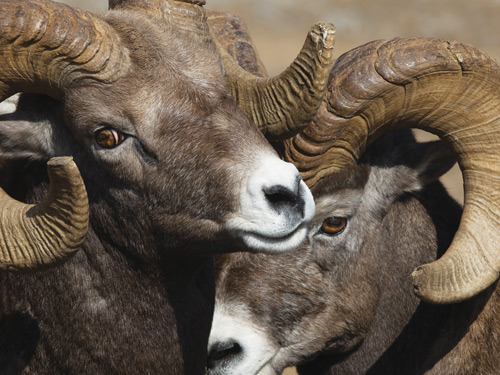
| Bighorn sheep came out of the closet long before we did. |
Animal behavior is not a direct guide to human behavior, for several very good and obvious reasons; but it still gives us some valuable insights into the biology and psychology of sex. Excerpt from an article in Slate magazine:
In an interview with CNN’s Piers Morgan on Sunday, former Growing Pains star Kirk Cameron called homosexuality “unnatural,” and a behavior that is “ultimately destructive to so many of the foundations of civilization.” We’ve heard that many species of nonhuman animals engage in gay sex, which calls into question the first part of Cameron’s statement. But what about the practice of shunning gays—can animals be homophobic too?And from Seed magazine's 2006 article about Roughgarden's research:
Not as far as we know. Homosexual behavior has been documented in hundreds of animal species, but the same does not hold for gay-bashing. For starters, few animals are exclusively gay. Two female Japanese macaques might have playful sex with each other on Tuesday, then mate with males on Wednesday. Pairs of male elephants sometimes form years-long companionships that include sexual activity, while their heterosexual couplings tend to be one-night stands. For these and many other species, sexual preferences seem to be fluid rather than binary: Gay sex doesn’t make them gay, and straight sex doesn’t make them straight. In these cases, the concept of homophobia simply doesn’t apply. . . .
Researchers believe that gay sex is even rewarded in certain species. For bonobos, sexual activity serves as an instrument of social harmony: It reinforces bonds and keeps the peace. For instance, when a female bonobo migrates into a new group, she often ingratiates herself to the clan’s other ladies by having a lot of sex with them. Far from being shunned, this homosexual behavior is welcomed. And former Stanford researcher Joan Roughgarden has argued that among male bighorn sheep bisexuality may be the norm; those that don’t participate end up as outcasts.
Male big horn sheep live in what are often called “homosexual societies.” They bond through genital licking and anal intercourse, which often ends in ejaculation. If a male sheep chooses to not have gay sex, it becomes a social outcast. Ironically, scientists call such straight-laced males “effeminate.”
Giraffes have all-male orgies. So do bottlenose dolphins, killer whales, gray whales, and West Indian manatees. Japanese macaques, on the other hand, are ardent lesbians; the females enthusiastically mount each other. Bonobos, one of our closest primate relatives, are similar, except that their lesbian sexual encounters occur every two hours. Male bonobos engage in “penis fencing,” which leads, surprisingly enough, to ejaculation. They also give each other genital massages.
As this list of activities suggests, having homosexual sex is the biological equivalent of apple pie: Everybody likes it. At last count, over 450 different vertebrate species could be beheaded in Saudi Arabia. You name it, there’s a vertebrate out there that does it. Nevertheless, most biologists continue to regard homosexuality as a sexual outlier. According to evolutionary theory, being gay is little more than a maladaptive behavior.
Joan Roughgarden, a professor of biology at Stanford University, wants to change that perception. After cataloging the wealth of homosexual behavior in the animal kingdom two years ago in her controversial book Evolution’s Rainbow — and weathering critiques that, she says, stemmed largely from her being transgendered — Roughgarden has set about replacing Darwinian sexual selection with a new explanation of sex. For too long, she says, biology has neglected evidence that mating isn’t only about multiplying. Sometimes, as in the case of all those gay sheep, dolphins and primates, animals have sex just for fun or to cement their social bonds. Homosexuality, Roughgarden says, is an essential part of biology, and can no longer be dismissed. By using the queer to untangle the straight, Roughgarden’s theories have the potential to usher in a scientific sexual revolution. . . .
Of course, most humans don’t see sex as a way of maintaining the social contract. Our lust doesn’t seem logical, especially when that logic involves the abstruse calculations of game theory. Furthermore, it’s strange for most people to think of themselves as naturally bisexual. Being gay or straight seems to be an intrinsic and implacable part of our identity. Roughgarden disagrees. “In our culture, we assume that there is a straight-gay binary, and that you are either one or the other. But if you look at vertebrates, that just isn’t the case. You will almost never find animals or primates that are exclusively gay. Other human cultures show the same thing.” Since Roughgarden believes that the hetero/homo distinction is a purely cultural creation, and not a fact of biology, she thinks it is only a matter of time before we return to the standard primate model. “I’m convinced that in 50 years, the gay-straight dichotomy will dissolve. I think it just takes too much social energy to preserve. All this campy, flamboyant behavior: It’s just such hard work.”
What I say: Your Head Trucker finds all this research mildly interesting, and an excellent rebuttal to the fundamentalists. Still, there doesn't have to be a reason for gayness, you know. It is what it is, and what it is is human - "that is all ye know, and all ye need to know."
You must remember this,A kiss is still a kiss,A sigh is just a sigh--The fundamental things applyAs time goes by . . . .