-----
Showing posts with label Germany. Show all posts
Showing posts with label Germany. Show all posts
Tuesday, March 14, 2023
Pencil It In
Just some interesting views of pencil production I happened upon while surfing YouTube. Not a subject I have a great interest in, but the videos are strangely soothing, somehow.
Sunday, January 8, 2017
Sunday Drive: Danke
When this German hymn was written in 1961, it was denounced as blasphemous "Negro music" and called a sin against both religion and music by critics. But I rather like it. See what you think, fellas.
Sunday, August 21, 2016
Sunday Drive: Unchained Melody
By some guy in Germany I stumbled upon who has never made a CD but is a truly excellent guitarist:
Saturday, August 17, 2013
You Can Help: Manny
Hey fellas, my truckbuddy Martin in Berlin, Germany, needs help paying the vet bills for his little dog who was savaged this week by a Rottweiler in a public park and nearly died. Here's Martin's appeal from Indiegogo, and a video of Manny.
You can contribute to Manny's recovery on the Indiegogo page here. Please do, if you can.
I'm Martin and Manny is my 13 year old Jack Russell terrier whom I rescued from the animal shelter in October 2011. Manny is the light of my life, and prior to having him, I never thought I could get this attached to another living thing. Manny is simply adorable, the cutest, sweetest, dog you can possibly imagine!
Last Monday evening, as I was walking him in a nearby park, Manny was viciously attacked by a Rottweiler. It was immediately clear that Manny was badly bitten as he bled heavily. It turned out, the owner of the Rottweiler had no dog insurance, even though it is mandatory in Berlin, nor did he assume any responsibility. Needless to say, I did call the police, but they could do little - so they claimed - as the dog owner stated that he had no money since he's living on welfare.
Taking Manny to the vet, Manny's wound was stitched and all seemed to fine, relatively speaking. The bill of 121 Euros was paid by me. A few days later, however, Manny's wound started to smell badly and he started limping. Taking him back to the vet, he unbelievably failed to diagnose the severe infection which was already well on its way destroying Manny from the inside.
Manny's condition went from bad to worse. Eventually, on Saturday night, I had little choice but taking him to the pet clinic as it was obvious that he was on his last legs - literally! Once at the pet clinic, he was put on a drip and it was made clear to me that his condition was, in fact, life-threatening. I was told that an operation was inevitable, starting with reopening the wound stitched by the vet a few days earlier. To do so, however, Manny had to be stabilised first and I was told that Manny had to spend the night at the clinic with the operation to follow the next day.
The next day, I received a phone call from the surgeon who explained that Manny could not be operated upon as his would will have to heal - and subsequently close - from the inside before any new stitching could be done, let alone any operation. For that, Manny has to stay at the clinic for a full 4 days, until I'll be allowed to take him home, though I will then have to take him back to the clinic as an out-patient for at least another week until his wound has fully healed and the infection has been contained.
I was told that entire bill, including the daily dressings of the wound once Manny's been discharged from the clinic, would come to well over 1,000 Euros, all depending on how swiftly Manny recovers.
Being on a low income, I cannot afford this kind of money, yet losing Manny would quite frankly break my heart and simply - is not an option!
I'm asking you to help Manny getting the care he needs to recover. Every single penny of my campaign will go towards Manny's vet bills, and I'm asking you hereby for your support!
Bear in mind that every little helps!
As perks, I have little to offer you other than keeping you posted in detail, including images, regarding Manny's recovery.
Trust me, you help, however little, is greatly appreciated by both Manny and me!
THANK YOU!
You can contribute to Manny's recovery on the Indiegogo page here. Please do, if you can.
Saturday, November 19, 2011
The Reluctant Superpower
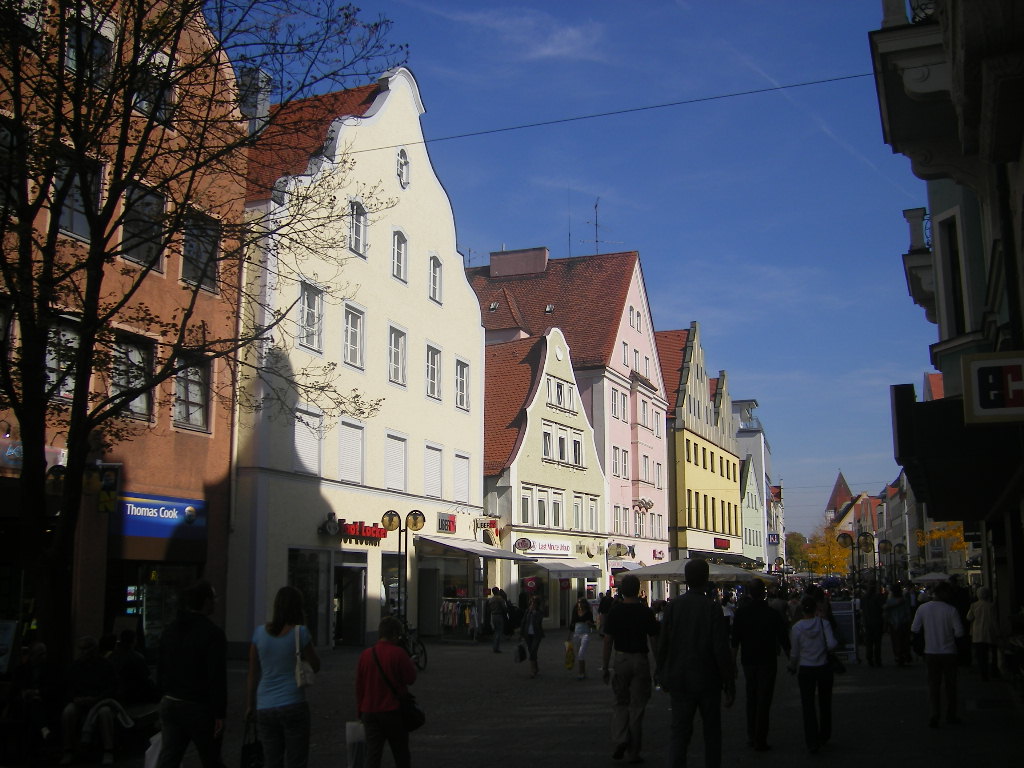 |
| Street scene in Ingolstadt, Bavaria |
I never studied economics (though I wish I had), so the current state of the world's finances flickers across the screen of my mental vision like some increasingly uncomfortable phantasmagoria in a Fellini film, incomprehensible and ever more bizarre. Probably I could understand more if I buckled down to study the matter; but I just don't want to. Even if I did truly comprehend all the causes and effects of this historical crisis, there is absolutely nothing I could do with that knowledge to help anyone; and the low, parlous state of my own finances away out here on the prairie is too uncomfortable already to bear the weight of much thought.
Like most ordinary folks, I realize that I am but a tiny cog in an enormous wheel, and just have to endure whatever the movers and shakers of the world decide to do, or not do. Still, from an historical point of view, it seems rather ironic that Germany - a nation I have no particular affinity or antipathy for, though in truth I am not much attracted to sausage, sauerkraut, and gutteral vowels - that having been put to utter ruin within living memory, it has now miraculously, so it seems, rebounded so much as to hold the fate of the world within its hands.
Why is that, exactly, when other European countries who also were laid waste by the war, and rebuilt with generous American help, are barely able to pay their light bill, so to speak? This interesting article in the Telegraph points to an answer, though how true it is, I can't say; but here's an excerpt for you to mull over:
Ingolstadt gives an excellent impression, aside from all the kebab houses and cars, of still being trapped in some much-earlier historical period. It is also one of the reasons that southern Germany remains such a powerful motor for Europe’s economy – indeed, Europe’s last great hope. And it is the behaviour and attitude of people like those living in Ingolstadt which will have a profound impact on how the current crisis plays out. . . . The German people value their local towns, worry about their neighbours’ views, relish the rules and are rewarded accordingly by a social and economic system that really does work. . . .By chance, the President's weekly video address today from Indonesia, where he is making trade agreements, touches on a related idea:
The devastated, occupied and shamed West Germany of 1945 rebuilt itself from a smaller version of the same principles as before – hundreds of towns, each producing something exceptional. And it turned out that this new German prosperity was also intimately linked with the successful export of things which foreigners liked, the ensuing money allowing Germans themselves to buy things. This successful pattern, a sort of conveyor belt of investment, ideas, things and consumers, continues to the present day. But instead of just being a source of happiness to many of its fortunate inhabitants, it must suddenly bear the brunt of a global disaster.
Since the end of the Cold War, Germany has given two gifts to the world. The first was the decision to pour many billions of Deutschmarks into the somewhat patchy rebuilding of old East Germany. The second was to be the principal begetter of the euro – what was meant to be the final act to wind up the legacy of the Second World War. In a grand restatement of the principles that had cemented the original Treaty of Rome, Europeans who shared a currency would have so much in common that they could not dream of fighting each other. Some of the applicants to join the euro seemed a little odd or dodgy, but the Germans would ignore this because there was a higher, almost mystical issue at stake.
It is perhaps the fundamental question now facing Europe: what will the people wandering along Ingolstadt’s principal shopping streets think about what has happened? Germany’s attempts to dominate Europe militarily ended in utter moral and physical disaster. Germany’s more recent attempt to dominate Europe through the benign means of hard work, constructive engagement and backing the euro appeared to be a brilliant success. The unique form of provincialism that lies at the heart of Germany somehow resulted in the belief that the rest of the world shared its values – work all week at Audi, spend the weekend in riotous drinking and arguments about the relative merits of long-haul holiday destinations, and mix this with occasional marital infidelity and spiritual crisis. It simply could not encompass the idea that Greece or Italy would use access to the euro knowingly and contemptuously to pour that work ethic down the plughole. . . .
These agreements will help us reach my goal of doubling American exports by 2014 – a goal we’re on pace to meet. And they’re powerful examples of how we can rebuild an economy that’s focused on what our country has always done best – making and selling products all over the world that are stamped with three proud words: “Made In America.”
This is important, because over the last decade, we became a country that relied too much on what we bought and consumed. We racked up a lot of debt, but we didn’t create many jobs at all.
If we want an economy that’s built to last and built to compete, we have to change that. We have to restore America’s manufacturing might, which is what helped us build the largest middle-class in history. That’s why we chose to pull the auto industry back from the brink, saving hundreds of thousands of jobs in the process. And that’s why we’re investing in the next generation of high-tech, American manufacturing.
Which sounds good. But what do I know. And as a matter of historical fact, we had the world's biggest and finest industrial plant already in place when the Great Depression happened, but that wasn't enough to prevent calamity.
Subscribe to:
Posts (Atom)