Bill Clinton's Secretary of Labor, Robert Reich, tells us in two and a half minutes exactly how to proceed from here:
A word to the wise is sufficient. If the wise have any balls.
Honk to Grandmere Mimi at Wounded Bird.
Showing posts with label economics. Show all posts
Showing posts with label economics. Show all posts
Thursday, December 6, 2012
Saturday, November 19, 2011
The Reluctant Superpower
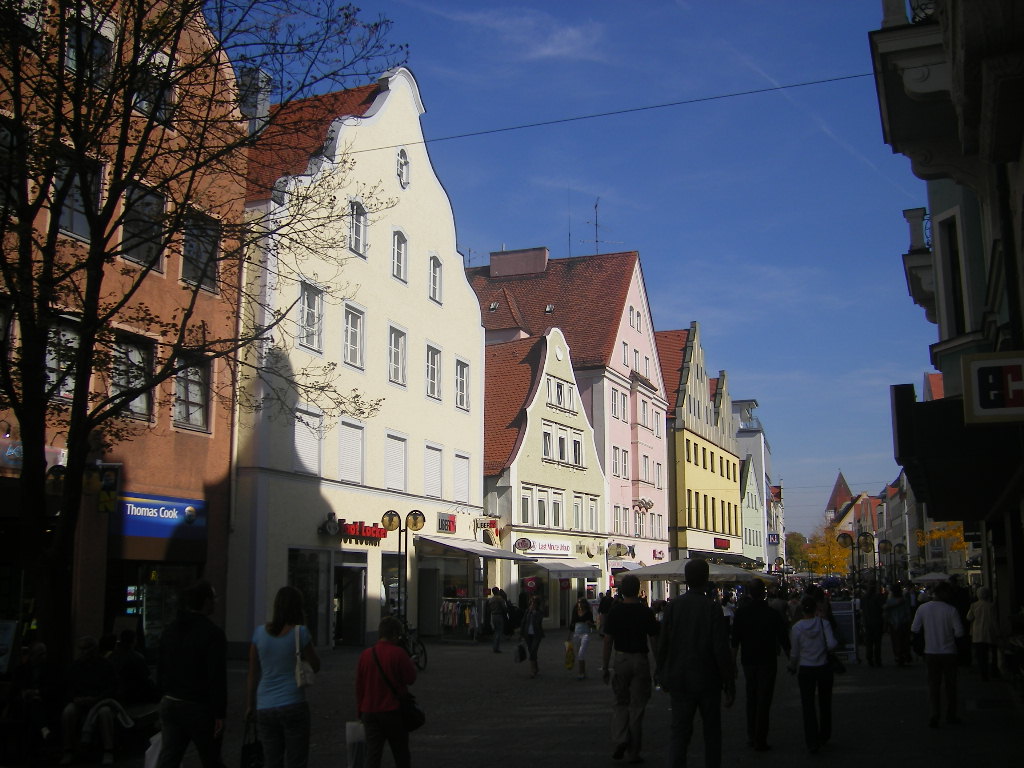 |
| Street scene in Ingolstadt, Bavaria |
I never studied economics (though I wish I had), so the current state of the world's finances flickers across the screen of my mental vision like some increasingly uncomfortable phantasmagoria in a Fellini film, incomprehensible and ever more bizarre. Probably I could understand more if I buckled down to study the matter; but I just don't want to. Even if I did truly comprehend all the causes and effects of this historical crisis, there is absolutely nothing I could do with that knowledge to help anyone; and the low, parlous state of my own finances away out here on the prairie is too uncomfortable already to bear the weight of much thought.
Like most ordinary folks, I realize that I am but a tiny cog in an enormous wheel, and just have to endure whatever the movers and shakers of the world decide to do, or not do. Still, from an historical point of view, it seems rather ironic that Germany - a nation I have no particular affinity or antipathy for, though in truth I am not much attracted to sausage, sauerkraut, and gutteral vowels - that having been put to utter ruin within living memory, it has now miraculously, so it seems, rebounded so much as to hold the fate of the world within its hands.
Why is that, exactly, when other European countries who also were laid waste by the war, and rebuilt with generous American help, are barely able to pay their light bill, so to speak? This interesting article in the Telegraph points to an answer, though how true it is, I can't say; but here's an excerpt for you to mull over:
Ingolstadt gives an excellent impression, aside from all the kebab houses and cars, of still being trapped in some much-earlier historical period. It is also one of the reasons that southern Germany remains such a powerful motor for Europe’s economy – indeed, Europe’s last great hope. And it is the behaviour and attitude of people like those living in Ingolstadt which will have a profound impact on how the current crisis plays out. . . . The German people value their local towns, worry about their neighbours’ views, relish the rules and are rewarded accordingly by a social and economic system that really does work. . . .By chance, the President's weekly video address today from Indonesia, where he is making trade agreements, touches on a related idea:
The devastated, occupied and shamed West Germany of 1945 rebuilt itself from a smaller version of the same principles as before – hundreds of towns, each producing something exceptional. And it turned out that this new German prosperity was also intimately linked with the successful export of things which foreigners liked, the ensuing money allowing Germans themselves to buy things. This successful pattern, a sort of conveyor belt of investment, ideas, things and consumers, continues to the present day. But instead of just being a source of happiness to many of its fortunate inhabitants, it must suddenly bear the brunt of a global disaster.
Since the end of the Cold War, Germany has given two gifts to the world. The first was the decision to pour many billions of Deutschmarks into the somewhat patchy rebuilding of old East Germany. The second was to be the principal begetter of the euro – what was meant to be the final act to wind up the legacy of the Second World War. In a grand restatement of the principles that had cemented the original Treaty of Rome, Europeans who shared a currency would have so much in common that they could not dream of fighting each other. Some of the applicants to join the euro seemed a little odd or dodgy, but the Germans would ignore this because there was a higher, almost mystical issue at stake.
It is perhaps the fundamental question now facing Europe: what will the people wandering along Ingolstadt’s principal shopping streets think about what has happened? Germany’s attempts to dominate Europe militarily ended in utter moral and physical disaster. Germany’s more recent attempt to dominate Europe through the benign means of hard work, constructive engagement and backing the euro appeared to be a brilliant success. The unique form of provincialism that lies at the heart of Germany somehow resulted in the belief that the rest of the world shared its values – work all week at Audi, spend the weekend in riotous drinking and arguments about the relative merits of long-haul holiday destinations, and mix this with occasional marital infidelity and spiritual crisis. It simply could not encompass the idea that Greece or Italy would use access to the euro knowingly and contemptuously to pour that work ethic down the plughole. . . .
These agreements will help us reach my goal of doubling American exports by 2014 – a goal we’re on pace to meet. And they’re powerful examples of how we can rebuild an economy that’s focused on what our country has always done best – making and selling products all over the world that are stamped with three proud words: “Made In America.”
This is important, because over the last decade, we became a country that relied too much on what we bought and consumed. We racked up a lot of debt, but we didn’t create many jobs at all.
If we want an economy that’s built to last and built to compete, we have to change that. We have to restore America’s manufacturing might, which is what helped us build the largest middle-class in history. That’s why we chose to pull the auto industry back from the brink, saving hundreds of thousands of jobs in the process. And that’s why we’re investing in the next generation of high-tech, American manufacturing.
Which sounds good. But what do I know. And as a matter of historical fact, we had the world's biggest and finest industrial plant already in place when the Great Depression happened, but that wasn't enough to prevent calamity.
Monday, January 26, 2009

Saturday, December 20, 2008
Today's Quote: An End to the Voodoo?
From Bob Herbert's column in the New York Times, on the appointment of Hilda Solis to be Obama's Secretary of Labor:
From Ronald Reagan’s voodoo economics to Henry Paulson’s $700 billion Troubled Asset Relief Program, we’ve put the mighty resources of the national government overwhelmingly on the side of those who were already rich and powerful.
Ordinary workers have suffered. It took years to get a lousy little boost in the minimum wage for the working poor. Attempts to expand health insurance coverage were fought almost to a standstill. Guaranteed pensions vanished. And the maniacs who set fire to the economy with their incendiary financial instruments (yet another form of voodoo) were hot to privatize Social Security.
As Andy Stern, president of the huge Service Employees International Union, told me on Friday: “We’ve had a 25-year experience with market-worshipping, deregulating, privatizing, trickle-down policies, and it has ended us up with the greatest economy on earth staggering, and with the greatest amount of inequality since the Great Depression.”
The contempt for workers over this long period has hardly been hidden. Until Mr. Bush was forced by circumstances to tap the TARP program for the auto industry loans (small potatoes compared with the gargantuan Wall Street bailouts), the administration had gone out of its way to keep the program’s hundreds of billions of dollars reserved for the elites of the financial services industry and their associates. . . .
Leo Gerard, president of the steelworkers union, summed up the government’s attitude nicely when he said: “Washington will bail out those who shower before work, but not those who shower afterwards.”
Working people have been treated like enemies, a class to be preyed upon. Labor unions were ferociously attacked. Jobs were shipped overseas by the millions. People were hired as temps or consultants so benefits could be denied.
All of this may finally be changing. It remains to be seen how strong a voice Ms. Solis will have in the Obama administration, but she is pro-worker to her core, a politician who actually knows what it’s like to walk a picket line.
Wednesday, September 17, 2008
A man, a plan, Obama
Intelligence. Rational thought. Good sense. How very refreshing.
By comparison, take just one glance at the wacky 3-ring circus the other candidate is leading, and there's simply no question who should be at the helm in January. Unless you truly believe it's God's plan for Geezer & Gidget to inherit the earth.
Read more: barackobama.com/plan
Tuesday, September 16, 2008
Don't panic
I'm no kind of economist, but one thing I do know: whatever may be happening on Wall Street, don't panic.
The big stock market dip in 1987 was very scary too, but in a couple of years stock prices had risen again to where they had been; and then soared higher than anyone thought possible over the next decade.
So if you're in the 98 percent of the population who doesn't know a convertible debenture from a ragtop Caddy, don't do anything rash right now. Probably our money is pretty damn safe right where it is. Bank accounts are all insured to $100,000 per person by the government, so not to worry. Sit tight and we'll ride this out just fine, is what I think will happen if history is any guide.
A very good list of tips and advice at Yahoo News here.
I can also recommend queer financial expert Andrew Tobias's book, The Only Investment Guide You'll Ever Need. Lots of plain English and common sense there from a real expert.
Don't panic. Vote! It's so damn funny listening to McSame & Co. castigating "Washington" for getting us into this economic train wreck. Who the hell do they think "Washington" has been for the last 8 years, hmmm???
The big stock market dip in 1987 was very scary too, but in a couple of years stock prices had risen again to where they had been; and then soared higher than anyone thought possible over the next decade.
So if you're in the 98 percent of the population who doesn't know a convertible debenture from a ragtop Caddy, don't do anything rash right now. Probably our money is pretty damn safe right where it is. Bank accounts are all insured to $100,000 per person by the government, so not to worry. Sit tight and we'll ride this out just fine, is what I think will happen if history is any guide.
A very good list of tips and advice at Yahoo News here.
I can also recommend queer financial expert Andrew Tobias's book, The Only Investment Guide You'll Ever Need. Lots of plain English and common sense there from a real expert.
Don't panic. Vote! It's so damn funny listening to McSame & Co. castigating "Washington" for getting us into this economic train wreck. Who the hell do they think "Washington" has been for the last 8 years, hmmm???
Subscribe to:
Posts (Atom)