My favorite books tend to be histories and biographies. Since childhood I have always been more interested in the past, which is to some degree certain and knowable, than in the future, which is anybody's guess, and probably best filed under "You Don't Want to Know." I will admit to an adolescent fascination with science fiction - Heinlein was tops in my estimation, followed by Bradbury and Asimov, and of course, like every other 12-year-old, I had a passion for
Star Trek - but somehow I grew out of all that.
I suppose I became less enchanted with the possibilities of the future as it slowly dawned on me that I had little control over things to come, the wide, sunlit vistas of childhood anticipation shrinking inexorably into the narrow bounds of my small and somewhat weedy garden: hard tilling much of the time with the limited tools available to me. Of course other people, possessed of greater abilities and finer soil, may yet feel the unbounded possibilities of life well into middle age; but such was not vouchsafed to me.
Be that as it may, I find it endlessly intriguing to read of how other people - both the great and the good, as our British friends are wont to say, as well as the poor and the humble - have reacted to the storms and stresses of life, how they charted a course through gales and high seas to reach a safe port or deliver a rich cargo - or, contrariwise, how they lost their bearings and ended up aground or shipwrecked, as the case may be. After reading a great many such stories, with a philosophic eye, one begins to notice certain recurring themes and patterns: those who make a safe landing in the end, very generally speaking, tend to be well endowed with the qualities of persistence and self-discipline - they have a job to do, and they stick to it come hell or high water, always busy and always reaching a little further ahead or upwards; they do not give up and say, "Oh, what's the use."
I think that very often, such folks attribute their success in life to the favoring motions of Providence, when in fact it is largely their own stubborn perseverance that sees them through - which success some of them, on some occasions, take too much pride in, and look down their noses at others less blessed than they with these inner qualities. Your Head Trucker, most unfortunately, has more often than not fallen into the what's-the-use camp, to my great disadvantage, being more heavily freighted with passion than with discipline: which, while the combination sometimes produces lovely things, has never been a recipe for great success in the material sense.
A couple of other adjuncts to success, which often lead straight to fame and fortune, may be noted. One is just the sheer dumb luck of being in the right place at the right time - the unknown understudy who steps in when the leading lady falls ill, the reporter who just happens to be on the spot when some disaster occurs, and so forth. Another crucial adjunct is the invaluable faculty of - how to define it? - I'm not sure there's a single word in English which combines what I want to express here, the ineluctable combination of personal charm, a kind of social magnetism, with the ability to meet many people easily and make quick friendships - of the sort that, when somebody needs a thing done or a problem solved, they think, "Oh yes, X could do that . . . " and straightaway they pick up a phone or dash off a telegram, summoning you to the next big step in your career.
Which never happens to your Head Trucker, and exactly why that is I really can't say. No doubt the inadequacies of my own talents are only too obvious to others, so that when they think of me, they say to themselves, "Oh . . . him." And think no more in that direction. Just my personality, I suppose, probably more prickly than charming, and one that will never be the subject of a biography, rightly so.
Well, that's just the breaks; not everyone gets to live a fascinating life, and if they did, fascinating would quickly become banal, wouldn't it? Still, as I said, it is rather interesting to read how various personalities in all sorts of positions and places have acted and reacted down through the years, some with more success - and honesty and effort - than others. Likewise, it is instructive to read a well written and researched study that uncovers the face behind the mask, the man behind the curtain. We all of us have a public persona, the mask we present to the world, delineated with confidence and certainty - but then there is the private reality, which may or may not accord very closely with our public face. The difference between the two is magnified in the lives of the famous, sometimes amusingly so, sometimes shockingly.
For example, I recommend to my readers
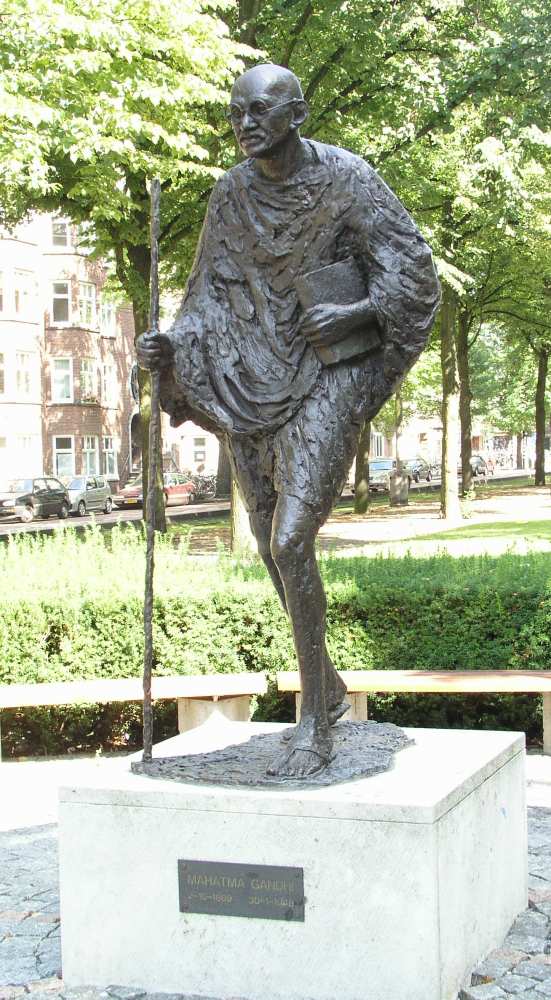
this very interesting review of a recent biography of Gandhi, which seems to reveal a rather different person behind the mask of sainthood we have come to revere:
Joseph Lelyveld has written a generally admiring book about Mohandas Gandhi, the man credited with leading India to independence from Britain in 1947. Yet Great Soul also obligingly gives readers more than enough information to discern that he was a sexual weirdo, a political incompetent and a fanatical faddist—one who was often downright cruel to those around him. Gandhi was therefore the archetypal 20th-century progressive intellectual, professing his love for mankind as a concept while actually despising people as individuals.
And was Gandhi gay? Another excerpt:
the love of his life was a German-Jewish architect and bodybuilder, Hermann Kallenbach, for whom Gandhi left his wife in 1908. "Your portrait (the only one) stands on my mantelpiece in my bedroom," he wrote to Kallenbach. "The mantelpiece is opposite to the bed." For some reason, cotton wool and Vaseline were "a constant reminder" of Kallenbach, which Mr. Lelyveld believes might relate to the enemas Gandhi gave himself, although there could be other, less generous, explanations.
Gandhi wrote to Kallenbach about "how completely you have taken possession of my body. This is slavery with a vengeance." Gandhi nicknamed himself "Upper House" and Kallenbach "Lower House," and he made Lower House promise not to "look lustfully upon any woman." The two then pledged "more love, and yet more love . . . such love as they hope the world has not yet seen."
And despite his influence as a preacher of non-violence, it seems that Gandhi took the concept to quite fanatical extremes, monstrously so,
as another reviewer notes:
Gandhi cannot escape culpability for being the only major preacher of appeasement who never changed his mind. The overused word is here fully applicable, as Gandhi entreated the British to let the Nazis
take possession of your beautiful island, with your many beautiful buildings. You will give all these but neither your souls, nor your minds. If these gentlemen choose to occupy your homes, you will vacate them. If they do not give you free passage out, you will allow yourself man, woman and child, to be slaughtered . . .
This passage is revealing, not so much for its metaphysical amorality as for its demonstration of what was always latent in Gandhism: a highly dubious employment of the mind-body distinction. For him, the material and physical world was gross and polluting and selfish, while all that pertained to the “soul” was axiomatically ideal and altruistic. (Let Hitler have Britain’s “beautiful buildings,” while their expelled inhabitants, even as they submitted to extermination, meditated on the sublime.) This false antithesis is the basis for all religious fundamentalism, even as its deliberate indifference permits and even encourages sharp deterioration in the world of “real” conditions. Not entirely unlike his contemporary fighter for independence Eamon De Valera, who yearned for an impossible Ireland that spoke Gaelic, resisted modernity, and put its trust in a priestly caste, Gandhi had a vision of an “unpolluted” India that owed a great deal to the ancient Hindu fear and prohibition of anything that originated from “across the black water.”
I don't know enough to judge for certain; I never saw the movie (not that Hollywood is any kind of dependable source), though in earlier years I have read about Gandhi's life, as well as some of his own writings. And of course it is possible for a man or woman to have some good ideas, even very good, mixed in with others less than good. But I offer these excerpts as a way of making the point that public and private are often rather different things; and sometimes the most unlikely characters end up being idolized for imagined qualities rather than real ones.
We could, of course, continue this line of examination by starting with political figures in our own country, like the current Republican line-up . . . oh, but what's the use?