As a follow-up to
my recent post on the latest figures from the Williams Institute, here's the
Wall Street Journal's
explanation of why it's so damned hard to come up with a reliable estimate of the number of gays (and other queer people):
In recent years more surveys have included questions about sexual behavior and identity, giving researchers a better shot at making an estimate. They also have learned how difficult it can be to define homosexuality, and to determine to what extent survey answers are affected by the way the questions are asked.
The Census Bureau, for instance, says it saw the number of people who identified themselves as spouses to someone of the same sex drop by more than 50% in 2008 from a year earlier just because of how the questionnaire was organized. "It's a very difficult statistical issue," says Howard Hogan, the agency's associate director for demographic programs, of counting same-sex couples. . . .
One problem [that demographers have noted about the Williams Institute] findings is that they combine results from surveys with different sample sizes and interview formats. The California Health Interview Survey canvassed about 50,000 Californians in 2009 by phone, finding that 3.2% identified themselves as gay, lesbian or bisexual. In contrast, roughly 5,900 people took Indiana University's online National Survey of Sexual Health and Behavior in 2009, and nearly twice as many— 5.6%—identified themselves that way.
"I think there are a lot of problems with every one of those data sets," says Randall Sell, associate professor at Drexel University's school of public health. A concern, he says, is that people are more likely to reveal their sexual identity via computer than by phone or in person.
Dr. Gates [author of the Williams Institute report] says without more information about the validity of each survey, averaging the results is the best compromise. "You can make an argument they're all credible," he says.
So. If a stranger knocks on your door, or calls you on the phone, and asks, "Are you gay?" - how many people will give a straight answer to that question? Online and anonymous, more people might be comfortable telling the truth - but that limits your field to people who are young and smart and affluent enough to own a computer - and who care about answering that kind of survey. Which is
not reflective of the whole population.
And what does "gay" mean, anyway? Having come out in 1980, the question has long been settled in my own mind. But ya know, guys, I have met friends in recent years who put off coming out till they were past 50; and meanwhile were married or had girlfriends, maybe some kids too. Think of Jack and Ennis in
Brokeback Mountain, which is very true to life out here on the prairie.
Likewise, I've also known mature women who were happily married, doing the wife-and-mommy thing; then one day woke up to the fact that they liked girls. Women's sexuality is often much more nebulous and fluid than men's, I've concluded, for reasons that have a lot to do with the plumbing and wiring.
Then too, I've, um, known guys who merrily fooled around with other guys in the rush of teenage sexuality; but later married a girl and have lived happily ever after with never a backward glance. So the question of "how many" is not totally clear until you decide on the "what" to count, see?
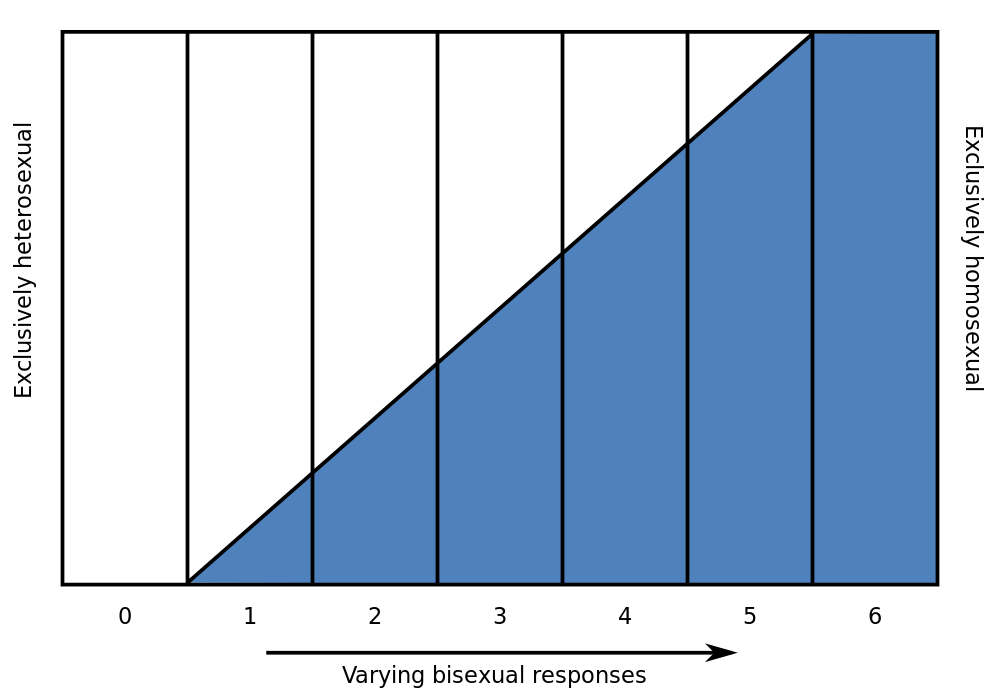
Which is why Kinsey - who is
constantly misquoted by the media on this subject - brilliantly came up with the
Kinsey Scale. Which is much more reflective of the reality of sexuality, I think, than any simplistic gay/straight dichotomy. A truly accurate survey would have to be based on something like that, seems to me.
Bottom line: Your Head Trucker's experience strongly suggests that no more than 3 to 5 people out of a hundred, at most - depending on where you are, and what kind of group you are in - are gay enough to raise a blip on my gaydar. Which is not all that good, I'm sorry to say - but that's been my consistent experience for the last thirty years or so down here in Dixie.