C I V I L    M A R R I A G E    I S    A    C I V I L    R I G H T.

A N D N O W I T ' S T H E L A W O F T H E L A N D.


Showing posts with label Matthew 25. Show all posts

Tuesday, February 17, 2026

Like Ships in the Night: Two Christian Leaders

Two men of different races, generations, and backgrounds, one departing, one just arriving, whose faith has informed their politics - not the other way around.  Hope is still alive.

The Reverend Jesse Jackson, 1941-2026; may he rest in peace after his long, weary struggles for civil rights and justice for all:


Texas state representative James Talarico, born 1989, in a censored interview with Stephen Colber:

For 50 years, the religious right, a political movement - that's the perfect description for it - they convinced a lot of our fellow Christians that the most important issues were abortion and gay marriage:  two issues that aren't mentioned in the Bible, two issues that Jesus never talked about. Jesus in Matthew 25 tells us exactly how you and I and every one of our fellow believers, how we're going to be judged and how we're going to be saved:  by feeding the hungry, by healing the sick, by welcoming the stranger. Nothing about going to church, nothing about voting Republican. It is all about how you treat other people.

Don't tell me what you believe; show me how you treat other people, and I'll tell you what you believe.

I couldn't have said it better myself.


Bonus:  Talarico speaks at a town hall in Laredo last week:

This man speaks my language.  He's young enough to be my grandson, but he talks with mature wisdom and confidence.  Wow.  

-----

Sunday, April 27, 2025

Sunday Drive: Peace Prayer

To honor the memory of Pope Francis


John Michael Talbot is a Grammy-award-winning Catholic musician and some kind of Franciscan monk.  His rendition of the Peace Prayer, which appears at the top of the sidebar of this blog, is a great favorite of your Head Trucker's.

In his funeral sermon for Pope Francis yesterday at the Vatican, Cardinal Re recalled the late pope's persistent concern for the poor, the suffering, and the outcasts of the world, on the model of his namesake saint.  This concern is at the heart of the Christian faith, as Jesus expressed it in Matthew 25:31-46, and is neatly summarized in what Catholics call the Seven Works of Corporal Mercy:
      1. Feed the hungry
      2. Give drink to the thirsty
      3. Clothe the naked
      4. Shelter the homeless
      5. Visit the sick
      6. Visit the prisoners
      7. Bury the dead
(This Episcopalian thinks it would not be amiss to add "and comfort the living" to that last point.)

Whether you are a Christian or not, this is a handy checklist if you find yourself wondering just what you can do to make a difference in the world.  You don't have to save the whole world; just do what you can for those nearest you.  I believe that the smallest act of sincere kindness - even just a friendly smile - counts for something in the scheme of the universe. 

And God needs workers in other areas besides those seven.  Your Head Trucker thinks He would be better pleased if you spent just an hour a week on the phone with your lonely old Aunt Sally, who always talks your ear off, than sitting and squirming for an hour in a church service you can't wait to get away from.  Aunt Sally has a real hunger for human company, and it costs you nothintg but a little time and patience to give a needed lift to her spirits.  That is the sort of service with which God is best pleased.  But who am I to say?

Blessed are the merciful, for they shall obtain mercy.

-----

Thursday, June 21, 2018

Today's Quote: What Kind of Country Are We?

Time cover, issue of July 2, 2018. Click to enlarge.

Karl Vick of Time magazine poses the question:
Presidents have many jobs, and one is telling us who we are.

For the first 240 years of U.S. history, at least, our most revered chief executives reliably articulated a set of high-minded, humanist values that bound together a diverse nation by naming what we aspired to: democracy, humanity, equality. The Enlightenment ideals Thomas Jefferson etched onto the Declaration of Independence were given voice by Presidents from George Washington to Barack Obama.

Donald Trump doesn’t talk like that. In the 18 months since his Inauguration, Trump has mentioned “democracy” fewer than 100 times, “equality” only 12 times and “human rights” just 10 times. . . .

A week after his return from the June 12 summit with North Korea’s dictator, family separation dominated the national conversation like no other political story since former FBI chief James Comey was shown the door. A steadily building wave of revulsion washed over the political spectrum, from MSNBC to the editorial page of the Wall Street Journal to Franklin Graham and into the White House living quarters, when a spokeswoman for the First Lady said she called for “a country that governs with heart.”

Which leaves us facing a question: What kind of country are we? The world has been nervously asking that since November 2016. And while Trump ultimately capitulated on the forced separation of children, his new order suggested that families would be detained not only together, but perhaps indefinitely. For many Americans, the forced separation of immigrant families left them looking into the void from which the brutal policy emerged: the dark space left by the words Trump does say. . . .

What values does America’s billionaire President embrace in place of the Founders’? A kind of gimlet-eyed competition. Trump purports to run the country as a business, the most meaningful metric being exports vs. imports: if you have more than your counterpart, you’re a winner, and the other guy a loser. But even in the bloodless world of accounting, “goodwill” has a place on the ledger (the left side; it’s an asset) and the U.S. may be writing down a loss. Its economy is strong. The people pitching up at its borders surely count as proof of that.

It was Alexis de Tocqueville, the French observer of the early American character, who recognized the danger of placing too much value on business, law and order at the expense of the higher values. Warning of the country’s obsession with material gain and the enforcement of order necessary to pursue it, he wrote, “A nation that asks nothing of its government but the maintenance of order is already a slave at heart.”

Which is why the test posed with Trump’s “zero tolerance” policy is as much about our future as it is about the tragedy of the families separated by its implementation. Trump may have backed down on the specific practice of family separation, but the larger question remains. In the balance between the integrity of the U.S. border with Mexico and a parent’s love for a child, where will we come down?

“Without a Border, you don’t have a Country,” the President wrote on June 19. Everyone knows that. The question is, what kind of country?

The photographer who took the photograph of the child explains the background of her story:


What I say: If this misled, misguided country does not repent and shed the cruel, uncaring, unjust evil twining about its heart, and quickly, it may be in store for a terrible retribution at the hands of Fate. For as everyone knows: What goes around, comes around.


Those who yearn for a truly "Christian nation" had best examine their own hearts and heed these words of warning:

Matthew 25:31-46 King James Version (KJV):
31 When the Son of man shall come in his glory, and all the holy angels with him, then shall he sit upon the throne of his glory:

32 And before him shall be gathered all nations: and he shall separate them one from another, as a shepherd divideth his sheep from the goats:

33 And he shall set the sheep on his right hand, but the goats on the left.

34 Then shall the King say unto them on his right hand, Come, ye blessed of my Father, inherit the kingdom prepared for you from the foundation of the world:

35 For I was an hungred, and ye gave me meat: I was thirsty, and ye gave me drink: I was a stranger, and ye took me in:

36 Naked, and ye clothed me: I was sick, and ye visited me: I was in prison, and ye came unto me.

37 Then shall the righteous answer him, saying, Lord, when saw we thee an hungred, and fed thee? or thirsty, and gave thee drink?

38 When saw we thee a stranger, and took thee in? or naked, and clothed thee?

39 Or when saw we thee sick, or in prison, and came unto thee?

40 And the King shall answer and say unto them, Verily I say unto you, Inasmuch as ye have done it unto one of the least of these my brethren, ye have done it unto me.

41 Then shall he say also unto them on the left hand, Depart from me, ye cursed, into everlasting fire, prepared for the devil and his angels:

42 For I was an hungred, and ye gave me no meat: I was thirsty, and ye gave me no drink:

43 I was a stranger, and ye took me not in: naked, and ye clothed me not: sick, and in prison, and ye visited me not.

44 Then shall they also answer him, saying, Lord, when saw we thee an hungred, or athirst, or a stranger, or naked, or sick, or in prison, and did not minister unto thee?

45 Then shall he answer them, saying, Verily I say unto you, Inasmuch as ye did it not to one of the least of these, ye did it not to me.

46 And these shall go away into everlasting punishment: but the righteous into life eternal.


Tuesday, February 21, 2017

Refugees Welcome

Activists today unfurled a welcome banner on the pedestal of the Statue of Liberty, which was soon removed by park rangers.  Earlier in the day, the Department of Homeland Security had issued its new plan for rounding up and deporting illegal aliens found in this country.


Although the banner made a cheerful sight, today's deportation orders remind me of this cartoon from 1939 and the shameful story behind it: a cautionary tale for our time.


I also came across this poster, source not stated, which gives pause for thought:


More food for thought, if anyone is hungry:


Thursday, May 16, 2013

Love Your Enemies

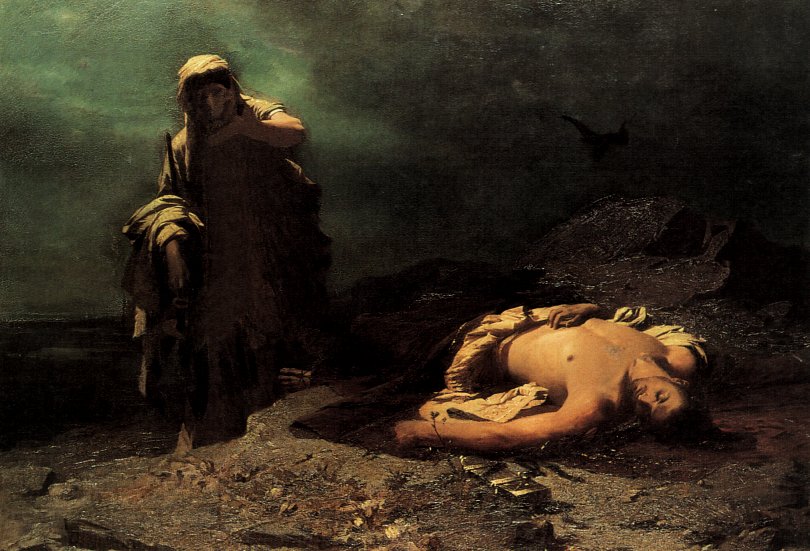
Nikiforos Lytras, Antigone in front of the dead Polynices (1865)

From the Sermon on the Mount:
Ye have heard that it hath been said, Thou shalt love thy neighbour, and hate thine enemy.

But I say unto you, Love your enemies, bless them that curse you, do good to them that hate you, and pray for them which despitefully use you, and persecute you;

That ye may be the children of your Father which is in heaven: for he maketh his sun to rise on the evil and on the good, and sendeth rain on the just and on the unjust.

Your Head Trucker feels old and weary, and not up to writing a lengthy, well-polished post today, so I will just throw out some thoughts and leave it up to you fellas to connect the dots, if they mean anything to you.

It's a gray, drizzly day here in Texas, where last night, several counties away from me, tornadoes destroyed a subdivision, killing or injuring scores of people. Which seems only to be expected somehow, in a week when the news has been brimful of scandal, crime, murder, outrage, and every kind of horrible mayhem. Too much to take in, and far too much to dwell on: it seems the veneer of civilization is worn through in many places, and the ugly, bloody, barbaric core is bleeding out. I suppose awful things have always been happening somewhere, to someone, every day of mankind's existence on this planet; but whereas news used to travel slowly and partially, now it comes roaring at you in living color at all hours of the night and day. Too much to bear. All one can do is look away, and occupy the mind with puttering around the house, and tending one's own narrow garden.

As much as I applaud the recent advances for gay rights and marriage equality that I often feature here in the Blue Truck, I also have to say that I can hardly help despairing for the future of the world, and to be honest, I am glad that whenever it is my time to depart from it, I will leave behind no posterity to worry about. "The best lack all conviction, while the worst are full of passionate intensity," Yeats wrote a hundred years ago, and it is even truer now than it was then.

At nearly 60 years of age, few illusions about human nature are left to me; with time and experience, one comes to see people for who and what they really are, not what they pretend to be. It is particularly discouraging to see that the great mass of supposedly civilized Western people - the great majority of them at least nominally Christian - are all in a headlong rush to the worst excesses of barbarism. It feels that way, anyhow.  My second-grade teacher got it exactly right one day, fifty years ago, when she asked why a bunch of us little boys were all stepping on one another's shoes in the cafeteria line. "Well, he did it to me, so I did it to the other boy," was the repeated answer to her question. Summing up her inquest with a wry face and a disapproving shake of the head, she exclaimed, "Monkey see, monkey do."

Man is an imitative creature. You become what you think about, what you idolize, what you adore - which may be something quite different from what you say you do. And it seems to me that nearly everyone is doing their damnedest to behave just like characters in a low-class, scrum-bum reality show nowadays. Hence the decline of manners, of civility, of literacy and of reason. Of course, I have to remind myself that the worst examples are not necessarily representative of the whole in any group, but - "Monkey see, monkey do."

Continued after the jump

Friday, April 20, 2012

Three Thoughts

Some thoughts that have coalesced with me in the last day or two.  Instead of linking them explicitly with an essay, I think I will just put them out here and let my truckbuddies make the connections for themselves.

I.  Via Wounded Bird, a quote from Brother Eldridge Pendleton, Society of St. John the Evangelist:
To each of us God gives riches that we may enhance by squandering on those who need us.

II. A book by a fellow Texan whose title I've heard of many times, but somehow never bothered to find out anything about - until now.


III. By chance today I rediscovered this breathtaking Norman Rockwell painting, ''Murder in Mississipppi'', which he created in response to the killing of three civil rights workers in 1964 - click to enlarge:

Monday, January 2, 2012

Occupy Christianity?

From the Baptismal Covenant in the Book of Common Prayer:

Celebrant:  Will you proclaim by word and example the Good
News of God in Christ?
People:  I will, with God’s help.

Celebrant:  Will you seek and serve Christ in all persons, loving
your neighbor as yourself?
People:  I will, with God’s help.

Celebrant:  Will you strive for justice and peace among all
people, and respect the dignity of every human
being?
People:  I will, with God’s help.


Honk to Wounded Bird

Tuesday, January 26, 2010

Different Strokes for Different Folks


Stroke 29 Rocket Fuel by Gun Oil

I used to have a certain admiration for the late Pope John Paul II as an indefatigable supporter of human rights in general, notwithstanding his also obvious support for the Catholic moral position on matters of sexuality.

But I can never forget the cold and cutting pronouncement he made in his last book, Memory and Identity, reported in the news media just a week or two after my husband's death, that same-sex marriage was an "ideology of evil."  Yes, two men and a little dog living quietly and peacefully in a little town far out on the prairie, working their jobs, serving the community, paying their taxes, attending church, buying groceries, doing all the very same things their neighbors did, day in and day out, were "objectively disordered" and "intrinsically evil," points he had already made in a letter to American bishops twenty years earlier. 

But now with my husband barely cold in the ground, I felt His Holiness's nasty, coldhearted, evil-minded words more acutely than ever before.  This was a man, it must be recalled, in a position of ultimate moral authority over more than a billion people; and for all his great intellect and wide experience, the best he could say about Cody and me is that we were evil, and promoting evil.  Really. 

Well now come to find out, as Sullivan and others have reported, the late Pontiff
whipped himself with a belt, even on vacation, and slept on the floor as acts of penitence and to bring him closer to Christian perfection, according to a new book by the Polish prelate spearheading his sainthood case...

"It's an instrument of Christian perfection," Oder said, responding to questions about how such a practice could be condoned considering Catholic teaching holds that the human body is a gift from God.

"As some members of his close entourage in Poland and in the Vatican were able to hear with their own ears, John Paul flagellated himself. In his armoire, amid all the vestments and hanging on a hanger, was a belt which he used as a whip and which he always brought to Castel Gandolfo," the papal retreat where John Paul vacationed each summer.
Sullivan, a devout Catholic, approves, saying
I have every respect for the practice of self-mortification and self-denial. . . .  I see the last Pope's embrace of these things as affecting signs of his deep and genuine closeness to God.
Yet despite his loyal support for self-flagellation - a practice which Jesus never indulged in, and never, ever recommended - that brilliant mind also has the independence to ask the pertinent question here:
So why is self-abuse inherently wrong when it is done by hand and yet saintly when it is done by whip?
Masturbation, of course, is also an "intrinsically and gravely disordered action," the Church says.

So - if you jack yourself off, or you get off with your committed partner, you are committing outrageous evil.  And destroying civilization while you're at it.  Don't even think about asking for the law to protect your love and marriage, you filthy, twisted, disordered creep, you.

But - if you whip yourself bloody in your bedroom every night, why, God smiles - and loves you even more.

Now I ask you, fellas:  Just how fucked up is that?

Christian perfection, my ass. 

And again I refer my truckbuddies to Matthew 25 for clarification.

Sunday, January 24, 2010

"Real Christian" Thinking

An anonymous commenter has, in a roundabout way, accused your Head Trucker of not thinking like a "Real Christian."  Because I don't support starving stray animals to death, or letting poor kids go hungry.

You can read his or her remarks here as well as my response.

But in the meantime, since it's Sunday, your Head Trucker would like to clear up what seems to be some widespread confusion about what "Real Christians" should be thinking and doing.  So as a public service, I therefore present the following excerpt without further comment.  Read it and make up your own minds.
When the Son of man shall come in his glory, and all the holy angels with him, then shall he sit upon the throne of his glory:

And before him shall be gathered all nations: and he shall separate them one from another, as a shepherd divideth his sheep from the goats:

And he shall set the sheep on his right hand, but the goats on the left.

Then shall the King say unto them on his right hand, Come, ye blessed of my Father, inherit the kingdom prepared for you from the foundation of the world:

For I was an hungred, and ye gave me meat: I was thirsty, and ye gave me drink: I was a stranger, and ye took me in:

Naked, and ye clothed me: I was sick, and ye visited me: I was in prison, and ye came unto me.

Then shall the righteous answer him, saying, Lord, when saw we thee an hungred, and fed thee? or thirsty, and gave thee drink?

When saw we thee a stranger, and took thee in? or naked, and clothed thee?

Or when saw we thee sick, or in prison, and came unto thee?

And the King shall answer and say unto them, Verily I say unto you, Inasmuch as ye have done it unto one of the least of these my brethren, ye have done it unto me.

Then shall he say also unto them on the left hand, Depart from me, ye cursed, into everlasting fire, prepared for the devil and his angels:

For I was an hungred, and ye gave me no meat: I was thirsty, and ye gave me no drink:

I was a stranger, and ye took me not in: naked, and ye clothed me not: sick, and in prison, and ye visited me not.

Then shall they also answer him, saying, Lord, when saw we thee an hungred, or athirst, or a stranger, or naked, or sick, or in prison, and did not minister unto thee?

Then shall he answer them, saying, Verily I say unto you, Inasmuch as ye did it not to one of the least of these, ye did it not to me.

And these shall go away into everlasting punishment: but the righteous into life eternal.
--Matthew 25.
Related Posts with Thumbnails