C I V I L    M A R R I A G E    I S    A    C I V I L    R I G H T.

A N D N O W I T ' S T H E L A W O F T H E L A N D.


Showing posts with label JFK. Show all posts

Saturday, September 11, 2021

The End of an Era


A U. S. Marine grieves at the memorial of a comrade killed in Afghanistan, 2012

Ben Rhodes, an American political commentator and former Deputy National Security Advisor to President Obama, writes in the Guardian:

Most importantly, the abandonment of Afghans to the Taliban, and Biden’s occasionally callous rhetoric laying the blame on Afghan security forces, who had fought on the frontlines for years, evoked a sense of national shame – even if that emotion should apply to the entirety of the war, and not simply its end. Indeed, in the chaotic days of withdrawal, the predominant concerns in US politics often had little to do with Afghans. The evacuation of Americans, the danger of Islamic State Khorasan Province, and the loss of US service members eclipsed the gargantuan Afghan suffering. Overwhelming public support for Biden’s decision, though undercut by dissatisfaction with the process of withdrawal, confirmed Biden’s core instinct: the thing most Americans agree upon is that we went to Afghanistan to take out the people who did 9/11 and prevent further attacks, and it was past time to abandon the broader aims of post-9/11 foreign policy, no matter the subsequent humanitarian cost.

In short, Biden’s decision exposed the cavernous gap between the national security establishment and the public, and forced a recognition that there is going to be no victory in a “war on terror” too infused with the trauma and triumphalism of the immediate post-9/11 moment. Like many Americans, I found myself simultaneously supporting the core decision to withdraw and shuddering at its execution and consequences. As someone who worked in national security, I have to recognise the limits of how the US can shape other countries through military intervention. As someone who has participated in American politics, I have to acknowledge that a country confronting virulent ethno-nationalism at home is ill-suited to build nations abroad. But as a human being, I have to confront how we let the Afghan people down, and how allies like Britain, who stood by us after 9/11, must feel in seeing how it all ended.

It is a cruel irony that this is the second time the US has lost interest in Afghanistan. The first time was in the 1990s, after much of the mujahideen we supported to defeat the Soviets evolved into dangerous extremists, plunged the country into civil war, and led to Taliban rule.

The final verdict on Biden’s decision will depend on whether the US can truly end the era that began with 9/11 – including the mindset that measures our credibility through the use of military force and pursues security through partnerships with autocrats. Can we learn from our history and forge a new approach to the rest of the world – one that is sustainable, consistent, and responsive to the people we set out to help; that prioritises existential issues like the fight against the climate crisis and genuine advocacy for the universal values America claims to support?

What I Say:  The twentieth anniversary of the 9/11 attacks, following close on the heels of the Afghanistan withdrawal, certainly does mark the end of an era - a nice, neat convenience for future history teachers - and the way forward is not at all clear.  The political divisions in this country have reached a horrendous frenzy now, exacerbated by the covid pandemic, that will not easily be tamped down.  There is a level of savagery and hysteria, not to mention widespread ignorance, arrogance, and sheer gullible superstition, on the tribal extremes of both the left and the right.

Before you start to contradict that last statement - was the anarchy at the Capitol on January 6th any more brutal than the nationwide anarchy that occurred last summer?  If you condemn the one, you must condemn the other.  In my view, both are equally nauseating and frightening, symptomatic of a dangerous, possibly fatal illness in the American body politic.  As Mr. Lincoln said - A house divided against itself cannot stand.  We have been warned.

As to foreign affairs, I hope all my truckbuddies will recall that the whole Afghan mess was the creation of the Bush-Cheney administration - and that Democrats criticized it from the very start, along with the shameful, senseless, needless war in Iraq that was based on Bush-Cheney's lies about non-existent "weapons of mass destruction."  It was necessary, and right by all standards of earthly justice, to hit back against the evil men who attacked our cities and mercilessly killed three thousand of our citizens on 9/11.  But it was not at all necessary to destroy two governments and colonize a Little America in the most inaccessible, inhospitable region on the other side of the world, at the cost of so many lives, so many dollars, and the respect and goodwill of nearly all the world.

Biden is responsible, as he himself has said repeatedly, for last month's frantic, shameful evacuation from Kabul - but we must remember that it was Bush-Cheney who dug us into that hole in the first place, against all reason and history and common sense, with glib Madison Avenue phrases like "regime change" and "nation building" - which are simply code for invasion, occupation, and control by a puppet government.  This has always been clear to those of us who had eyes to see it for what it was - Vietnam 2.0.  It was never about giving the Afghans what they wanted - it was all about giving them what we wanted for them.  And a cash cow beyond the wildest dreams of the military-industrial complex.

Continued after the jump . . .

Friday, November 22, 2013

Fifty Years Ago


Yes, I know what day it is, but no, I don't want to write about it. I was there - not in Dealy Plaza, but in 1963, staying home from school with the sniffles and sitting up on my parents' bed watching TV when the first bulletin broke in on a soap opera - and the dark story slowly unwound itself across the screen all that long November afternoon, brilliant with southern sunshine. I remember it all quite clearly, the four days of sadness, and though I did later read several books and many articles about it all, now the trials and tribulations of my own life across six decades have left me too familiar with sorrow to want to borrow any.  It was a tragedy, not a piece of entertainment to be endlessly revisited.

RIP JFK. If the gaping crowds will ever let you.

Monday, October 22, 2012

The Cuban Missile Crisis

Department store employees and customers pause to listen
to the President's address on October 22, 1962.

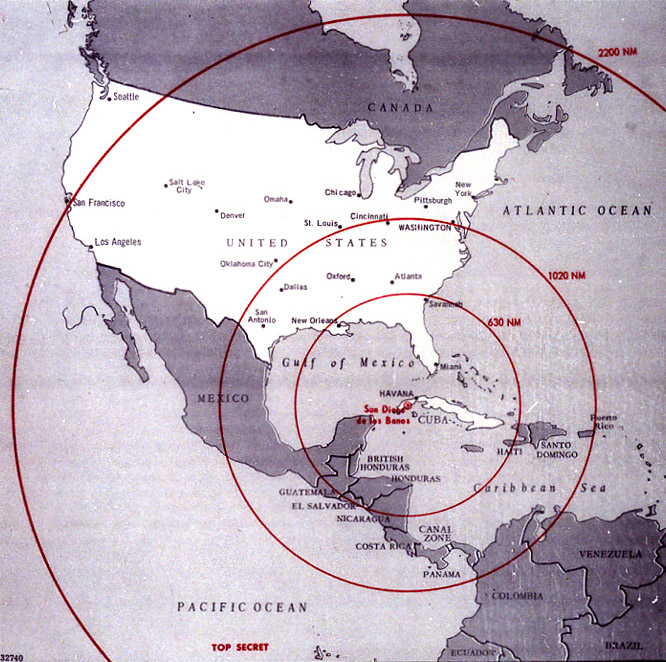
It was 50 years ago today that President Kennedy alerted the nation to the possibility of nuclear war with the Soviet Union, during a nationwide broadcast at the height of the Cuban Missile Crisis. I don't remember the President's broadcast itself, but I do remember the fear I felt that something awful might happen. My parents didn't let on that they felt afraid, but I can remember them discussing the situation with their friends, in tones of indignation over the Russian actions down there. The nerve of them!

Also, we started having air-raid drills at school for the first time. At first, my third-grade teacher taught us to listen for the alarm, then crouch under our desks. Which of course we kids thought was great fun, and a neat break from lessons. Then it was thought that we were in too much danger from being lacerated by flying glass from the bank of tall windows in our classroom, so were directed to go out into the hallways and crouch against the wall; and finally, we were all told to bring a white towel from home to use in our drills to cover ourselves with - teacher said that scientists had discovered that a white towel was the best for deflecting radiation away from us.

I'm not making this up.

As there were a number of military bases in the vicinity of where we lived at that time, everyone took it as a given that if war came, the bombs would surely fall on our town. We were never shown any of those "duck-and-cover" films that you've heard about; but I remember I developed a fantasy in my own mind of how I would rescue my stunned or wounded parents from the worst of it all by driving the family car myself to take us all to safety through a dismal, bombed-out landscape. It did not occur to me then that I was still too short to reach the foot pedals, nor did I ever quite figure out exactly where in the ruins of civilization we would go to - but it was a comforting little fantasy anyway.

Thanks be to God, nothing bad ever happened, and eventually our air-raid drills were quietly forgotten. But to review the whole situation now, as an adult, really brings some chills to my spine when I think of all that might have happened. Here's the first part of a PBS report on the crisis that was first aired in 1992. Scary stuff.


By coincidence, tonight's third and final presidential debate is to be on foreign policy. Quite apart from political leanings, I just can't imagine Romney handling a crisis like this one without losing his shit - can you?


CIA map from the crisis period, showing strike ranges of Soviet missiles in Cuba.

Thursday, March 1, 2012

Santorum Smears Kennedy's Speech

Yes, I know I'm a little behind time on this point, which all my truckbuddies have heard about by now, but I wanted to give you guys the facts so that you can be informed, and be able to respond intelligently to anyone who might bring up the subject.

First, here from Santorum's own mouth is what he actually said about Kennedy's great speech invoking the separation of church and state, and his wilful, slimy misquoting and twisting of Kennedy's words:


Andrew Sullivan, gay, married, and a devout Catholic, has this to say about it:
What's fascinating to me about Santorum's outburst yesterday was not its content, but its candor. In fact, one of Santorum's advantages in this race, especially against Romney, is that we can see exactly where he stands. There can be no absolute separation of church and state, let alone a desire to keep it so; and in their necessary interactions, the church must always prevail, or it is a violation of the First Amendment, and an attack on religious freedom. The church's teachings are also, according to theoconservatism, integral to the founding of the United States. Since constitutional rights are endowed from the Creator, and the Creator is the Judeo-Christian one, the notion of a neutral public square, embraced by liberals and those once called conservatives, is an attack on America. America is a special nation because of this unique founding on the Judeo-Christian God. It must therefore always be guided by God's will, and that will is self-evident to anyone, Catholic or Protestant, atheist or Mormon, Jew or Muslim, from natural law. . . .

For Santorum, as for Ratzinger, if your conscience says one thing, and the Pope says another, you obey the Pope, not your conscience. And for the Christianists, if your conscience or intelligence says one thing, and the Bible says another, you obey the Bible, not your conscience, and certainly not your intelligence. Because beneath Christianism is a deep fear of the human mind - as if they actually believe that reason is stronger than religion and therefore must be restrained. As if the human mind can will God out of existence.

This is Santorum's fear-laden vision. Which is why he is not a man of questioning, sincere faith and should not be flattered as such. He is a man of the kind of fear that leads to fundamentalist faith, a faith without doubt and in complete subservience to external authority. There is a reason he doesn't want many kids to go to college. I mean: when we already know the truth, why bother to keep seeking it? And if we already know the truth, why are we not enforcing it as a matter of law in a country founded on Christian principles? It is not religious oppression if it is "the way things are supposed to be", by natural law. In fact, a neutral public square, in his mind, is itself religious oppression.

We can also see here the collision of the Second Vatican Council and the current hierarchy. Kennedy was a Catholic of another era, unafraid of modernity, interested in other paths to God, publicly humble and cheerful, privately devout and deeply connected to others of all faiths and none. Santorum is of a different kind: authoritarian, deeply suspicious of freedom when it leads to disobedience of the Papacy's diktats, and publicly embracing a religious identity as his core political one.

For the record, here is the film, in two parts, of Kennedy's 1960 speech to a convention of Baptist ministers in Houston. At the time, there was great anxiety among some Protestants that a Catholic president would be taking orders from the Vatican, so that the Pope would effectively rule the USA. There was even what we now call an urban legend going around - which your Head Trucker remembers hearing as a kid - that Catholics were filling their basements with guns and ammunition, ready to rise up and overthrow the government when the order came from Rome. I'm not making this up - people seriously believed that here in the Deep South.

But in a magnificent way, and faithful to the oldest traditions of the Republic, Kennedy allayed those fears with this speech, a fine summary of the secular principles of our government, and one which I earnestly urge my truckbuddies to read or listen to.

Part I:


Part II:


A transcript of the entire speech is on the NPR website. If you don't have time, here's an excerpt of the crucial points he made - and it's worth noting that no one accused Kennedy of being a disloyal Catholic, much less of making "war on religion," a canard being slung at our current President:
I believe in an America where the separation of church and state is absolute, where no Catholic prelate would tell the president (should he be Catholic) how to act, and no Protestant minister would tell his parishioners for whom to vote; where no church or church school is granted any public funds or political preference; and where no man is denied public office merely because his religion differs from the president who might appoint him or the people who might elect him.

I believe in an America that is officially neither Catholic, Protestant nor Jewish; where no public official either requests or accepts instructions on public policy from the Pope, the National Council of Churches or any other ecclesiastical source; where no religious body seeks to impose its will directly or indirectly upon the general populace or the public acts of its officials; and where religious liberty is so indivisible that an act against one church is treated as an act against all.

For while this year it may be a Catholic against whom the finger of suspicion is pointed, in other years it has been, and may someday be again, a Jew— or a Quaker or a Unitarian or a Baptist. It was Virginia's harassment of Baptist preachers, for example, that helped lead to Jefferson's statute of religious freedom. Today I may be the victim, but tomorrow it may be you — until the whole fabric of our harmonious society is ripped at a time of great national peril.

Finally, I believe in an America where religious intolerance will someday end; where all men and all churches are treated as equal; where every man has the same right to attend or not attend the church of his choice; where there is no Catholic vote, no anti-Catholic vote, no bloc voting of any kind; and where Catholics, Protestants and Jews, at both the lay and pastoral level, will refrain from those attitudes of disdain and division which have so often marred their works in the past, and promote instead the American ideal of brotherhood.

That is the kind of America in which I believe. And it represents the kind of presidency in which I believe — a great office that must neither be humbled by making it the instrument of any one religious group, nor tarnished by arbitrarily withholding its occupancy from the members of any one religious group. I believe in a president whose religious views are his own private affair, neither imposed by him upon the nation, or imposed by the nation upon him as a condition to holding that office.

I would not look with favor upon a president working to subvert the First Amendment's guarantees of religious liberty. Nor would our system of checks and balances permit him to do so. And neither do I look with favor upon those who would work to subvert Article VI of the Constitution by requiring a religious test — even by indirection — for it. If they disagree with that safeguard, they should be out openly working to repeal it.

I want a chief executive whose public acts are responsible to all groups and obligated to none; who can attend any ceremony, service or dinner his office may appropriately require of him; and whose fulfillment of his presidential oath is not limited or conditioned by any religious oath, ritual or obligation.

This is the kind of America I believe in, and this is the kind I fought for in the South Pacific, and the kind my brother died for in Europe. No one suggested then that we may have a "divided loyalty," that we did "not believe in liberty," or that we belonged to a disloyal group that threatened the "freedoms for which our forefathers died."

And in fact ,this is the kind of America for which our forefathers died, when they fled here to escape religious test oaths that denied office to members of less favored churches; when they fought for the Constitution, the Bill of Rights and the Virginia Statute of Religious Freedom; and when they fought at the shrine I visited today, the Alamo. For side by side with Bowie and Crockett died McCafferty and Bailey and Carey. But no one knows whether they were Catholic or not, for there was no religious test at the Alamo.
Yet Santorum and his ilk would gladly make a religious test for just about everything in this country; and in an historical irony, his supporters include many fanatical Protestants for whom the Catholic boogeyman has lost all dread.  Andrew Sullivan again:
American religion is splitting into two factions - most mainstream Catholics, mainline Protestants and Jews vs Theocon Catholics, Christianist evangelicals and Mormons. It's telling to me that this split is really about politics, not religion. The theological divisions are far less important to these groups than political rallying cries.

In other words, as I see it, it's not really about religion anymore, as was the case when Kennedy spoke: it's about control, control, control - and fear, not of the Vatican devil, but of everything that proceeds from the Enlightenment, fear of reason and science and equality and - though they will never admit it - of freedom.

Both the right and the left in this country love to mouth about freedom, freedom, freedom, from morning till night. Alas, what far too many people on both sides really mean when they say the word freedom is - obey me, bitch.

Or else.

I have sworn upon the altar of God eternal hostility against every form of tyranny over the mind of man.

--Thomas Jefferson

Sunday, November 23, 2008

Sunday Drive: JFK

Yesterday was the 45th anniversary of that awful day. I remember it vividly: a brilliantly sunny autumn day, my mother hanging clothes out on the line in the backyard, myself watching TV in my parents' bed - I'd stayed home from school that day with the sniffles. All the ordinary routines of life going on as they should, as they always had, safe and predictable.

Then suddenly all was changed: a blank screen and the CBS logo; the ominous words, We interrupt this program . . . ; shots fired in Dallas at the Presidential motorcade; President Kennedy taken to a hospital; confusion on the streets and in the broadcast studio. I ran to tell my mother to come see. "Oh honey, don't joke about a thing like that." "No, Mommy, it's true, Walter Cronkite said . . . ."

And then the long, sad weekend, no cartoons on Saturday, no programs at all but news coverage and documentaries about the President's life. Not even any commercials for three days. We kids bemoaned the fact that there was nothing else to watch on TV; but young as we were, we were unwillingly fascinated by all that was happening, just like the grownups. And all the unforgettable images that have been replayed and repeated so many times across the years since then.

Well, I don't want to dwell today on the details of JFK's death, the poignant tableau of his widow and young children, the grief of a whole nation united in shock and sadness. Instead, I want to put a reminder here of who Kennedy was and why he inspired the nation and the world: the legacy of hope, the vision of all that America could be and should be to the world.

The times are too grave, the challenge too urgent, and the stakes too high--to permit the customary passions of political debate. We are not here to curse the darkness, but to light the candle that can guide us through that darkness to a safe and sane future.

The New Frontier of which I speak is not a set of promises--it is a set of challenges. It sums up not what I intend to offer the American people, but what I intend to ask of them. It appeals to their pride, not to their pocketbook--it holds out the promise of more sacrifice instead of more security.

It would be easier to shrink back from that frontier, to look to the safe mediocrity of the past, to be lulled by good intentions and high rhetoric--and those who prefer that course should not cast their votes for me, regardless of party.

But I believe the times demand new invention, innovation, imagination, decision. I am asking each of you to be pioneers on that New Frontier. My call is to the young in heart, regardless of age--to all who respond to the Scriptural call: "Be strong and of a good courage; be not afraid, neither be thou dismayed."


Related Posts with Thumbnails